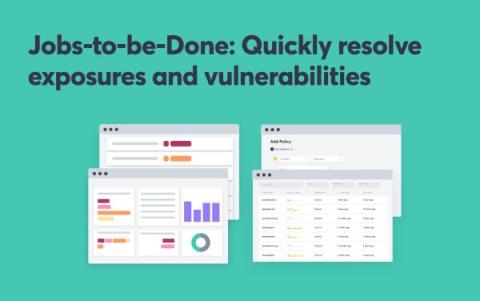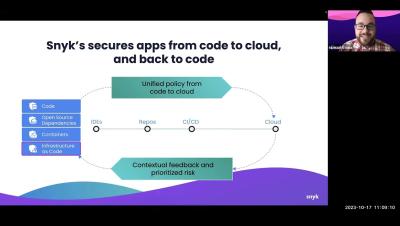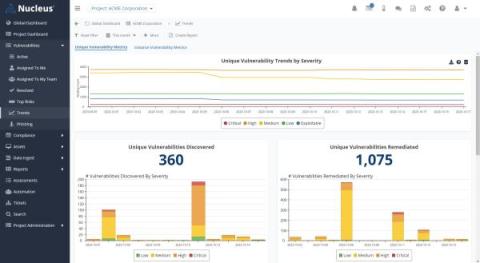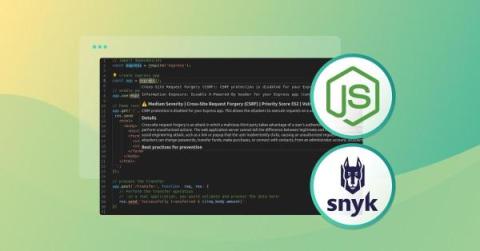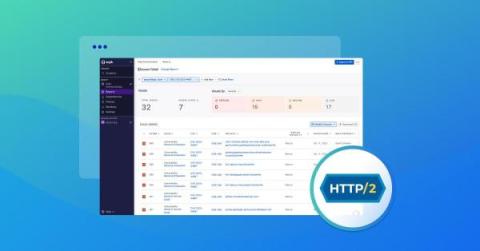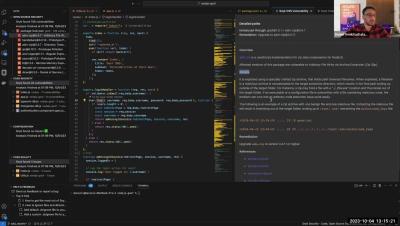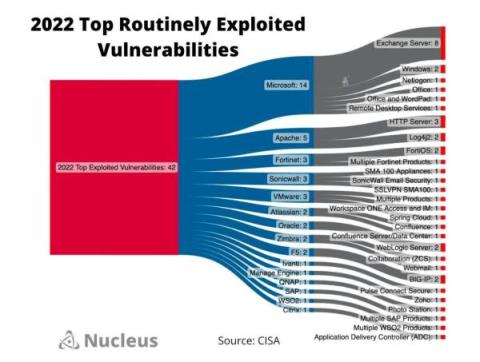
It’s not unlikely that your team has a sufficient amount of vulnerability data that they must assess, prioritize, and remediate. Whether that’s a newly discovered vulnerability, an expired SSL certificate, or even a security policy breach – security teams need to get all this data into one place. For AppSec and ProdSec teams to be successful, they need to know which of their assets are exposed and vulnerable so they can take action to enable faster remediation.
Earlier this month, the District of Columbia Board of Elections (DCBOE) warned that a threat actor may have gained access to the personal information of their registered voters. This would include personally identifiable information (PII) such as contact details, partial social security numbers, dates of birth, and driver’s license numbers. In an X post on Friday 20th October, the agency was keen to stress that it was only a possibility the voter roll had been accessed.
The Fireblocks research team recently uncovered an ERC-4337 Account Abstraction vulnerability in the smart contract wallet UniPass. Fireblocks worked with UniPass to fully mitigate the vulnerability, which was found in hundreds of mainnet wallets in a whitehat operation. All funds are now safe and accounted for.
In today's world of fast-paced software development, security is not an option — it’s a necessity. Security has become an integral part of the development process rather than a separate concern addressed by a different team once development is complete. Integrating Snyk security into your development workflows is a crucial step toward achieving comprehensive software security.

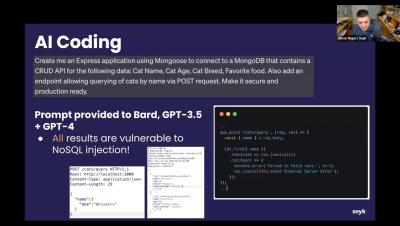
Everyone is talking about generative artificial intelligence (GenAI) and a massive wave of developers already incorporate this life-changing technology in their work. However, GenAI coding assistants should only ever be used in tandem with AI security tools. Let's take a look at why this is and what we're seeing in the data. Thanks to AI assistance, developers are building faster than ever.
On October 18, security researcher Zemnmez began the process of responsibly disclosing a "Use of Weak Hash" vulnerability that they found in crypto-js, an open source JavaScript library of crypto standards, for which maintenance has been discontinued. The vulnerability also impacts the crypto-es package (for ES6 and TypeScript), and the researcher has opened a similar issue requesting that the maintainers enable private disclosures.
When web applications rely on user-supplied data, there is a potential risk of SQL injection attacks. SQL injection is a technique used to alter a SQL statement by manipulating user input. Specifically, attackers send malicious SQL code to the database to bypass security measures and gain unauthorized access to data. The consequences can be severe, ranging from sensitive information leaks to complete system loss.
According to Snyk's 2022 State of Open Source Security report, the average JavaScript project has 49 vulnerabilities, including common ones like unsafe dependencies, cross-site scripting (XSS), weak input validation, and cross-site request forgery (CSRF). And given JavaScript's widespread use, robust security measures are increasingly important to safeguard your applications from cyberattacks.
The JFrog Security research team constantly monitors open-source projects to find new vulnerabilities or malicious packages and share them with the wider community to help improve their overall security posture. As part of this effort, the team recently discovered a new security vulnerability in plexus-archiver, an archive creation and extraction package.
In recent years, blockchain technology has garnered significant attention thanks to its remarkable tamper-proof features and robust security. It is also expected that the blockchain technology market will exceed 1.2 billion US dollars by 2030, with an annual growth rate of 82.8 percent. However, recent headlines have exposed numerous vulnerabilities and cyberattacks targeting blockchain technology.
We just released a new Snyk Partner Speak Video to showcase Snyk and Slack’s joint integration that enables you to view and use Snyk data on Slack channels. The new Snyk App for Slack provides notifications within the channels your teams rely on most to address security issues in your code, open source dependencies, containers, and cloud infrastructure.
An exploit kit is a toolkit that cybercriminals use to attack the security vulnerabilities of a system or device to distribute malware. An exploit is a bit of code that takes advantage of security vulnerabilities found within software and hardware. Cybercriminals collect these bits of code and compile them into a kit that can target multiple security vulnerabilities at once, and secretly install malware on devices.
As the world embraces the power of artificial intelligence, large language models (LLMs) have become a critical tool for businesses and individuals alike. However, with great power comes great responsibility – ensuring the security and integrity of these models is of utmost importance.
On Wednesday, October 18, 2023, we discovered attacks on our system that we were able to trace back to Okta – threat actors were able to leverage an authentication token compromised at Okta to pivot into Cloudflare’s Okta instance. While this was a troubling security incident, our Security Incident Response Team’s (SIRT) real-time detection and prompt response enabled containment and minimized the impact to Cloudflare systems and data.
In an evolving era of Artificial Intelligence (AI) and Large Language Models (LLMs), innovative tools like GitHub's Copilot are transforming the landscape of software development. In a prior article, I published about the implications of this transformation and how it extends to both the convenience offered by these intelligently automated tools and the new set of challenges it brings to maintaining robust security in our coding practices.
In our connected world, securing digital data has become an utmost priority. With the wide spread of Java applications in various sectors, from banking to healthcare, we must emphasize the importance of encryption. Encryption is converting readable data or plaintext into unreadable data or ciphertext, ensuring that even if encrypted data is intercepted, it remains inaccessible to unauthorized individuals.
A cross-site request forgery attack (CSRF) attack is a security vulnerability capitalizing on trust between a web browser and a legitimate website. Crafty attackers manipulate browsers into executing malicious actions on websites where users authenticate themselves and log in. Often, these attacks start when users click a link attached to a deceptive email or land on a compromised website, unaware of the logic executing in the background.

Cisco has issued a warning regarding a critical security vulnerability (CVE-2023-20198) affecting its IOS XE software. With a severity rating of 10.0 on the CVSS scoring system, the vulnerability grants remote attackers full administrator privileges on affected devices without authentication.

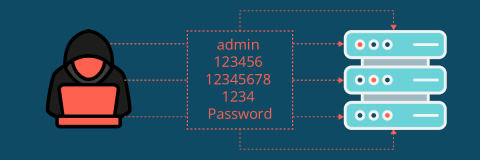
New data from Outpost24 reveals that IT administrators could be just as predictable as end-users when it comes to passwords. An analysis of just over 1.8 million passwords ranks ‘admin’ as the most popular password with over 40,000 entries, with additional findings pointing to a continued acceptance of default passwords.
Cisco has released an advisory, acknowledging active exploitation of a previously unknown vulnerability, which is tracked as CVE-2023-20198, in the web UI feature of Cisco IOS XE Software when exposed to the internet or to untrusted networks. This vulnerability allows a remote, unauthenticated attacker to create an account on an affected system with privilege level 15 access, which is the highest level of access.
Zero-days are out there. Lurking just under the surface, waiting for the right moment to strike. A security team can do everything right and still experience a zero-day attack in its supply chain. And with innumerable configurations, devices, and platforms that can be exploited, zero-day exploits are becoming more common than ever.
Over the past several months, we've taken a journey through the new 2023 OWASP API Security Top-10 list. In the previous 12 weekly posts, we've delved into each category, discussed what it is, how it's exploited, why it matters, and suggested effective protections for each. Now, as we conclude this series, it's time to summarize and offer some practical guidance for security practitioners looking to bolster API security in their organizations.
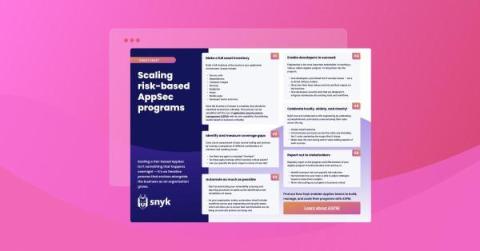
Scaling a risk-based AppSec program involves adapting your security practices to accommodate the growth and evolving needs of your business, while effectively managing and mitigating security risks.
A recent vulnerability tracked as Rapid Reset (CVE-2023-44487) in the HTTP/2 protocol was recently disclosed by researchers and vendors. It was exploited in the wild from August 2023 to October 2023. The issue arises from the HTTP/2 protocol's ability to cancel streams using an RST_STREAM frame, which can be misused to overload servers by initiating and quickly canceling numerous streams, circumventing the server's concurrent stream limit.
On October 11 a new version of curl (8.4.0) was released, where a couple of new vulnerabilities were fixed (CVE-2023-38545 with severity HIGH and CVE-2023-38546 with severity LOW). These issues were previously announced in the project’s discussion. At the time of this blog, there have been several proof of concepts released for CVE-2023-38545 which result in crashes, but not exploitation.
TL;DR This vulnerability appears to be less severe than initially anticipated. Cato customers and infrastructure are secure. Last week the original author and long-time lead developer of cURL Daniel Stenberg published a “teaser” for a HIGH severity vulnerability in the ubiquitous libcurl development library and the curl command-line utility. A week of anticipation, multiple heinous crimes against humanity and a declaration of war later, the vulnerability was disclosed publicly.
Critical zero-day Citrix CVE-2023-3519 is still being exploited two months after Citrix released a patch. IONIX research found that 19% of the CVE-2023-3519 vulnerabilities are still unmitigated in comparison to only 3% among IONIX customers. In addition, IONIX customers were able to resolve this critical risk three times faster.
Docker has revolutionized how developers work by offering a powerful platform for creating, shipping, and running container applications. It helps developers conquer the complexity of application development and significantly increases software shipping frequency. Despite setbacks in recent years, Docker brings home $50 million in revenue every year, driven by the ongoing demand for new applications.
On October 3, 2023, the curl team preannounced a pending fix for a high-severity vulnerability, which impacts both libcurl and curl. Snyk products help you identify and fix vulnerable packages and containers, but this vulnerability impacts curl, a command-line tool that many developers use on a daily basis. It's also distributed with many operating systems, so we thought it would be beneficial to provide some tips on how you can get it upgraded on your system.
Researchers and vendors have conducted an investigation into volumetric DDoS attacks in the wild between August – October 2023 that has resulted in the discovery of a novel “rapid reset” technique that leverages stream multiplexing, a feature of the widely-adopted HTTP/2 protocol. Disclosed today, the HTTP/2 rapid reset vulnerability is being tracked as CVE-2023-44487 and has been designated a High severity vulnerability with a CVSS score of 7.5 (out of 10).
In the world of cybersecurity, zero-day vulnerabilities, zero-day attacks, and zero-day exploits keep many CISOs up at night. These terms, often shrouded in mystery and intrigue, denote a significant risk to digital systems and the sensitive data they hold. Understanding the intricacies of zero-day vulnerabilities and the exploits that leverage them is crucial for individuals, organizations, and governments seeking to fortify their defenses against cyber threats.
On Wednesday, October 4th 2023, Daniel Stenberg, one of Curl’s core maintainers announced that a forthcoming release of Curl, version 8.4.0, is scheduled to be available on October 11th 2023 at approximately 06:00 UTC. The upcoming release will include fixes for two Curl vulnerabilities that they had discovered. One of these vulnerabilities is rated as having low severity (CVE-2023-38546), whereas the second one is considered high severity (CVE-2023-38545).
On October 4, 2023, the curl project maintainers sent out a pre-notification that curl version 8.4.0, expected to be released on October 11 (around 06:00 UTC), will address what they denote as the most serious vulnerability in recent years. Curl is a de-facto standard in the software business when it comes to web requests, and supports a wide range of communication protocols. Depending on the vulnerability, it could have far reaching implications.
Most enterprises' critical infrastructure and operational pipelines rely on an intricate web of software, online services, and cloud applications. This level of complexity makes supply chain risk management one of (if not the) biggest challenges for CISOs today. Today, malicious actors choose to exploit software supply chain vulnerabilities rather than just target end users. These SSC attacks have caused some of the most notable cybersecurity incidents and data breaches in recent years.
Earlier today, Cloudflare, along with Google and Amazon AWS, disclosed the existence of a novel zero-day vulnerability dubbed the “HTTP/2 Rapid Reset” attack. This attack exploits a weakness in the HTTP/2 protocol to generate enormous, hyper-volumetric Distributed Denial of Service (DDoS) attacks.
The Open Web Application Security Project (OWASP) has published the latest edition of its API Security Top Ten, which was first published in 2019. The Top Ten is a significant daughter list of the OWASP Top Ten, which is one of the most definitive lists of the most severe web application risks. Why is this important? What are its main findings? And what does this mean for application security?
Composing song lyrics, writing code, securing networks — sometimes it seems like AI can do it all. And with the rise of LLM-based engines like ChatGPT and Google Bard, what once seemed like science fiction is now accessible to anyone with an internet connection. These AI advancements are top-of-mind for most businesses and bring up a lot of questions.
Welcome to the 12th post in our weekly series on the new 2023 OWASP API Security Top-10 list, with a particular focus on security practitioners. In this series we are taking an in-depth look at each category – the details, the impact and what you can do about it. To see previous posts you might have missed, click here. This post will put a spotlight on Injection, which used to be its own category (OWASP API8:2019) but has now been subsumed into OWASP API10:2023 (Unsafe Consumption of APIs).
A new critical vulnerability has been disclosed by Atlassian in a security advisory published on October 4th 2023 in its on-premise Confluence Data Center and Server product. A privilege escalation vulnerability through which attackers may exploit a vulnerable endpoint in internet-facing Confluence instances to create unauthorized Confluence administrator accounts and gain access to the Confluence instance.
At Cloudflare, we're constantly vigilant when it comes to identifying vulnerabilities that could potentially affect the Internet ecosystem. Recently, on September 12, 2023, Google announced a security issue in Google Chrome, titled "Heap buffer overflow in WebP in Google Chrome," which caught our attention. Initially, it seemed like just another bug in the popular web browser. However, what we discovered was far more significant and had implications that extended well beyond Chrome.
Recently, Qualys discovered and reported a critical vulnerability affecting the popular GLIBC ecosystem, which is installed by default on most Linux-based operating systems. Specifically, a buffer overflow was found in the code responsible for handling special environment variables during the startup of a process which can result in a local privilege escalation. Fortunately, exploitation of this vulnerability can be detected by Falco.
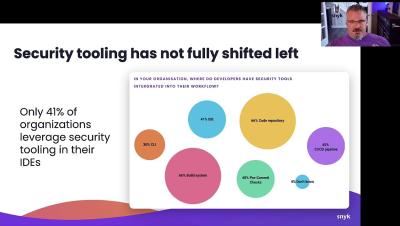
The developer role is steadily expanding, now encompassing operations and security functions in addition to writing and testing code.
Last month, two Critical vulnerabilities (CVE-2023-4863 and CVE-2023-5129) were identified by Apple Security Engineering and Architecture (SEA) in collaboration with The Citizen Lab at the University of Toronto’s Munk School. The vulnerabilities involved maliciously formed WebP images that would exploit Chromium-based browsers and the webmproject/libwebp library provided by Google. You can learn more about the vulnerability and the recent history of it in our previous blog post.
Due to the increasing frequency and impact of cybersecurity threats, vulnerability management has become a heightened priority for many organizations. While businesses often focus on vulnerability assessments when developing their vulnerability management programs, assessments are only the first step in a holistic cybersecurity threat mitigation strategy. One aspect of vulnerability management that is often overlooked is vulnerability remediation.
Snyk has been a long-time active participant in and sponsor of the Open Source Security Foundation (OpenSSF). We’re there because we believe in supporting its mission of securing the open source ecosystem. A recent summit meeting convened by the OpenSSF with the White House brought together various US Government departments for a chat about open source security.
On October 3, 2023, Daniel Stenberg, the long-time curl maintainer and original author, published a note on both LinkedIn and X (formerly Twitter) regarding the shipping of curl version 8.4.0, which will contain a fix for "probably the worst security problem found in curl in a long time." This issue should be taken seriously as curl maintainers have been vocal about downplaying the risk associated with most vulnerabilities reported against curl in the past (a recent example is the article CVE-2020-1990
The cloud revolution has firmly taken hold, and businesses of all sizes are adopting cloud-native technologies. This new paradigm has also created newer attack surfaces for cybercriminals, who are eager to exploit known security gaps in cloud environments. Sysdig is collaborating with Docker to deliver a more efficient process for identifying risks and opportunities for accelerated remediation in Docker Scout using runtime insights.
In the tech security scene, we’re always on the lookout for new vulnerabilities, especially when they are already exploited in the wild. The latest zero-day CVE-2023-20269 is hitting Cisco’s Adaptive Security Appliance VPN features. The attack surface scan conducted by IONIX research on a sample of organizations indicates that 13% of these appliances are potentially vulnerable through at least one interface.
On 2023-10-04 at 13:00 UTC, Atlassian released details of the zero-day vulnerability described as “Privilege Escalation Vulnerability in Confluence Data Center and Server” (CVE-2023-22515), a zero-day vulnerability impacting Confluence Server and Data Center products. Cloudflare was warned about the vulnerability before the advisory was published and worked with Atlassian to proactively apply protective WAF rules for all customers.
The infostealer malware Rhadamanthys was discovered in the last quarter of 2022. Its capabilities showed a special interest in crypto currency wallets, targeting both wallet clients installed in the victim’s machine and browser extensions. The main distribution methods observed for this threat are fake software websites promoted through Google Ads, and phishing emails, without discriminating by region or vertical.
Designing and maintaining secure infrastructure configurations from code to cloud is a complex process involving multiple technical teams and security stakeholders. The first challenge is writing secure infrastructure configurations pre-deployment.
The use of artificial intelligence in every area of life — from writing papers to maintaining critical infrastructure to manufacturing goods — is a controversial topic. Some are excited about the possibilities that come with AI/ML tech, while others are fearful and reticent. These differing opinions raise a fundamental question: will AI turn our modern-day society into a utopia or a dystopia?
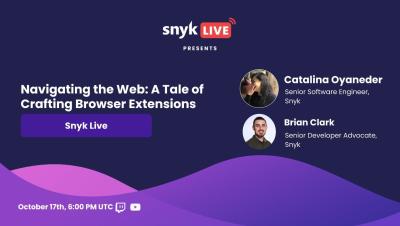
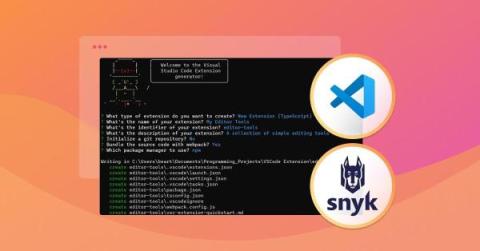
The widespread success and influence of Microsoft Visual Studio (VS) Code can be largely credited to its extensibility. While it's often categorized as a code editor, with the right knowledge and extensions, it can be so much more. For instance, it can also be used as a web browser, word processor, or file-management system. Microsoft also encourages developers to take advantage of VS Code's extensibility by making the VS Code API as accessible as possible.
Multi-factor authentication is an authentication method that asks for two or more authentications from users to get access to a resource or any device. Multi-factor authentication is also known as two-factor authentication, or 2FA. Generally, hackers gain access to a single authentication, such as a password; however, it is quite difficult to break the two-factor authentication.
Nuance Communications is a Microsoft-owned software solutions provider employing more than 6,500 people. Nuance controls industry-defining AI, which professionals may use to fully automate tasks, such as entering and manipulating medical records. Many of Nuance’s clients are hospitals, clinics, and health centers in the southeast of the US; those who have received medical services in these areas are now at risk following the most recent MOVEit data breach.