


|
By Fireblocks
With only a handful of working days left in 2025, it might be useful to look back on the year of crypto policy that passed, to inform us as we look forward. What were the main industry’s key policy expectations of this year?

|
By Fireblocks
Banks make money from trading and brokerage. JP Morgan’s Markets division: $31 billion in 2024 and Goldman Sachs: $26 billion, according to private industry analysis. Morgan Stanley’s wealth division made $28 billion. Digital assets don’t change the role banks play to earn this revenue. In fact, they extend it. But activity is migrating. Coinbase generated $4 billion in transaction revenue in 2024, the same intermediation function banks provide.

|
By Fireblocks
Brazil has formalized a comprehensive framework for virtual asset service providers (VASP). This is the moment when the rules become operational, enforceable, and aligned with the scale of activity taking place in the country. For institutions already active in Brazil and those evaluating market entry, this is a shift that raises expectations and lowers uncertainty at the same time.

|
By Fireblocks
Most banks approach digital assets with the same assumptions they use for traditional custody. It is a natural starting point, but it does not hold. Digital assets behave differently, and control that once sat inside core systems now has to be applied in the wallet layer. Institutions that understand this now gain meaningful advantages in speed, flexibility, and market positioning.
|
By Fireblocks
On October 10, 2025, crypto markets experienced their largest liquidation event in history. A whopping $19.5 billion was liquidated across all markets with approximately $1 trillion in total market cap wiped out. Binance halted trading. Ethereum Layer 2s lagged. Arbitrum fees spiked above $500, with median fees jumping to $116. The entire ecosystem was under unprecedented stress. This was the ultimate real-world test of mission-critical infrastructure.

|
By Fireblocks
Over the next decade, wallet infrastructure will be a defining factor in onchain finance. Institutions that invest in robust wallet capabilities in the next 18–24 months will shape how value is moved, held, managed, and issued. This shift isn’t driven by hype. It’s grounded in a real transformation of how financial markets function. From banking to payments to capital markets, leading institutions are doing more than building products.

|
By Fireblocks
For the first time in history, banks and financial institutions are adopting digital assets as an integral part of their internal operations and product offerings. As they do so, they face new threat vectors, unfamiliar custody models, and growing pressure to identify and align with emerging supervisory standards, which may or may not serve as complete safe havens from risk.

|
By Fireblocks
By the time of Sibos 2025, banks and policymakers seemed to agree: digital money will be part of the operating models of traditional finance. The question now is how to make it happen. The urgency comes from a structural shift already under way. For the first time in regulated finance, value can meaningfully cross borders without banks. Virtual asset service providers are already moving stablecoins from Singapore to São Paulo without correspondent banks.

|
By Fireblocks
On September 8, 2025, a sophisticated attacker compromised a prominent staking provider’s infrastructure and walked away with customer funds. The breach at Kiln was not prevented by audits, penetration tests, or SOC 2 compliance, all of which were in place. The attacker used state-actor-level techniques that evaded every security measure.

|
By Fireblocks
The industry’s focus on stablecoin connectivity is showing up in the data, as institutions shift resources toward the infrastructure that makes these flows possible. The EY-Parthenon 2025 Stablecoin Survey shows that 56% of financial institutions view wallet infrastructure as a top strategic priority, matched by the same share prioritizing on- and off-ramp services. Together, these capabilities define how U.S.
|
By Fireblocks
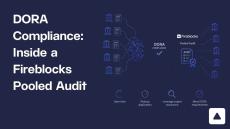
An internal auditor from Boerse Stuttgart Digital explains how a Fireblocks-hosted pooled audit helped meet DORA's third-party ICT requirements. Instead of every customer auditing Fireblocks one by one, the pooled audit community joined forces on a single common audit: shared scope, shared evidence, shared result. In this conversation, the pooled audit coordinator walks through how the community set the scope, why a pooled audit covers customer-specific requirements that a standard SOC 2 might miss, and how Fireblocks supported the process with subject matter experts, documentation, and on-site coordination.
|
By Fireblocks
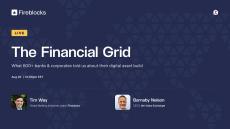
89% of banks have committed budget to digital asset infrastructure. Only 16% are in production. The Financial Grid, our January 2026 survey of 600+ C-suite leaders at banks and corporates, maps what sits between funded and live. Barnaby Nelson, CEO of the Value Exchange, whose team ran the research, joins Fireblocks' Tim Way to unpack the gap: the internal constraints, the custody decision at the foundation, and the one call that turns budget into production.
|
By Fireblocks
Treasury teams have always faced the same trade-off: keep cash safe and available, or chase yield and give up flexibility. Onchain finance is starting to remove that trade-off.

|
By Fireblocks
Learn how to use USDC Gateway in Fireblocks to hold one unified USDC balance across chains and move it without managing per-chain inventory yourself. In this walkthrough, Matt from Fireblocks activates a Gateway wallet, makes a deposit, sets up recurring deposit automation, and withdraws to another chain, showing each step in both the API (Postman) and the Console UI. You'll also see how withdrawals pull gas from your USDC balance, so you don't need to hold native gas on the destination chain.

|
By Fireblocks
Fireblocks Flow lets businesses accept any crypto asset and settle in the stablecoin they choose, through a single SDK. Watch a live demo of checkout, deposit, and withdrawal flows. Accepting stablecoins looks simple and is anything but. Users show up holding one asset on one chain, merchants want to settle in another, and payment sources are scattered across wallets, exchanges, and off-ramps. Most teams end up stitching vendors together and still ship a clunky experience.

|
By Fireblocks
In this comprehensive guide, learn how to effectively use the Policy Inspector tool within Fireblocks to diagnose and resolve transaction failures. The Policy Inspector provides clear insights into which policy rules blocked a transaction and the reasons behind it, eliminating guesswork and streamlining communication with your security team. Key Features of Policy Inspector: Transaction Simulation: Test any transaction against your active policies directly in the console. Detailed Insights.

|
By Fireblocks
In this comprehensive guide, learn how to export your Fireblocks transaction policies in both CSV and JSON formats. This video walks you through the process of selecting your policies, choosing the appropriate format, and securely downloading your data. Key Topics Covered: Exporting Policies: Understand how to access the active policy section from the Policy Overview screen. Choosing Formats: Discover the differences between CSV and JSON exports.

|
By Fireblocks
In this comprehensive guide, we will explain how to efficiently publish multiple policy types in a single request using the Fireblocks Policy Engine. This streamlined process allows you to update various policy types—such as transfer policies and typed message policies—simultaneously, ensuring that all changes are coordinated and compliant. Key Benefits of Multi-Type Policy Publishing.

|
By Fireblocks
In this tutorial, we provide a detailed walkthrough of the Transaction Policy Overview Screen, designed to streamline your management of transaction policies. This powerful tool consolidates all essential information into a single interface, eliminating the need to switch between multiple screens. Key Features of the Policy Overview Screen: Centralized Access: Quickly access pinned and compliance policies at the top of the screen.

|
By Fireblocks
Stablecoins moved $33 trillion globally last year, and the UAE is right at the center. Fireblocks' John Hallahan on how banks get from pilot to production. John Hallahan, Head of Business Solutions & Advisory at Fireblocks, joins Raghda Ibraheem to unpack the UAE Stablecoin Payments Playbook from MFTA and Fireblocks, a practical roadmap for banks and payment companies moving from proof of concept to large-scale production.

|
By Fireblocks
Migrating traditional assets to blockchain and wallet infrastructure has game-changing benefits, including reduced settlement costs and increased transaction security, speed, and transparency. At Fireblocks, we have already seen advancements in tokenization use cases in the commodities, debt securities, equity securities, and real estate markets. As the tokenized asset market expands, it will enable these assets to be used in new and innovative ways.

|
By Fireblocks
As the global transformation to digital assets and crypto goes into full swing, a number of questions are standing out to decision makers at banks and other financial institutions. For one, you may be wondering: As we expand to the digital asset space, what's the best way to custody these new assets? At Fireblocks we have found that FIs often achieve better results by deploying a "direct custody" system for digital assets.
- August 2026 (4)
- July 2026 (7)
- June 2026 (7)
- May 2026 (3)
- April 2026 (4)
- February 2026 (2)
- January 2026 (1)
- December 2025 (3)
- November 2025 (13)
- October 2025 (7)
- September 2025 (9)
- August 2025 (6)
- July 2025 (11)
- June 2025 (10)
- May 2025 (12)
- April 2025 (10)
- March 2025 (8)
- February 2025 (15)
- January 2025 (3)
- December 2024 (6)
- November 2024 (9)
- October 2024 (6)
- September 2024 (11)
- August 2024 (8)
- July 2024 (10)
- June 2024 (4)
- May 2024 (7)
- April 2024 (4)
- March 2024 (3)
- February 2024 (3)
- January 2024 (2)
- December 2023 (2)
- November 2023 (2)
- October 2023 (4)
- September 2023 (8)
- August 2023 (11)
- July 2023 (2)
- June 2023 (3)
- May 2023 (2)
- April 2023 (5)
- March 2023 (6)
- February 2023 (4)
- January 2023 (4)
- December 2022 (1)
- June 2022 (1)
- May 2022 (3)
- April 2022 (4)
- March 2022 (2)
Fireblocks is an easy to use platform to create new blockchain based products, and manage day-to-day digital asset operations.
An all-in-one platform for running your digital asset business:
- Fireblocks Network: The most connected institutional network gives you fast and secure on-chain settlement.
- MPC Wallet-as-a-Service: Our proprietary protocol pushes transaction speeds up to 8X faster than the industry average.
- Tokenization: A robust engine to easily consolidate your assets into stablecoins or security tokens.
- AML/Compliance: Automatically leveraged risk scores, user-defined policies for safety and compliance.
- Policy & Workflow Engine: Meet regulatory requirements and manage transaction policies from anywhere, at any time.
- DeFi: Access DeFi apps with enterprise-grade protection and fully customizable governance & policy control.
- Web3: Build engaging Web3 experiences for every user.
- Payments: Launch new merchant services with the newest payment suite from Fireblocks.
Remove the complexity of working with digital assets.