Security | Threat Detection | Cyberattacks | DevSecOps | Compliance

CVE-2026-27825: Critical Unauthenticated RCE and SSRF in mcp-atlassian

On February 24, 2026, sooperset, the mcp-atlassian project maintainer, released fixes for a critical vulnerability in mcp-atlassian, tracked as CVE-2026-27825. The flaw arises from missing directory confinement and inadequate path traversal validation in the Confluence attachment download tools which could allow a remote (network-adjacent), unauthenticated threat actor to write files to arbitrary paths, enabling local privilege escalation and remote code execution.


React2Shell (CVSS 10.0): Patch React & Next.js NOW | Unauth RCE Explained

A maximum-severity vulnerability is hitting React Server Components - and if you're running Next.js, you may be vulnerable by default. React disclosed CVE-2025-55182, nicknamed React2Shell, an unauthenticated remote code execution (CVSS 10.0) affecting React Server Components via the Flight protocol. Next.js tracks downstream exposure as CVE-2025-66478: That means internet-wide scanning is likely. Who’s affected?

CVE-2026-20127: In-Depth Analysis of the Cisco Catalyst SD-WAN Authentication Bypass Vulnerability

Software-defined networking (SD-WAN) has transformed enterprise infrastructure, enabling dynamic connectivity between sites with centralized management and control. But when the control plane itself becomes vulnerable, network integrity is no longer a given.

Emerging Threat: Cisco Catalyst SD-WAN Authentication Bypass (CVE-2026-20127)

CVE-2026-20127 is a critical authentication bypass vulnerability affecting Cisco Catalyst SD-WAN Controller (vSmart) and Cisco Catalyst SD-WAN Manager (vManage). The flaw stems from improper validation within the control plane and management plane authentication mechanisms, allowing a remote, unauthenticated attacker to submit crafted requests that bypass standard authentication controls. Successful exploitation results in access to the system as a high-privileged internal user account.

CVE-2026-20127: Cisco Catalyst SD-WAN Controller Authentication Bypass Vulnerability

On February 25, 2026, Cisco released fixes for a maximum severity authentication bypass vulnerability in Cisco Catalyst SD-WAN Controller (formerly vSmart) and Cisco Catalyst SD-WAN Manager (formerly vManage), tracked as CVE-2026-20127. The flaw arises from a broken peering authentication mechanism in the control-plane authentication workflow. This vulnerability potentially allows a remote, unauthenticated threat actor to bypass authentication and obtain administrative privileges on an affected system.

CVE-2026-25639: Axios Vulnerability Triggers DoS in Node.js Applications

A newly disclosed vulnerability tracked as CVE-2026-25639 puts Node.js applications using Axios at risk of remote Denial-of-Service attacks. By sending a specially crafted configuration object, attackers can trigger a fatal runtime error inside Axios’s internal request handling logic, causing the Node.js process to crash instantly.

What CVE 2026 23550 Is & Why It's Critical

CVE-2026-23550 is a critical unauthenticated privilege escalation vulnerability affecting the Modular DS WordPress plugin (versions ≤ 2.5.1). With a CVSS score of 10.0, this flaw allows attackers to gain full administrator access without authentication. In this video, we break down: What CVE-2026-23550 is How the vulnerability works (technical root cause) What attackers can do after exploitation.

Meet Seema: A Simpler Way to Understand Risk

Getting clear answers about your security risk shouldn’t require hours of manual work or deep platform expertise. Meet Seema – Seemplicity’s new AI assistant designed to translate complex remediation data into plain-spoken, actionable insights. Whether you’re a practitioner investigating a specific vulnerability, an engineer needing context on a finding, or a leader briefing on overall risk, Seema provides the clarity you need to move from data to action.

Internet Exposure as a Critical Layer of Context in Vulnerability Management

During a recent video interview, we spent time unpacking a deceptively simple question: what actually makes a vulnerability critical? Severity scores, exploitability, and asset importance all factor into the answer. But one layer of context consistently changes the urgency of a finding more than most teams expect: internet exposure. The difference between a vulnerability that exists and one that matters often comes down to whether an attacker can reach it.

The Rise of the AI Security Engineer: A New Discipline for an AI-Native World

We are witnessing the birth of a new profession in the blend of security engineering and security operations, a discipline that didn't exist five years ago because the systems it protects didn't exist five years ago. As artificial intelligence moves from experimental to essential and agentic systems begin to perceive, reason, act, and learn autonomously, we need defenders who can operate at the same velocity. I'm talking about the AI Security Engineer.

OAuth security guide: Flows, vulnerabilities and best practices

OAuth is a commonly used authorisation framework, that allows websites and web applications to request limited access to a user’s account on another application. Users can grant this limited access to their account, without ever needing to expose their password with the requesting website or application. This is commonly seen with sites that allow you to log in with popular accounts such as a social media login, Microsoft or Google account.

Emerging Threat - Dell RecoverPoint for VMs Hardcoded Credential (CVE-2026-22769)

CVE-2026-22769 is a hardcoded credential vulnerability affecting Dell RecoverPoint for VMs, a disaster recovery orchestration platform used to manage replication and failover of virtualized workloads. The issue stems from static authentication credentials embedded within a product component. Because these credentials are not uniquely generated per deployment and cannot be changed by administrators, they introduce a structural authentication weakness.

Claude Code Security: A Welcome Evolution in the Remediation Loop

AI accelerates discovery — but enterprise trust still depends on deterministic validation, remediation automation, and governance at scale. Last Friday, Anthropic launched Claude Code Security, powered by Opus 4.6, inside Claude Code. The demo is impressive: Frontier AI reasoning scanned open source codebases and surfaced over 500 previously unknown high-severity vulnerabilities — including subtle heap buffer overflows that had survived decades of expert review and fuzzing.

Cursor Composer 1.5 is Here: Is It Actually Better?

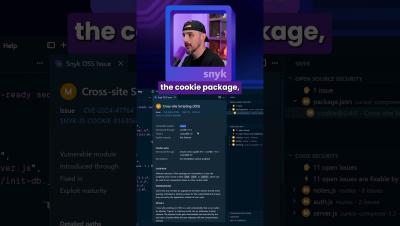
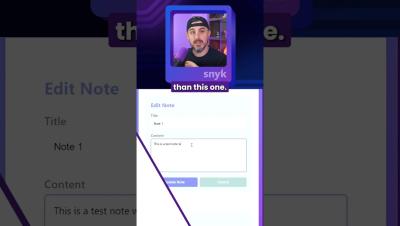
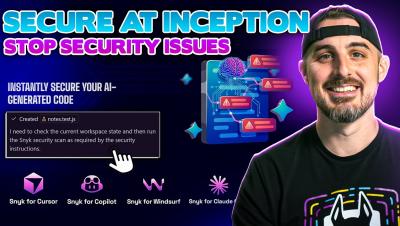
Is Cursor’s new Composer 1.5 model a major leap forward, or just a marginal update? Today, we’re putting the latest version of Cursor’s agentic AI to the test using our "Production-Ready Note App" prompt. We compare the speed, UI design, and agentic capabilities of 1.5 against version 1.0. Most importantly, we run a full security audit using the Snyk extension to see if the AI-generated code is actually safe for production.

Vulnerability Remediation: Key Steps for Securing Your Systems

Vulnerability remediation is an important way to keep systems safe from possible attacks in a world where cybersecurity is always changing. Since cyberattacks are becoming more common, finding and fixing system flaws is no longer a choice; it's a must. One security hole that isn't fixed can lead to large-scale data breaches that cost businesses millions of dollars.

Notepad++ Supply Chain Attack Explained | CrowdStrike OverWatch Identified It Months Early

Your next software update could be weaponized. In this short breakdown, we examine how adversaries compromised the Notepad++ update mechanism to distribute malware and how CrowdStrike identified the activity four months before public disclosure.

Is AI Making Us Mentally Lazy? The Hidden Security Risk of Cognitive Offloading

Modern aviation offers a powerful warning about overreliance on automation. When autopilot systems became highly advanced, pilots transitioned from hands-on flying to supervising computer-driven controls. Efficiency improved-but skill degradation followed. In rare moments when automation failed, even seasoned pilots sometimes struggled with basic manual maneuvers.

EventLog-in: Propagating With Weak Credentials Using the Eventlog Service in Microsoft Windows (CVE-2025-29969)

While attackers often find low-privileged credentials after creating a process dump of LSASS or harvesting hashes with a tool like Responder, they are rarely able to do anything with those credentials (RDP aside). We set out to discover how malicious actors might exploit Microsoft Windows remote procedure call (RPC) protocols to gather data remotely as a low-privileged user using RPC as an attack surface.

Vulnerability Remediation: From Scan Results to Real Fixes

Vulnerability scanning is useless if you don’t fix what you find. This short breaks down a practical vulnerability remediation process to prioritize risk, patch faster, and reduce real-world exposure. Learn how security teams move from detection to closure, without months of backlog.

How "Clinejection" Turned an AI Bot into a Supply Chain Attack

On February 9, 2026, security researcher Adnan Khan publicly disclosed a vulnerability chain (dubbed "Clinejection") in the Cline repository that turned the popular AI coding tool's own issue triage bot into a supply chain attack vector. Eight days later, an unknown actor exploited the same flaw to publish an unauthorized version of the Cline CLI to npm, installing the OpenClaw AI agent on every developer machine that updated during an eight-hour window.

Why Patching Cadence Should Be a Risk Priority in 2026

Patching cadence is a critical component of maintaining an organization’s cybersecurity posture. It refers not just to whether patches are applied, but how quickly and consistently vulnerabilities are addressed across systems and software. A regular, timely patching process reduces the window of exposure to known vulnerabilities, limiting opportunities for exploitation and strengthening overall vulnerability management.

Disclosure: XWiki CSS Injection (CVE-2026-26000)

During independent security research, a CSS injection vulnerability (CVE-2026-26000) was identified in the XWiki platform. XWiki is an open-source enterprise wiki and collaboration platform commonly used for internal documentation and knowledge management. According to XWiki, the platform has over 8,000 active installations and is used by organisations such as Lenovo and Amazon, meaning vulnerabilities can affect a large and diverse user base.

Top 3 Threat Actors Targeting the Insurance Industry

Threat actors target the insurance industry for a simple reason: insurers sit on concentrated volumes of sensitive personal data, financial records, and in many cases health information, all of which are highly valuable for resale on dark markets. Claims systems, customer portals, broker platforms, and third-party service providers also present a complex attack surface that offers threat actors multiple paths into the business.

Remediate transitive vulnerabilities faster with Datadog Software Composition Analysis

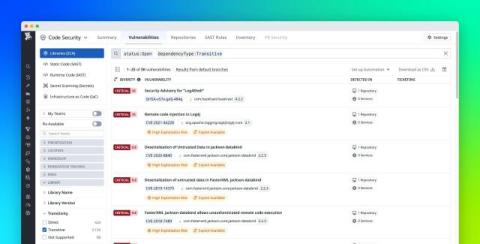
Security teams are responsible for finding and remediating vulnerable dependencies within applications that are built from large ecosystems of frameworks, SDKs, and utilities. What makes this task especially challenging is that these dependencies can pull in dozens or even hundreds of transitive dependencies through complex dependency chains. Even when scanners identify what’s vulnerable, teams still often lack the information they need about the dependency chain to safely address the issue.

Snyk and Cline: Securing the Future of Autonomous Coding

We are thrilled to announce a strategic partnership with Cline Bot Inc. to bridge the gap between autonomous speed and enterprise trust. By embedding Snyk’s security intelligence directly into Cline’s autonomous loops, we are delivering an end-to-end automated secure coding workflow that empowers developers to innovate with confidence. The evolution of AI coding tools is accelerating rapidly. We have moved from simple completion to sophisticated chat, and now to full autonomy.

CredShields Contributes to OWASP's 2026 Smart Contract Security Priorities

The OWASP Smart Contract Security Project has released the OWASP Smart Contract Top 10 2026, a risk prioritization framework developed from structured analysis of real world exploit data observed across blockchain ecosystems in 2025. Crypto protocols continued to experience significant smart contract failures in 2025, with exploit patterns increasingly pointing to structural weaknesses rather than isolated bugs.

CVE-2026-1357: WordPress Plugin RCE Exposes Sites to Full Takeover

A critical vulnerability in the WPvivid Backup & Migration WordPress plugin allows unauthenticated attackers to upload and execute arbitrary PHP files on exposed websites. Tracked as CVE-2026-1357, the vulnerability affects vulnerable versions of the plugin and enables remote code execution through network-accessible functionality intended for backup and migration workflows. With over 900,000 active installations, WPvivid is widely deployed across production WordPress environments.

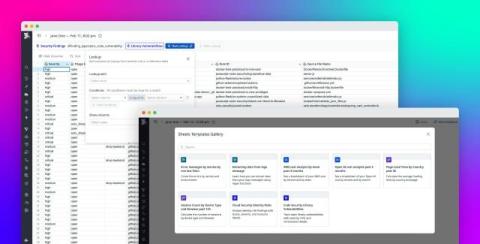
Generate audit-ready vulnerability and compliance reports with Datadog Sheets

Security teams are frequently asked to provide clear, time-bounded evidence of their organization’s security posture. Whether the request comes from external auditors validating SOC 2, ISO 27001, PCI DSS, or internal governance reviews, they typically require collecting vulnerability data from multiple tools, reconciling resource lists, and manually generating spreadsheets for auditors. This process is slow, error-prone, and difficult to repeat consistently.

Can You Trust AI Code? I Built a Scanner to Find Out

Can you trust the code AI generates? In this video, we build a custom AI Security Benchmarking tool to put models like Gemini, Mistral, and GLM 4.5 to the test. Using Windsurf, OpenRouter, and Snyk, we automate a pipeline that prompts multiple LLMs to write an application, then immediately scans the output for security vulnerabilities.

Vulnerability or Not a Vulnerability?

Every CVE starts as a vulnerability claim, but not every claim ends in agreement. Between researchers racing to disclose vulnerabilities, and open-source maintainers guarding the stability and reputation of their projects, a gray zone appears where “vulnerability” becomes a matter of debate. This is the story of many disputed CVEs. Where “vulnerability” is rarely a yes-or-no answer.

What is threat and vulnerability management? Essential cybersecurity guide

Threat and vulnerability management (TVM) is a continuous, risk-based cybersecurity discipline that combines vulnerability assessment with threat intelligence to identify, prioritize, and remediate security weaknesses before attackers can exploit them. Rather than treating vulnerability scanning and threat detection as separate activities, TVM integrates both into a unified lifecycle that connects visibility, context, action, and validation.

Emerging Threat: CVE-2026-1731 - BeyondTrust Privileged Access Exposure Risk

CVE-2026-1731 is a vulnerability disclosed in products developed by BeyondTrust. At the time of writing, publicly available technical details regarding the root cause, vulnerable code paths, and exploitation prerequisites remain limited. Based on initial advisory information, the issue affects components involved in privileged access or remote access workflows, which are typically deployed to manage high-value credentials, session brokering, or secure administrative access to enterprise systems.

Update: Arctic Wolf Observes Threat Campaign Targeting BeyondTrust Remote Support Following CVE-2026-1731 PoC Availability

Since our previous security bulletin, Arctic Wolf has observed malicious activities in the wild tied to suspected exploitation of CVE-2026-1731 of self-hosted BeyondTrust Remote Support and Privileged Remote Access deployments. We are sharing threat intelligence related to this activity to help defenders protect against this campaign. CVE-2026-1731 allows unauthenticated remote threat actors to execute operating system commands in the context of the site user via specially crafted requests.

From Acceleration to Exposure: Why AI Demands Mature AppSec

For most engineering teams, AI feels like a breakthrough years in the making. Code gets written faster, reviews move quicker, and releases that once took weeks now happen in days—or even hours. But as more of the software lifecycle becomes automated, a less comfortable reality is setting in: application security hasn’t kept pace, and AI-native security practices are often missing. When AppSec foundations are immature, AI doesn’t reduce risk—it scales it.

Pulled Pork and Watermelon: Why Integrated Cybersecurity Depends on Unlikely Synergies

Security teams are facing an attack surface that changes faster than it can be fully understood. Cloud adoption, Software-as-a-Service sprawl, and continuous delivery cycles have dissolved the traditional perimeter, replacing it with an environment where assets change with little notice. Shadow IT, abandoned infrastructure, expired certificates, and misconfigured services quietly expand exposure, often outside formal ownership.

What Seemplicity's Exposure Action Report Reveals about Modern Exposure Management

Exposure management has outgrown visibility. With 67M+ findings per year, the real challenge is execution at scale. The 2026 Exposure Action Report shows that risk clusters in predictable places, most exposure is operational (not novel), and meaningful risk reduction comes from consolidation, prioritization, and disciplined remediation workflows — not adding more tools.

Detecting Notepad++ CVE-2025-49144 Using Sysmon Logs

Text editors rarely show up in threat models. Installers show up even less. CVE-2025-49144 changes that. The issue is a local privilege escalation in the Notepad++ Windows installer that can allow a low-privileged user to gain SYSTEM-level execution by abusing insecure executable search behavior during installation. Affected versions include Notepad++ 8.8.1 and earlier, per the NVD record.

CISA BOD 26-02 and the Next Phase of Vulnerability Management

CISA recently published BOD 26-02, the latest Binding Operational Directive shaping how federal agencies manage cyber risk. While attention often gravitates toward highly visible directives like KEV, this one matters for a different reason: it raises the standard for how lifecycle risk must be tracked and sustained over time. BOD 26-02 is described as guidance on unsupported edge devices, which is accurate but incomplete.

The Future of AI Agent Security Is Guardrails

If you've been paying attention to the AI agent space over the past few months, you've probably noticed a pattern: every week brings a new story about an AI agent doing something it absolutely should not have done: reading private emails, exfiltrating credentials, or executing shell commands that a human would have never approved. The OpenClaw saga alone gave us exposed databases, command injection vulnerabilities, and a $16 million scam token, all in the span of about five days.

Exploitability Isn't the Answer. Breakability Is.

Why don’t developers fix every AppSec vulnerability, every time, as soon as they’re found? The most common answer? Time. Modern security tools can surface thousands of vulnerabilities in a given codebase. Fixing them all would take up a development team’s entire capacity, often competing with feature development and other priorities.

Detecting file security vulnerabilities with file analysis

In today's hyper-connected digital world, every file you touch could be more dangerous than it appears. A simple spreadsheet, an innocent-looking PDF, or a shared presentation can all hide malicious code beneath their surface. These files, often exchanged freely across devices, cloud and collaboration platforms, can act as ticking time bombs. When triggered, they lead to devastating cyberattacks, massive data breaches, and severe compliance violations.

Why This Moment Matters: Announcing our Series C Funding

Today, we announced our Series C funding. I want to start by saying thank you to Delta-v Capital and Arthur Ventures for their partnership and conviction in what we’re building. We’re grateful for their support and for the trust they’ve placed in our team. They didn’t invest because Nucleus tells a good story.

Why Your "Skill Scanner" Is Just False Security (and Maybe Malware)

Maybe you’re an AI builder, or maybe you’re a CISO. You've just authorized the use of AI agents for your dev team. You know the risks, including data exfiltration, prompt injection, and unvetted code execution. So when your lead engineer comes to you and says, "Don't worry, we're using Skill Defender from ClawHub to scan every new Skill," you breathe a sigh of relief. You checked the box. But have you checked this Skills scanner?
FortiOS VPN Auth Bypass Flaw (CVE-2026-22153) Exposes Remote Access

LDAP is commonly used as a centralized authentication backend for VPN gateways. In a typical setup, users submit credentials to the VPN service, which forwards them to the LDAP server for validation. The VPN gateway then grants or denies access based on the response it receives. CVE-2026-22153 does not rely on malformed packets or memory corruption. Instead, it stems from flawed authentication logic, where certain LDAP response states can be misinterpreted under specific configurations.
BeyondTrust Remote Support and Privileged Remote Access (CVE-2026-1731)

A recently disclosed vulnerability, tracked as CVE-2026-1731, affects BeyondTrust Remote Support (RS) and certain older versions of Privileged Remote Access (PRA). The flaw is rated critical, with a CVSS v4 score of 9.9 according to the National Vulnerability Database. BeyondTrust published advisory BT26-02 confirming that an unauthenticated remote attacker may be able to execute operating system commands by sending specially crafted client requests.

How a Malicious Google Skill on ClawHub Tricks Users Into Installing Malware

You ask your OpenClaw agent to "check my Gmail." It replies, "I need to install the Google Services Action skill first. Shall I proceed?" You say yes. The agent downloads the skill from ClawHub. It reads the instructions. Then, it pauses. "This skill requires the 'openclaw-core' utility to function," the agent reports, displaying a helpful download link from the skill's README. "Please run this installer to continue." You copy the command. You paste it into your terminal. You have just been compromised.

Metro4Shell RCE (CVE-2025-11953) Is Putting Apps at Risk

A critical vulnerability known as Metro4Shell (CVE-2025-11953) has been identified in the React Native Metro development server, enabling unauthenticated remote code execution when exposed beyond localhost. Active exploitation is already underway, with attackers targeting exposed development environments to gain system-level access. For more insights on website and API security fundamentals, subscribe to our newsletter.

0-Click RCE in Claude Desktop: How AI Extensions Threaten Endpoint Security

The modern enterprise software ecosystem increasingly relies on desktop AI applications enhanced through extensible plugin or extension frameworks. These extensions are designed to improve productivity by enabling integrations with local files, browsers, APIs, developer tools, and internal systems. However, this same extensibility introduces a high-risk attack surface when extension permissions, sandboxing, and input validation are weakly enforced.

I Built a Production-Ready App in 20 Minutes with Claude Opus 4.6

My boss dropped a bombshell at 4:00 PM: build a secure, production-ready app from scratch by tomorrow morning. Instead of panicking, I put Claude Opus 4.6 to the test. In this video, I walk you through the entire end-to-end process of using an AI agent to architect, code, and debug a full-stack application. We’ll look at "Plan Mode," how the AI handles environment errors (like Windows SQLite issues), and most importantly, how we verified the AI's code for security vulnerabilities using Snyk.

CVE-2025-11953 - Metro4Shell RCE in React Native Metro Server

A critical unauthenticated remote code execution (RCE) vulnerability has been identified in the React Native Metro development server, with nearly 3,500 exposed instances currently reachable on the public internet. Tracked as CVE-2025-11953, also known as Metro4Shell, this flaw affects the Metro server used during React Native application build and testing workflows.

CVE-2025-59287 WSUS Vulnerability: Exploitation, Defense & Detection Explained

CVE-2025-59287 turns WSUS (Windows Server Update Services) into a high-value attack surface—and attackers are already abusing it. In this video, we break down how CVE-2025-59287 is exploited, what defenders should look for, and how to mitigate and detect attacks before damage spreads across your environment. What you’ll learn in this video: How attackers scan exposed WSUS servers on ports 8530 and 8531.

What are OWASP Secure Coding Practices? Top 10 Web App Security Vulnerabilities 2021 vs 2025

OWASP (Open Web Application Security Project) is a non-profit organisation that has been in existence since 2001. Its mission is to educate (provide direction) webmasters and security professionals about how to create, buy, and keep secure, trusted software applications.” In simple terms, OWASP is a group of application security companies and experts that work collectively to develop a list of the most serious security threats to web applications.

Snyk Finds Prompt Injection in 36%, 1467 Malicious Payloads in a ToxicSkills Study of Agent Skills Supply Chain Compromise

The first comprehensive security audit of the Agent Skills ecosystem reveals malware, credential theft, and prompt injection attacks targeting OpenClaw, Claude Code, and Cursor users Agent skills are reusable capability packages that instruct AI agents how to interact with tools, APIs, or system resources—and they're rapidly becoming standard in AI-powered development.

280+ Leaky Skills: How OpenClaw & ClawHub Are Exposing API Keys and PII

On Monday, February 3rd, Snyk Staff Senior Engineer Luca Beurer-Kellner and Senior Incubation Engineer Hemang Sarkar uncovered a massive systemic vulnerability in the ClawHub ecosystem (clawhub.ai). Unlike the malware campaign we reported yesterday involving specific malicious actors, this new finding reveals a broader, perhaps more dangerous trend: widespread insecurity by design. In this write-up, Snyk is presenting Leaky Skills - uncovering exposed and insecure credentials usage in Agent Skills.

Lessons From 2025: Zero-Day Exploitation Shaping 2026

Zero-day exploits were among the defining cyber threats of 2025, with high-severity flaws affecting platforms such as React2Shell, Oracle E-Business Suite (EBS), and CitrixBleed 2 highlighting how quickly zero-days can be weaponized and how damaging they can be. To help organizations understand the zero-day threat landscape, Outpost24’s threat intelligence team has compiled a review of the vulnerabilities they encountered in the wild throughout 2025.

Internet Exposure and Vulnerability Risk: Why Reachability Changes Everything

In this conversation, Ryan Cribelar, R&D Engineer at Nucleus Security, breaks down why internet exposure is one of the most important layers of context in vulnerability and exposure management. Security teams are flooded with vulnerability data, but not every finding carries the same level of risk. As Ryan explains, whether a vulnerability is reachable from the internet can dramatically change how urgent it really is. Internet exposure shortens the path from discovery to exploitation and often determines whether a vulnerability is theoretical or immediately actionable.
Sponsored Post

Ten threats traditional Antivirus misses (and Next-Gen AV doesn't)

The cybersecurity arena is rapidly shifting and CISOs are locked in a relentless struggle against adversaries who rarely reveal themselves. Traditional antivirus (AV) solutions, which has been the primary shield (and still is for many companies) has reached its 'End of life'. The reason is clear: signature-based protection simply isn't enough anymore.

Disclosure: SupportCandy Ticket Attachment IDOR (CVE-2026-1251)

During independent security research conducted as part of the Wordfence Bug Bounty Program, we identified a broken access control vulnerability in the SupportCandy plugin for WordPress. SupportCandy is a helpdesk and customer support ticketing plugin that enables organisations to manage user-submitted support requests directly within their WordPress environment, including the ability to upload files and exchange attachments through ticket replies.

Critical Vulnerability Alert: CVE-2025-40551 in SolarWinds Web Help Desk

A critical vulnerability (CVE-2025-40551) has been identified in SolarWinds Web Help Desk, a widely used IT service management platform deployed across enterprise and public sector environments to manage support tickets, assets, and internal workflows. Successful exploitation could allow an unauthenticated attacker to execute arbitrary commands on the underlying host system.

CVE-2026-25253: OpenClaw Bug Enables One-Click Remote Code Execution via Malicious Link

CVE-2026-25253 is a high-severity vulnerability (CVSS 8.8) in OpenClaw (formerly Clawdbot/Moltbot), an open-source AI agent framework. It allows attackers to exfiltrate authentication tokens via a crafted URL, leading to full gateway compromise and remote code execution (RCE) with one click. Disclosed in early February 2026, it affects versions before 2026.1.29.

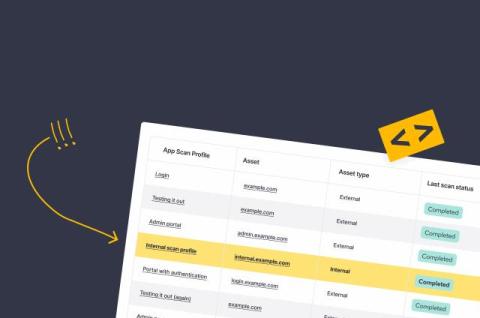
Introducing Detectify Internal Scanning for internal scanning behind the firewall

Detectify Internal Scanning is an internal vulnerability scanning solution that brings Detectify’s proprietary crawling and fuzzing engine behind your firewall. Built for AppSec and DevOps teams, it enables authenticated testing of internal applications, admin panels, staging environments, and microservices, all from a single, unified platform. Teams can now monitor both internal and external vulnerabilities side by side, without slowing down release cycles.

Notepad++ Publishes Full Details of 2025 Compromise

On February 2, 2026, the Notepad++ open source project disclosed new details about a supply chain compromise that impacted its update delivery infrastructure between June and December 2025. The attack was attributed to state-sponsored threat actors with links to China. In this campaign, the threat actors had gained access to a third-party hosting provider used by Notepad++ to distribute updates.

The Prescriptive Path to Operationalizing AI Security

In introducing the AI Security Fabric, we have outlined how security must evolve as software is built by humans, models, and autonomous agents working at machine speed. The Fabric defines the architectural shift required to build trust at AI speed, delivered through the Snyk AI Security Platform. We’re now focusing on the next question: how organizations put that vision into practice. Operationalizing AI security is not about enabling a single feature or deploying a tool.

Introducing the AI Security Fabric: Empowering Software Builders in the Era of AI

Today, we’re thrilled to introduce the AI Security Fabric, delivered through the Snyk AI Security Platform, and operationalized through a prescriptive path for AI security. As software creation shifts to humans, models, and autonomous agents working together at machine speed, security must evolve just as fundamentally. The AI Security Fabric defines the new paradigm, and the Prescriptive Path shows how the Snyk AI Security Platform gets you there.

Cyberthreat Detection: Key Steps Every Company Should Take 

Today, an organization's survival is intrinsically linked to its cybersecurity posture. Proactive cyberthreat detection has transitioned from a technical best practice to a core business imperative. With adversaries employing increasingly sophisticated methods, from AI-driven phishing campaigns to fileless malware and stealthy lateral movement, relying solely on preventive controls can be a recipe for failure. A robust detection strategy is what separates companies that suffer prolonged breaches from those that contain incidents swiftly.

Snyk Advisor is Reshaping Package Intelligence on Snyk Security Database

Choosing safe, healthy open source dependencies shouldn’t require jumping between tools or piecing together context from multiple places. Developers and AppSec teams need package health signals exactly where security decisions already happen. This is why we’re bringing Snyk Advisor data into security.snyk.io.

Staying PCI DSS Compliant: The Annual Checklist

Payment Card Industry Data Security Standard (PCI DSS) compliance isn’t a once-a-year exercise; it’s a year-round effort that requires regular validation to protect cardholder data, manage risk, and maintain audit readiness throughout the year. Compliance failures are rarely caused by a single missing control.

Emerging Threat: CVE-2026-24858 - FortiCloud SSO Authentication Bypass

CVE-2026-24858 is an authentication bypass vulnerability affecting FortiCloud’s Single Sign-On (SSO) implementation. Under certain conditions, the flaw allows an unauthenticated attacker to bypass standard authentication checks and gain access to FortiCloud services without valid credentials. The root cause is tied to insufficient validation within the SSO authentication flow, where trust boundaries between identity assertions and session establishment are not enforced strictly enough.