Security | Threat Detection | Cyberattacks | DevSecOps | Compliance

Governing at the speed of AI: What IT leaders need to know

AI is reshaping the IT leadership role faster than any shift in the last decade. As AI makes it dramatically easier to build software (agents, apps, automations, and more), the volume of software entering the enterprise is far beyond what IT teams have had to govern before. That shift demands new ways of thinking about enterprise control: how security, access, and oversight evolve to keep pace with software that's built faster and by far more people than ever before. The leaders who treat this as an operating shift, not just a technical one, are the ones expanding their influence.
How Headspace is taming wild code with Tines 3B

One of my favorite parts of my role is working closely with innovative customers like Chris Oh, Senior Director of AI Enablement at Headspace. Chris and I recently caught up to talk through how Headspace uses Tines 3B to give teams the freedom to build with AI, without the operational risk. We covered the problem Headspace set out to solve, why they chose Tines 3B, and some of their early wins with the product.

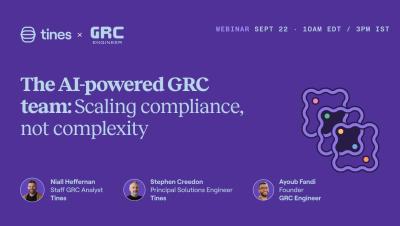
The AI-powered GRC team: Scaling compliance, not complexity

GRC teams have invested heavily in building mature control frameworks. But the real challenge? Having the visibility into whether they’re working, where gaps exist, and how to keep them running effectively at scale. As compliance programs become more complex, teams need new ways to move beyond manual processes and maintain confidence in control effectiveness. Join GRC experts from Tines for a conversation with Ayoub Fandi, Founder of GRC Engineer, to learn how leading organizations are reducing manual effort and improving visibility, and building compliance programs that scale.

"Better than the tools we were quoted six figures for": How Tines' finance team built a custom billing app for <$1,000

At Tines, Salesforce and NetSuite form our core finance and billing stack. But anyone using these tools will be familiar with the issues this set-up presents — it requires manual, time-consuming work to connect data across the two platforms. Over the years, my team evaluated a bunch of solutions to this problem, including third-party tools and NetSuite’s own native offering.

AI governance monitoring: how to prove your program is actually working

Ask a governance lead which of their AI controls actually ran last Tuesday at 2:14 p.m., when a specific agent touched a specific dataset, and the answer usually arrives as a policy document, an org chart, and a shrug. That gap between the controls a program claims to have and the controls that actually fired when an agent acted is where AI governance quietly fails. Policy documents describe intent. Model monitoring tracks accuracy and drift.

Why wild code is the next big challenge for CIOs

Tines co-founder and COO Thomas Kinsella recently joined Peter High on the Technovation podcast to talk about the evolution of Tines, the rise of "wild code," and why agents aren’t always the right tools for the job. The conversation covered a lot of ground — from the original problem that inspired Tines, to how teams should think about combining AI agents, deterministic automation, and humans in a single workflow. Here, we’ll share some of the highlights.

The AI SOC is commoditized. Here's why building our own is the next frontier.

If you walked the floor at Black Hat this year, you likely noticed a glaring trend: the AI Security Operations Center (SOC) is no longer a bleeding-edge novelty. It’s officially a commodity. With close to 70 AI SOC platform companies vying for attention, the market is completely saturated. What was once the hottest standalone category in cybersecurity is rapidly becoming a standard feature.

Wild code: You can't govern what you can't see

AI changed who can build. Employees across the business can now create workflows – apps, agents, and automations, faster than ever before. The result is a growing wave of “wild code”: AI-generated software, automations, and agents that solve real business problems but exist outside traditional governance, operational ownership, and support models. For IT, this creates a new challenge. How do you empower teams to move quickly without creating more risk, complexity, and technical debt? How do you support innovation without opening the door to shadow AI, data leakage, and unmanaged systems?