





Dublin, Ireland
2018
One of my favorite parts of my role is working closely with innovative customers like Chris Oh, Senior Director of AI Enablement at Headspace. Chris and I recently caught up to talk through how Headspace uses Tines 3B to give teams the freedom to build with AI, without the operational risk. We covered the problem Headspace set out to solve, why they chose Tines 3B, and some of their early wins with the product.
  |  By Tines
At Tines, Salesforce and NetSuite form our core finance and billing stack. But anyone using these tools will be familiar with the issues this set-up presents — it requires manual, time-consuming work to connect data across the two platforms. Over the years, my team evaluated a bunch of solutions to this problem, including third-party tools and NetSuite’s own native offering.
  |  By Tines
Ask a governance lead which of their AI controls actually ran last Tuesday at 2:14 p.m., when a specific agent touched a specific dataset, and the answer usually arrives as a policy document, an org chart, and a shrug. That gap between the controls a program claims to have and the controls that actually fired when an agent acted is where AI governance quietly fails. Policy documents describe intent. Model monitoring tracks accuracy and drift.
  |  By Tines
Tines co-founder and COO Thomas Kinsella recently joined Peter High on the Technovation podcast to talk about the evolution of Tines, the rise of "wild code," and why agents aren’t always the right tools for the job. The conversation covered a lot of ground — from the original problem that inspired Tines, to how teams should think about combining AI agents, deterministic automation, and humans in a single workflow. Here, we’ll share some of the highlights.
  |  By Tines
If you walked the floor at Black Hat this year, you likely noticed a glaring trend: the AI Security Operations Center (SOC) is no longer a bleeding-edge novelty. It’s officially a commodity. With close to 70 AI SOC platform companies vying for attention, the market is completely saturated. What was once the hottest standalone category in cybersecurity is rapidly becoming a standard feature.
  |  By Tines
More teams are building Apps in Tines Stories to deliver their most important work. This month, you can connect Apps to your Tines data, assign clear ownership, and share view access through your identity provider. Bring your data directly into an app. Apps can now read cases, records, and resources through built-in Workbench functions, so you spend less time configuring Workbench tools and building endpoints to interact with your data..
  |  By Tines
In July, we launched Tines 3B to the world, and it’s been incredible to see the response from our customers. It wasn’t a surprise though, we had a sneak peek of how much value 3B could bring when we launched it internally. On June 2, around eight weeks before the product's general availability, we unlocked the doors of 3B, let every single Tines employee into our own instance, and invited them to start building.
  |  By Tines
Government teams are under growing pressure to modernize and improve efficiency while continuing to meet rigorous requirements for security, governance, and accountability. Meeting both demands requires technology that can support innovation without sacrificing control. That’s why we’re proud to share that Tines has achieved TX-RAMP Level 2 certification for both Tines Stories and Tines 3B.
Security and IT teams are managing growing volumes of logs, alerts, and telemetry data across disconnected tools and data stores. When teams are tasked with responding to audit or compliance requests, they need to pull the right information quickly and accurately and that is rarely a straightforward process. Investigations span multiple tools, logs sit in storage, routing and retrieving archived logs are manual processes that overburden teams when they can least afford it.
  |  By Tines
July was an exciting month in the world of Tines. We launched Tines 3B, the single, secure environment for every team’s apps, agents, and automation. It’s a new platform where everyone can build, while you safely run and monitor your organization’s most important work. The Tines platform you already know is now called Tines Stories, and we’ll continue to invest in, support, and develop it.
  |  By Tines
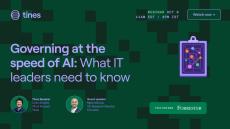
AI is reshaping the IT leadership role faster than any shift in the last decade. As AI makes it dramatically easier to build software (agents, apps, automations, and more), the volume of software entering the enterprise is far beyond what IT teams have had to govern before. That shift demands new ways of thinking about enterprise control: how security, access, and oversight evolve to keep pace with software that's built faster and by far more people than ever before. The leaders who treat this as an operating shift, not just a technical one, are the ones expanding their influence.
  |  By Tines
GRC teams have invested heavily in building mature control frameworks. But the real challenge? Having the visibility into whether they’re working, where gaps exist, and how to keep them running effectively at scale. As compliance programs become more complex, teams need new ways to move beyond manual processes and maintain confidence in control effectiveness. Join GRC experts from Tines for a conversation with Ayoub Fandi, Founder of GRC Engineer, to learn how leading organizations are reducing manual effort and improving visibility, and building compliance programs that scale.
  |  By Tines
AI changed who can build. Employees across the business can now create workflows – apps, agents, and automations, faster than ever before. The result is a growing wave of “wild code”: AI-generated software, automations, and agents that solve real business problems but exist outside traditional governance, operational ownership, and support models. For IT, this creates a new challenge. How do you empower teams to move quickly without creating more risk, complexity, and technical debt? How do you support innovation without opening the door to shadow AI, data leakage, and unmanaged systems?
  |  By Tines
Building a workflow is only the beginning. Autotune monitors workflows and suggests improvements, while Autofix investigates failures and proposes repairs. In this video we show how both features help keep an IT device management application and workflow reliable.
  |  By Tines
In Tines 3B, you don't always need to build a workflow to get things done. Sometimes, you just want a quick answer or to take an action, that’s what chat is for. In this video, we look at how to use chat in Tines 3B.
  |  By Tines
AI changed who can build, and now IT teams must navigate a new challenge. Employees across the business are creating apps, agents, and automations faster than ever. The result is a wave of "wild code": unmonitored workflows that solve immediate problems but bypass traditional governance and operational ownership. Without the right platform to centralize visibility and ensure safety, you face blind spots that compromise your most important workflows.
  |  By Tines
Your teams are moving fast with AI — but is IT and Security able to see what's actually being built? IT and AI leaders are facing a career-defining challenge right now: AI-generated code and shadow AI spreading faster than anyone can track. Introducing Tines 3B — a single, secure environment that gives employees the freedom to build with AI, and gives IT and security the control to govern that work safely.
  |  By Tines
Description: Tines 3B is an AI-native environment that gives every team the power to build agents, apps, and automations with AI, and gives IT and security the control to govern that work safely across the business. Here, Eoin Hinchy (Co-founder and CEO), Stephen O'Brien (Head of Product), Eoghan Reid (Lead Product Designer), and Rosie Ellison (Product Manager) share the story behind building Tines 3B, and the mission driving it: making automation 100x simpler and 100x faster, without compromising on AI governance or control.
  |  By Tines
Automate user account provisioning for Okta and Office 365, with a built-in approval step. In this five-minute flow, you'll see how Tines handles the full lifecycle of a new user access request: from a self-service form submission, through a Slack-based approval, all the way to account creation in Okta or Microsoft Entra ID (Office 365). No more manual back-and-forth between IT, system owners, and new starters.
  |  By Tines
Networking and network security stakes are high. Like really high. Infrastructure downtime costs teams at minimum $50,000 per hour, according to Business Wire. So what’s standing in the way of a faster, more coordinated response? Join Netskope and Tines for a live conversation on how you can move from reactive networking and network security operations to proactive response. Learn how to bridge the gap between detection and resolution across modern hybrid environments, improving reliability, accelerating response times, and reducing the manual work that slows teams down.

The world’s best companies – from startups to the Fortune 10 – trust Tines with their mission-critical security workflows.

Security and operations teams are too often stuck doing manual, repetitive tasks, and we want to change that. Tines is an automation platform designed to allow anyone to automate any manual task, regardless of complexity. No apps, plugins, or custom code required.

Tines customers automate an average of 20 workflows in year one. Build classic SOAR capabilities like endpoint detection & response and phishing response, solve needs like employee onboarding and Slack bots, and automate complex workflows unique to your business – all in the same tool.

With 1,000+ template options for common security actions, Tines is power and simplicity through direct integration with your existing tools.