


|
By Joe DeFever
96% of security teams are now using AI. Whether it's through chatbots, native platform features, in-house agents, or custom-built tools, AI has become standard equipment in the SOC. Yet, only 18% of teams have structured and enforced frameworks for how AI should be used in the SOC. Security leaders aren't struggling to adopt AI. They're struggling to control it, explain it, and defend it when a board or a regulator asks What happened? Why did the system do that?

|
By Karen Mcdermott
What Elastic Security’s November 2026 threat report means for financial institutions and the teams that protect their customers, systems, and payments A user is presented with a pop-up or CAPTCHA that looks like a routine verification step when browsing to a seemingly legitimate website. It asks them to copy and paste a command. They follow the instructions, and the command runs on their device.

|
By Allison Halataei
Over recent years, US critical infrastructure has become a primary target for coordinated cyber attacks. Small water, gas, and electric utilities have faced serious risk from cyber attacks while dealing with limited budgets, staff, and forensic expertise, leaving them further exposed. Advancements in AI have made the cyber threat landscape even more challenging. AI has become an enabler of cyber attacks, rather than a solitary perpetrator.

|
By Joe DeFever
With 96% of security teams now using AI, the question is no longer whether AI delivers real value to the SOC, but one of efficiency and reliability. The recent AI Adoption in the SOC report, conducted by Dimensional Research and sponsored by Elastic, surveyed more than 400 cybersecurity professionals responsible for security operations at companies with more than 500 employees.

|
By TJ Banasik
The rules of cyber defense have shifted. Threat actors are increasingly using advanced automation to accelerate reconnaissance, evade static signatures, and orchestrate rapid intrusions across critical infrastructure, software supply chains, and insider pathways. This has created a critical velocity gap: when adversaries compress attack timelines from days to minutes and defenders rely on manual triage across fragmented legacy tools, the defense falls behind.
|
By Will Markham
The future of policing depends on more than changing force structures or investing in AI. It depends on making data work across boundaries. Policing is being asked to change at pace.

|
By Karen Mcdermott
As autonomous AI reshapes cyber risk, financial institutions need the visibility and context to detect unusual behavior and respond at machine speed. AI agents are changing more than just how financial services companies operate. They are also changing the speed and scale of cyber risk.

|
By Woody Walton
On August 20, 2026, the Cybersecurity and Infrastructure Security Agency (CISA) published its Logging Reference Architecture (LRA), the implementation guidance federal civilian executive branch (FCEB) agencies have been waiting for since the Office of Management and Budget's Memorandum M-26-14 reset the requirements for enterprise logging.
|
By Mia LaVada
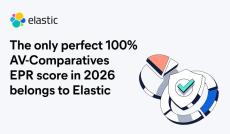
Elastic sits at the very top of this year’s AV-Comparatives' CyberRisk Quadrant within the 2026 Endpoint Prevention and Response (EPR) test with the only protection scores at 100%, combined with both the lowest modelled operational footprint of any tested product and zero false alerts.

|
By Roberto Arico
How teams are leaving value on the table and what it costs when they do It's 3:00 a.m. Your on-call engineer gets paged that the central processing unit (CPU) is at 97% on payment-processor-01. They open their observability platform, look at the metric spike, reboot the host, and close the ticket.

|
By Elastic
When a new cyber threat emerges, how do you know if your organization has already been compromised? Mike Nichols, GM Security at Elastic, explains how Elastic AlertZero uses specialized AI agents to connect continuous threat hunting with detection engineering. AlertZero's Hunt Watch analyzes threat intelligence, builds queries, and searches historical data for signs of compromise. It can then trigger Detection Watch to propose new detection rules, helping security teams investigate past activity and improve detection coverage against future threats.

|
By Elastic
Elastic confirmed two live intrusions in August 2026 where attackers ran commands through AI tools already on the victim’s machine: Claude Code on Windows and the ChatGPT desktop app on macOS.

|
By Elastic
With Elastic AlertZero, security teams can configure agent autonomy, audit agent activity, and choose the AI models that fit their environments without being locked into a single model provider. Mike Nichols, GM of Security at Elastic, explains how AlertZero addresses three priorities for bringing agentic AI into security operations: transparency, control, and model flexibility.

|
By Elastic
What are the five pillars of Zero Trust? Across Zero Trust frameworks, five control points remain consistent: users, devices, networks, applications, and data. In this episode of Quick Question, we cover how each pillar generates critical security data, and why that data often lives in disconnected tools, leaving organizations with a fragmented view.

|
By Elastic
What is Zero Trust Architecture, and why is it important? Zero Trust is a security framework built on one core principle: never trust, always verify. In this episode of Quick Question, we explain how Zero Trust shifts security from protecting the front door to locking everything inside by default, granting access room by room based on identity, context, and authorization.

|
By Elastic
No two tech stacks are the same, so no agent can protect every organization the same way. This Short explains why human judgment needs to stay in the loop when it comes to agentic AI in security operations and what it means to build AI that handles the heavy lifting without sacrificing analyst control.

|
By Elastic
Somesh Agarwal, Senior Director of Security Operations at o9 Solutions, explains how the AI planning platform behind many of the world's largest supply chains consolidated security operations and observability on Elastic Security to gain unlimited threat-hunting retention, accelerate detection engineering, and simplify multicloud security operations.
|
By Elastic
Attackers are using AI to compress timelines from hours to minutes. Most SOCs, and most security platforms, weren’t built for that speed. Join Elastic Security product and research experts for a look at how modern security teams can detect, investigate, and respond faster using agentic AI. You’ll learn how to: You’ll leave better equipped to reduce investigation time, keep analysts focused on decision-making, and modernize security operations for machine-speed threats without removing humans from the loop.

|
By Elastic
Discover how implementing Elastic helped drive measurable improvements across key security metrics, from performance to client satisfaction. In this video, Tyler Hopperton, Chief Information Security Officer at Coretek, shares how a flexible, data-driven approach to cybersecurity, combined with Elastic and Microsoft Azure, enables teams to better understand, normalize, and act on critical security data. Learn how this partnership is helping modern organizations adapt to evolving threats and build more effective security operations.
|
By Elastic
In this video, we introduce Elastic Security and how it helps modern teams manage security operations more efficiently. It brings together detection, investigation, and response into one unified platform using AI, automation, and integrated security tools. Additional Resources.
Elastic is the world's leading software provider for making structured and unstructured data usable in real time for search, logging, security, and analytics use cases. Built on an open source foundation, the Elastic Stack lets you reliably and securely take data from any source, in any format, and search, analyze, and visualize it in real time.
The Elastic Stack:
- Kibana gives shape to your data and is the extensible user interface for configuring and managing all aspects of the Elastic Stack.
- Elasticsearch is a distributed, JSON-based search and analytics engine designed for horizontal scalability, maximum reliability, and easy management.
- Beats is a platform for lightweight shippers that send data from edge machines to Logstash and Elasticsearch.
- Logstash is a dynamic data collection pipeline with an extensible plugin ecosystem and strong Elasticsearch synergy.
Founded in 2012 by the people behind the Elasticsearch, Kibana, Beats, and Logstash open source projects, Elastic's global community has more than 80,000 members across 45 countries. Since its initial release, Elastic's products have achieved more than 100 million cumulative downloads.