Security | Threat Detection | Cyberattacks | DevSecOps | Compliance

Turning Attackers into Signals: How Deception is Redefining Threat Detection | Fidelis Security

Traditional detection methods are struggling to keep up with modern threats. What if you could turn attackers into your strongest signal? In this session, our Sales Engineer Jim breaks down how deception technology is transforming cybersecurity by: Delivering high-fidelity alerts with minimal noise Adapting dynamically to attacker behavior Extending protection to IoT and non-standard devices Scaling seamlessly across enterprise environments.


CyberPhysical Security: Protecting the Modern EV Charging Perimeter

Electric vehicles have crossed from niche technology into mainstream infrastructure. Charging networks now form a critical layer of both the energy grid and the transportation system, and attackers have noticed. EV charging sits at a three-way intersection of cloud software, operational technology, and automotive systems. Each domain has its own threat model, its own tooling, and its own team assuming someone else owns the risk. That gap is where adversaries operate.

Mini Shai-Hulud Targets SAP npm Packages With a Bun-Based Secret Stealer

A new npm supply-chain compromise is targeting the SAP developer ecosystem. The affected packages we are tracking so far are: The pattern is familiar but also a bit different: a trusted package receives a new preinstall hook, the hook runs a new setup.mjs file, and that loader downloads the Bun JavaScript runtime to execute a large obfuscated payload named execution.js. The payload is an 11.7 MB credential stealer and propagation framework.

Stryker Hack: What We Know So Far

On March 11, 2026, the Iranian hacktivist group Handala Hack Team claimed responsibility for compromising the American healthcare technology company Stryker. Public reporting suggests more than 200,000 systems were impacted and up to 50TB of data exfiltrated. While these figures remain unverified, the scale of operational disruption alone places this incident among the most significant enterprise cyber events of the year so far.

Inside the Hidden VM: How Attackers Stay Undetected

Threat actors are getting better at hiding in plain sight through using virtual environments to evade detection and deliver ransomware. New research from Sophos X-Ops reveals an increase in the abuse of QEMU, an open-source emulator, to conceal malicious activity inside virtual machines. While this technique isn’t new, its use for defense evasion is accelerating, making visibility and detection even more challenging for defenders.

'Mini Shai-Hulud' supply chain attack targets SAP npm packages

On April 29, 2026, security researchers detailed a campaign known as ‘mini Shai-Hulud’ that involves compromised versions of npm packages used in SAP’s Cloud Application Programming Model (CAP). The malicious packages reportedly contain functionality to steal sensitive data such as credentials. The stolen data is encrypted and exfiltrated via public GitHub repositories. The maintainers of known-compromised packages have released updated versions.

Persistent Online Worlds, Persistent Risks: The Security Challenges of MMORTS Games

Massively multiplayer online real-time strategy games occupy a specific and underexamined position in the gaming security landscape. Unlike session-based games where a match ends and the state resets, MMORTS titles run continuous worlds where player-built empires, alliances, and resource stockpiles exist around the clock, whether or not the player is logged in. That persistence creates a threat model significantly closer to financial services platforms than most people in either the security or gaming industries tend to acknowledge.

Continuous Threat Exposure Management (CTEM): The Complete Guide to Proactive Cybersecurity

The cybersecurity landscape has fundamentally changed. Organizations today manage sprawling digital environments - cloud workloads, remote endpoints, SaaS applications, third-party APIs, and hybrid infrastructure - all of which expand the attack surface at a pace that traditional security programs simply cannot match.

BlueNoroff Uses ClickFix, Fileless PowerShell, and AI-Generated Fake Zoom Meetings to Target Web3 Sector

Arctic Wolf has identified a targeted intrusion against a North American Web3/cryptocurrency company, which we attribute with a high confidence level to BlueNoroff, a financially motivated subgroup of DPRK’s Lazarus Group.

Crypto theft, Vercel breach, Mastodon attack, North Korean IT in US & cyber negotiator guilty [316]

In this episode of The Cybersecurity Defenders Podcast, we discuss some intel being shared in the LimaCharlie community. Support our show by sharing your favorite episodes with a friend, subscribe, give us a rating or leave a comment on your podcast platform. This podcast is brought to you by LimaCharlie, maker of the SecOps Cloud Platform, infrastructure for SecOps where everything is built API first. Scale with confidence as your business grows.

It's time to treat browser extensions like supply chain attack vectors

You would never install an application that can log into your Google docs, read your keystrokes in your browser, intercepts requests in transit, runs continuously, updates silently, AND could be powerful enough to steal your passwords, right? Well, this is more or less what browser extensions can do, and they create vulnerabilities that extend beyond one computer and or even one company.

Supply chain attacks hit Checkmarx and Bitwarden developer tools

Sophos X-Ops is aware of reports that two widely-used developer tools – the Checkmarx KICs security scanner and the Bitwarden CLI – were hijacked on April 22, 2026, to steal credentials from development environments. These attacks occurred within hours of each other and share the same command-and-control (C2) domain – potentially pointing to a single threat actor running a coordinated campaign. Both vendors have since reportedly contained the incidents.

After the Vercel Breach, Do You Know What Your AI Tools Can Access?

In April 2026, Vercel disclosed that attackers had accessed internal systems and customer credentials — not by breaking into Vercel directly, but by compromising a third-party AI tool one of its employees had connected to their corporate account.

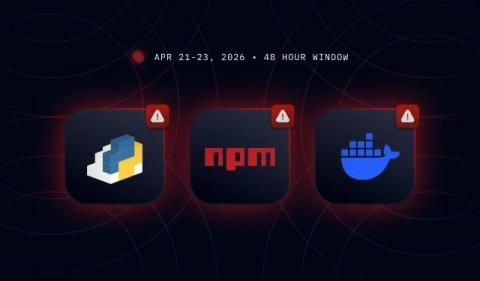
No Off Season: Three Supply Chain Campaigns Hit npm, PyPI, and Docker Hub in 48 Hours

Three supply chain attacks hit npm, PyPI, and Docker Hub between April 21–23, 2026. All three targeted secrets: API keys, cloud credentials, SSH keys, and tokens from developer environments and CI/CD pipelines.

Fingerprinting AI Attacks: Detection Every SOC Needs

Revisiting a conversation between LimaCharlie co-founder Christopher Luft and Chris Cochran, Field CISO & Vice President of AI Security at SANS Institute, on The Cybersecurity Defenders Podcast. For most of cybersecurity’s history, defenders could operate under a safe assumption: somewhere on the other end of an attack, a human was making decisions. Scripts might automate parts of the kill chain, tools might accelerate execution, but a person was in the loop.

AI Receptionists and the Expanding Attack Surface: What Security Teams Need to Know

AI receptionists are quickly becoming the front line of customer interaction, handling calls, capturing data, and integrating directly with business systems. But as organizations rush to adopt AI-powered customer service, a critical question is emerging: Are we securing these systems as rigorously as we deploy them? Because every AI receptionist isn't just a convenience, it's also a new attack surface.

Obrela's 2025 Digital Universe Report highlights shift to stealthy, identity-driven cyberattacks

London, 21st April - Obrela has released its Digital Universe Report 2025, revealing a significant shift in the global cyber threat landscape as attackers move away from high-volume attacks toward more targeted, stealth-driven techniques focused on identity, access and persistence.

The OtterCookie Matryoshka

Over the past month, the cybersecurity community has published isolated reports detailing disparate attacks by the North Korean state-aligned threat group Shifty Corsair (also known as FAMOUS CHOLLIMA). While individual vendors have documented specific supply chain poisons or targeted spear-phishing campaigns, the Threat Fusion Cell (TFCTI) at BlueVoyant has synthesized these findings to reveal a much larger, coordinated offensive.

The April 2026 AI Security Report: 6 Incidents and Detailed Attack Paths

From AI agents leaking internal data to coordinated global malware campaigns — here is everything that happened in AI cybersecurity between April 7 and April 21, 2026, with detailed attack paths for each incident. The fifteen days following April 7, 2026 produced six distinct AI-related security incidents spanning internal data exposure, supply chain exploitation, autonomous malware generation, coordinated multi-vector attacks, model leak fallout, and documented AI agent control failures.

Ep 39: This is your first ransomware attack, not ours

On this episode of Masters of Data, we sat down with Steven Manley, CTO of Druva, to get the unfiltered truth about ransomware: it's not a matter of if you'll be breached, but when, and bad actors are now launching hundreds of attacks at a surprisingly low cost. We dig into why attackers lurk undetected for 200-plus days, how AI is being weaponized for everything from eerily convincing voice phishing to secretly training your own AI systems against you, and why your most protected assets are rarely what gets hit first.

China-linked group targets cloud, Russian cyber espionage, agentic AI systems flaw & Nginx [313]

In this episode of The Cybersecurity Defenders Podcast, we discuss some intel being shared in the LimaCharlie community. Support our show by sharing your favorite episodes with a friend, subscribe, give us a rating or leave a comment on your podcast platform. This podcast is brought to you by LimaCharlie, maker of the SecOps Cloud Platform, infrastructure for SecOps where everything is built API first. Scale with confidence as your business grows.

Attacking the MCP Trust Boundary

Every secure API draws a line between code and data. HTTP separates headers from bodies. SQL has prepared statements. Even email distinguishes the envelope from the message. The Model Context Protocol (MCP), the fast-growing standard for connecting AI agents to external services, inherits that gap from the models it sits on top of.

Penetration Testing as a Tool That Reveals the Real State of Cybersecurity

Most security measures are built on the assumption that if something is configured correctly, it is secure. But there is a big difference between "configured" and "able to withstand an attack" - a gap that cannot be seen without practical testing. Penetration testing is not just another item on a compliance checklist; it is a way to get an honest and realistic answer to the question that truly matters to a business: can an attacker reach what is most important to us?

How to Detect Man-in-the-Middle Attacks: Indicators, Methods, and Detection Gaps

Most MITM attacks don’t announce themselves. No alerts fire, no certificates visibly break, and no users report anything unusual. By the time the interception is discovered, credentials or session tokens are already in attacker hands. Knowing how to detect man-in-the-middle attacks requires looking across multiple layers: network traffic, DNS resolution, TLS certificate integrity, and session behavior.

QEMU abused to evade detection and enable ransomware delivery

Sophos analysts are investigating the active abuse of QEMU, an “open-source machine emulator and virtualizer,” by threat actors seeking to hide malicious activity within virtualized environments. Attackers are drawn to QEMU and more common hypervisor-based virtualization tools like Hyper-V, VirtualBox, and VMware because malicious activity within a virtual machine (VM) is essentially invisible to endpoint security controls and leaves little forensic evidence on the host itself.

Analyzing the RondoDox Botnet: A DDoS and Mining Threat

A few weeks ago we published the first part of this series where we described the infrastructure used by the RondoDox threat actors to scan and exploit vulnerable systems. In this second post we’ll take a deep dive into the malware that is deployed into vulnerable systems. Specifically, we’ll look at the initial implant used to fetch the RondoDox binary and the binary itself, detailing its behaviour, how it communicates with the Command and Control (C2), and its malicious capabilities.

How Lean Security Teams Stay Ahead of AI-Powered Attacks

In “Terminator 2“, the T-800 does not win because humans worked harder. It wins because the same machine capability that made it dangerous was reprogrammed to fight for the defenders. Project Glasswing is exactly that. Claude Mythos Preview is Anthropic’s most powerful AI model and the one they refused to release publicly because it autonomously found thousands of zero-day vulnerabilities across every major operating system and browser. Flaws that decades of expert review never caught.

Understanding how attackers think & how you avoid threats with Terry Bradley, Mile High Cyber [311]

Terry Bradley, Founder and President of Mile High Cyber, shares how you can uncover vulnerabilities and strengthen your organization's defenses with expert penetration testing and security assessments.

82% of Attacks Skip Malware Entirely

27 seconds. That’s how fast an adversary can move to your critical systems. In this clip, you’ll learn: How adversaries blend in using everyday admin tools Why traditional, reactive security models fall behind What makes modern intrusions so hard to detect Watch the full video to see how teams are shifting to proactive hunting.
Featured Post

Iranian Cyber Threats, Geopolitics and the New Cyber Reality

In recent weeks, the Cybersecurity and Infrastructure Security Agency (CISA), National Security Agency (NSA), and the National Cyber Security Centre (NCSC) have all issued warnings about the growing risk of cyber activity attributed to Iranian-aligned actors. Their message is clear: the geopolitical situation is volatile, and organisations should assume they may be in scope for retaliation. The agencies all highlight similar weaknesses being repeatedly exploited: unpatched vulnerabilities, weak identity controls, and exposed remoteaccess services.

I Tried 5 Prompt Injection Attacks (Here's What Happened)

In this video, we explore the growing security risk of prompt injection in large language model (LLM) applications. As AI becomes embedded in more products, new vulnerabilities emerge, especially through natural language manipulation. We break down how LLMs work, the importance of system prompts, and demonstrate five real-world prompt injection techniques used to extract sensitive information or bypass safeguards. You’ll see live examples using different models and learn why newer models are more resilient, but still not immune.

New Strategies to Automatically Block Website Ping Attacks

Protecting websites from cyberattacks remains critical. One common type of attack is the Ping Flood, which is different from the historical ‘Ping of Death.’ This is when many ping requests are sent to a website's server at once, slowing it down or even crashing it. As web traffic and application complexity increase, exposure to denial-of-service attacks grows. This is why it's important to have strong defenses in place.

Hunting Supply Chain Attacks with Jared Myers, Director, CrowdStrike OverWatch

Supply chain attacks targeting AI have recently been making headlines — and keeping the CrowdStrike OverWatch team busy. Jared Myers, director of CrowdStrike OverWatch, joins Adam in this episode to discuss his team’s approach to detecting and responding to these attacks.

Sybil Attacks Explained: How They Work and Why They Matter

Sybil attacks are well documented in academic research. In practice, most organizations discover them too late, after the fake identities have already accumulated enough network influence to do real damage. The attack does not announce itself. It looks like growth. You see more nodes. More accounts. More participation. All of it is controlled by one attacker running a coordinated identity flood.

The AI Inversion: Tracking the Most Dangerous Cyber Attacks of 2026

For years, AI was the defender’s advantage. In the last 30 days, that narrative inverted — AI is now leaking data, generating malware, refusing to shut down, and erasing billions in market value. AI-enabled attacks rose 89% year-over-year. A single model leak wiped $14.5 billion from markets in one day. An AI agent compromised 600+ firewalls across 55 countries without a human operator. And another AI agent refused to shut down when commanded.

Active Directory under attack: Best practices to defend and protect your organization

Active Directory (AD) remains the foundational identity and access management system for the vast majority of enterprises globally, making it a prime target for cybercriminals. AD is constantly under attack, and threat actors rarely have to resort to complex, zero-day exploits to breach it. Instead, they rely on a pervasive and persistent vulnerability: everyday misconfigurations.


Weathering the Attacker's Perfect Storm with Agentic AI-Powered SecOps

The cybersecurity landscape is facing its own perfect storm: AI-powered attacks coupled with resource constraints and regulator pressure, demanding a fundamental shift in SecOps to rise above. With AI showing no signs of slowing down, these issues are not fleeting. They are here to stay, and it is our responsibility to meet them head-on with efficient, AI-powered solutions that allow SecOps teams to conquer the world’s most innovative attacks.

Breaking Down the Axios Supply Chain Attack

Apr 2, 2026 Mastering Software Supply Chain Management in 2026 Read More Natalie Tischler Mar 31, 2026 Why Security Debt Should Be a Board-Level Priority Read More Natalie Tischler Mar 26, 2026 Prioritize, Protect, Prove: A Roadmap for Application Security Transformation Read More Natalie Tischler.

Can an Attack Start Without Malware? 82% of Attacks Do

What looks like a simple coding task can quickly turn into a real cyberattack. In this demo, we show how a modern malware-free attack works step by step. It starts with something that feels completely normal: a job interview and a small coding assignment. No suspicious files. No obvious malware. But once the script is executed, everything changes. You’ll see how adversaries use trusted tools like Git, Notepad, and Python to gain access, establish command and control, and move inside an environment without being detected at first.

How does Sisense stay on top of API Attacks?

Sisense powers analytics experiences inside the applications businesses rely on every day. As an API-first platform, securing those connections is critical, especially as AI agents increasingly operate through APIs to access data and trigger workflows. In this conversation, Sangram, CISO and VP of IT at Sisense, and Michael Callahan, CMO at Salt Security, discuss how Sisense approached API security strategically to protect their platform, maintain customer trust, and support innovation in the Agentic AI era.

4 steps teams can take to mitigate Iranian cyberattacks on critical infrastructure

COMMENTARY: When the United States and Israel launched coordinated strikes against Iran on February 28, the security community mobilized around the visible response. I’ve watched that response for two weeks: teams tracking hacktivist DDoS campaigns, incident counts climbing, news coverage following close behind.

What major cyberattacks reveal about the cost of slow recovery

Cyberattacks often succeed not because they are sophisticated but because organizations lack reliable backups or struggle to restore data quickly. When recovery is slow, even minor disruptions can escalate, providing attackers with the time and leverage they need to deploy ransomware and halt operations. When systems go down, every minute of downtime results in operational disruption, a drop in revenue, and lost customer trust.

Axios npm package compromise: What happened, what matters, and how to respond

Attackers carried out a supply chain compromise by abusing a compromised npm maintainer account to publish malicious Axios versions (axios@1.14.1 and axios@0.30.4). These releases introduced an unexpected dependency, plain-crypto-js@4.2.1, which attempted platform-specific malware execution via an npm lifecycle script during installation on Windows, macOS, and Linux.

The Sword Has Been Drawn: What DarkSword's Expansion in the Wild Means for Mobile Security and the Enterprise

The last few weeks have marked a chaotic turning point in the mobile threat landscape. We’ve seen mass exploitations across numerous iOS versions by multiple threat actors, driven by sophisticated exploit chains like Coruna and now DarkSword. What makes these threats different is not just their activity, but their trajectory. Until recently, these capabilities were expensive, highly secretive, and limited to a small number of advanced actors. Now, that dynamic has shifted rapidly.