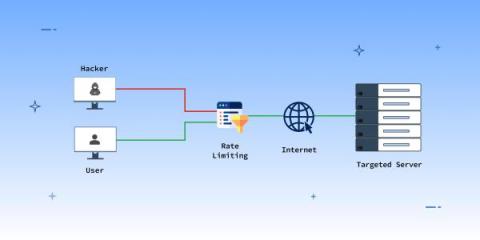
A Denial of Service (DoS) attack will prevent your legitimate users from accessing your API. The attack could be physical, such as unplugging network cables, but a Distributed DoS is more prominent. It involves generating a volume of user requests from various machines to overwhelm your servers. DDoS attacks can result in a loss of $50,000 of revenue due to downtime and mitigation.
Contrary to stereotype, today’s cyberattacks aren’t limited to complex tactics such as the use of zero-day exploits or polymorphic malware that flies under the radar of traditional defenses. Instead of going the extra mile to set such schemes in motion, most threat actors take a shortcut and piggyback the human factor.
On June 7th, the Federal Bureau of Investigation (FBI) and the Cybersecurity and Infrastructure Security Agency (CISA) issued an advisory highlighting the recent efforts of threat actors to disseminate CL0P ransomware. The various malicious indicators of compromise (IOCs) and tactics, techniques, and procedures (TTPs) being leveraged by the threat actors are listed in US-CERT Alert (AA23-158A) – CL0P Ransomware Gang Exploits CVE-2023-34362 MOVEit Vulnerability.
NOTE: The MOVEit Transfer vulnerability remains under active exploitation, and Kroll experts are investigating. Expect frequent updates to the Kroll Cyber Risk blog as our team uncovers more details. On June 5, 2023, the Clop ransomware group publicly claimed responsibility for exploitation of a zero-day vulnerability in the MOVEit Transfer secure file transfer web application (CVE-2023-34362).
MiTM or Man-in-the-middle attack is one of the most common cyberattacks that online users must be aware of. Anyone who’s actively connected to the internet for both work and entertainment purposes is at risk of being a victim of a MiTM attack. Fortunately, you can prevent the above from happening. This blog is here to help. Below, we’ll discuss MiTM attacks, their types, how they work, and how to prevent becoming a victim.