Security | Threat Detection | Cyberattacks | DevSecOps | Compliance

A Framework for Vulnerability Mitigation

Vulnerability management has long been seen as one of the most straightforward areas in security. Scan your assets, identify vulnerabilities, prioritize the findings, and patch what you can. On paper, it looks like a repeatable process. But in reality, vulnerability mitigation is anything but simple. Environments are constantly changing. Assets come and go. New integrations, temporary exceptions, and incomplete inventories make it hard to know what is truly at risk.
DuneSlide: Two Critical RCE vulnerabilities via Zero-Click Prompt Injection in Cursor IDE

Cato AI Labs has discovered two critical remote code execution (RCE) vulnerabilities in Cursor IDE, the popular development environment which, according to Cursor, is used by over half of the Fortune 500. Both RCE vulnerabilities, which we refer to as “DuneSlide,” achieved a 9.8 CVSS score, and involve breaking out of the IDE’s sandbox environment and were assigned CVE IDs CVE-2026-50548 and CVE-2026-50549.

Intel Chat: Cisco CUCM exploited, ransomware profiles, Gamaredon & AI agent phishing [335]

Intel Chat with Matt Bromiley and Chris Luft. Matt and Chris break down four stories from the week in threat intel: Chapters: The Cybersecurity Defenders Podcast — a podcast about cybersecurity and the people that keep the internet safe. New episodes drop weekly. Subscribe wherever you listen.

Emerging Threat: (CVE-2026-55957) Apache Tomcat Authentication Bypass via JNDIRealm GSSAPI Binds

CVE-2026-55957 is a missing critical step in authentication in Apache Tomcat, present when the JNDIRealm is configured to authenticate binds using GSSAPI. The vulnerability carries a CVSS v3.1 base score of 9.8 (Critical), based on network attack vector, low attack complexity, no privileges required, and no user interaction.

AI Just Shrank the Time Hackers Need to Weaponize Your Vulnerabilities

The Five Eyes intelligence alliance—NSA, CISA, GCHQ, Australia's ASD, Canada's Cyber Centre, and New Zealand's GCSB—just issued a joint warning: AI has compressed the window between vulnerability discovery and exploitation from years to months. Adrian breaks down what the "AI Shift in Cyber Risk" statement actually means for patching timelines and attacker sophistication—and why most organizations aren't moving fast enough to keep up.

Why Your Asset Counts Are Wrong (And What to Do About It)

If you've ever pulled an asset count from one tool and compared it to another, you've probably noticed they don't match. The discrepancy isn’t minor, either. The difference is likely to be substantial. One scanner says you have 4,200 assets. Your CMDB says 3,800. Your cloud inventory says 1,100. None of them agree, and none of them are right. That's not a data hygiene problem you can solve with a spreadsheet cleanup.

Where Severity Scores Go Wrong: "Just Add Prototype Pollution"

At JFrog, our Security Research team continuously monitors and analyzes newly disclosed CVEs across the open-source ecosystem. Throughout our research, we have repeatedly observed cases where the assigned severity score does not accurately reflect a vulnerability’s real-world impact or exploitability. In fact, during 2025, JFrog researchers reassessed NVD critical-severity vulnerabilities and concluded that 96% warranted a lower severity rating.

Brace Yourself: Denial-of-Service in a Billion-Download Dependency

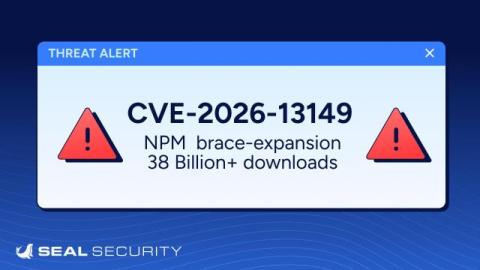
brace-expansion is a very popular npm package with over 38 billion all-time downloads (yeah, over 38,000,000,000) and used by tooling almost every JavaScript project relies on - eslint, glob, and npm itself. Despite being in the public eye for a while, we found a new Denial-of-Service vulnerability that could affect millions. This post walks through what the package does, existing issues that were fixed, and the new one we found - CVE-2026-13149.

Critical Remote Code Execution Vulnerability in libssh2 Client Library Require Urgent Mitigation

A suite of severe vulnerabilities has been disclosed in libssh2 (an SSH client library widely embedded in software such as curl, Git GUI clients, PHP, backup tools, and many IoT/embedded devices). The most critical, CVE-2026-55200 (CVSS 9.2/9.8), is a memory corruption bug in libssh2’s ssh2_transport_read() triggered by a malicious SSH server pre-authentication via a crafted packet_length.