Security | Threat Detection | Cyberattacks | DevSecOps | Compliance

SHA1-Hulud, npm supply chain incident

On November 24th, 2025, we identified a new supply chain attack in the npm ecosystem, referred to as SHA1-Hulud. We believe this is a second wave of the Shai-Hulud attack, which occurred in September 2025. Snyk will continue monitoring this active incident until it is resolved. Updates on this incident will be on our trust center.

Emerging Threat: CVE-2025-41115 - Critical SCIM Privilege Escalation in Grafana Enterprise

CVE-2025-41115 is a critical privilege escalation and user-impersonation vulnerability in Grafana Enterprise. The issue occurs within the SCIM (System for Cross-domain Identity Management) provisioning feature. When SCIM is enabled, Grafana incorrectly maps the externalId field supplied by a SCIM client to an internal user.uid.

CVE-2025-9501: Identifying High-Risk WordPress Instances Using W3 Total Cache

CVE-2025-9501 is a critical remote code-execution vulnerability affecting W3 Total Cache versions prior to 2.8.13, a plugin used by more than a million WordPress sites to improve performance and caching. The issue lies in the plugin’s _parse_dynamic_mfunc handler, which can process user-controlled inputs inside dynamic fragments.

Remediation Agent: Step-By-Step Guidance for Faster Fixes

Remediation shouldn’t require research. Seemplicity’s Remediation Agent embeds clear, asset-specific, step-by-step guidance directly into every finding – eliminating ambiguity, reducing rework, and accelerating time-to-resolution. Learn how it standardizes fixes, supports all skill levels, and removes one of the biggest bottlenecks in exposure management.

Elevating and Evolving the Role of the Channel

Nucleus Manager of Channel Enablement and Training, Tony Ramirez, talks about his recent recognition in CRN's 100 people to know for the channel. During this conversation, he also discusses the evolving role of channel leaders in cybersecurity, the importance of continuous threat exposure management (CTEM) as a process rather than a tool, and the need for contextual understanding in vulnerability management. Tony emphasizes the significance of engaging non-security stakeholders and the opportunities for the channel to educate clients on security posture and vulnerability management.

FortiWeb CVE-2025-58034: Exploited Zero-Day Command Injection in WAF

Dissecting the active-in-the-wild OS command injection vulnerability and its implications for enterprise threat monitoring In November 2025, threat intelligence teams began warning of a newly discovered zero-day vulnerability in a widely-deployed web application firewall appliance. The vulnerability — CVE-2025-58034 — allows authenticated attackers to execute arbitrary OS commands via crafted HTTP requests or CLI commands.

Obscure MCP API in Comet Browser Breaches User Trust, Enabling Full Device Control via AI Browsers

SquareX released critical research exposing a hidden API in Comet that allows extensions in the AI Browser to execute local commands and gain full control over users' devices. The research reveals that Comet has implemented a MCP API (chrome.perplexity.mcp.addStdioServer) that allows its embedded extensions to execute arbitrary local commands on users' devices, capabilities that traditional browsers explicitly prohibit. Concerningly, there is limited official documentation on the MCP API.

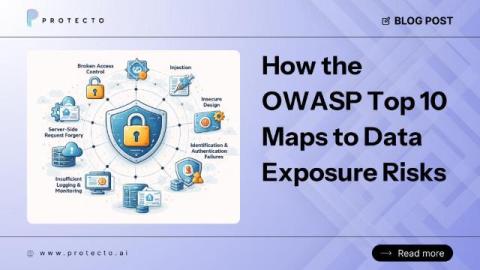
OWASP Named Software Supply Chain Failures. Now It's Time to Fix Them.

Since OWASP unveiled its 2025 Top 10, one of the most-discussed items has been A03: Software Supply Chain Failures. For many in AppSec, this came as no surprise; enterprise software’s reliance on open source has become one of its greatest strengths and arguably its biggest liability.

UK Cyber Security and Resilience Bill: What you need to know

The UK government introduced the Cyber Security and Resilience Bill to Parliament on November 12th, 2025. Science, Innovation and Technology Secretary Liz Kendall stated: “Cybersecurity is national security. This legislation will enable us to confront those who would disrupt our way of life.” If you work in healthcare, energy, water, transport, or supply IT services to these sectors, this legislation will directly affect how you manage cybersecurity.