

|
By Akshay V
TrustCloud showed up across the security and analyst landscape in recent months. CEO Sravish Sridhar published three columns in SecurityWeek and SC Media on why point-in-time assurance no longer holds up, and both IDC and 451 Research covered TrustCloud’s continuous, AI-native approach. The pieces come at it from different angles, but they land on a common point: boards and buyers increasingly want proof a control is working now, not a snapshot from last quarter.
|
By Sravish Sridhar
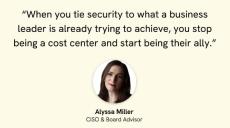
A CISO can run a genuinely strong security program and still lose the room the moment they start presenting it to the board. They lead with what they know best: threats, vulnerabilities, mean time to detect, a heat map of likelihood and impact. It’s accurate, but it doesn’t tell the board what any of it means for the business.
|
By Tejas Ranade
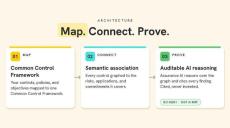
Most GRC platforms claim to use AI. That makes it harder, not easier, to judge the near-identical claims in every demo. Leaders need to know the standards to hold these claims to, what can actually be verified, and how to tell two product pitches apart before letting one of them touch critical controls. It helps to split what you are looking at into two groups: demo-grade AI and enterprise-grade AI. Nearly every GRC vendor now describes itself as the second.
|
By Tejas Ranade
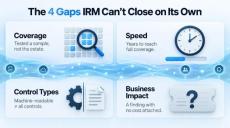
A buyer’s checklist for the IRM gaps a ServiceNow program leaves open. Many teams deploy IRM, watch the assessments come back clean quarter after quarter, and reasonably conclude they are covered. Months later, the greatest risk turns out to have been outside the sample. It may have changed the week after the review, or lived in a control type nobody tested, or lacked context or prioritization to see its importance.

|
By Richa Tiwari
GRC transformation is the organizational change from running governance, risk, and compliance as periodic, check-the-box paperwork to running it as continuous, AI-native cyber risk assurance measured in business outcomes. It is not a tooling upgrade. It is a change in what you are asked to prove. The old question was whether the work got done by audit time. The new question is whether risk is understood and the controls meant to manage it are working right now.

|
By Sravish Sridhar
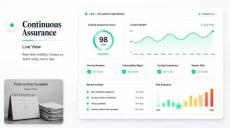
“Friends don’t send friends security questionnaires. “If you hang around me long enough, you will hear me say it. It gets a laugh, but the point underneath it is serious. Are security questionnaires enough to manage third-party risk? No. A questionnaire tells you what a vendor is willing to claim on a given day. It does not tell you whether the control behind that claim is working. Those are two very different things, and most third-party risk programs are still built on the first one.
|
By Tejas Ranade
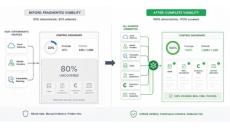
Enterprise security teams need to secure a risk surface that is constantly changing. However, the tools in their stack were built to check only a fraction of that risk. For confirmation, they rely on static snapshots and annual attestations. I now see this as the defining problem in GRC. When 451 Research (S&P Global) initiated coverage of TrustCloud in this space, they described a clear and growing divide.
|
By Abheer Bipin
Enterprises settled the question:“is my software actually working” about a decade ago. Not by hiring more people to read logs, but by instrumenting the data plane once and letting anyone query it. Observability became infrastructure, and the people who used to read logs went and solved harder problems. GRC has never had that moment. We still read the logs, opine, and complete the attestation. And then it stops. The demo proved the concept and became the ceiling.
|
By Tejas Ranade
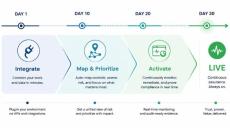
Continuous control monitoring may sound like a program you have to rebuild your whole GRC function to reach. It isn’t. It’s a phased build that integrates with the systems you already run, and a focused team can have continuous monitoring live across its priority controls in about a month.

|
By Sravish Sridhar
If your board asked today how you are governing AI, how would you respond? Not just the policy you wrote, but what is actually happening across the business. Could you answer with evidence? Many CISOs cannot answer with certainty. AI has entered the business faster than anyone could write policy for it, and securing it across all areas now seems to be the CISO’s responsibility.
|
By TrustCloud
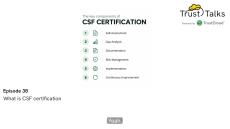
Organizations across industries are constantly challenged to protect their sensitive information and manage potential risks effectively. CSF certification, short for Cybersecurity Framework certification, has emerged as a significant marker of an organization’s readiness to face cybersecurity challenges while ensuring compliance with industry standards. In this podcast, we explain what CSF certification is, examine its origins and benefits, and offer insights into how organizations can achieve and maintain this critical certification.
|
By TrustCloud
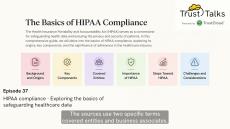
With digital health records and telemedicine becoming the norm, safeguarding patient information is more critical than ever. The Health Insurance Portability and Accountability Act (HIPAA), enacted in 1996, serves as the cornerstone of healthcare data protection in the United States. Designed to ensure the confidentiality, integrity, and availability of Protected Health Information (PHI), HIPAA sets national standards for healthcare providers, insurers, and their partners. Compliance with HIPAA not only mitigates legal and financial risks but also fosters trust between healthcare organizations and patients.

|
By TrustCloud
Becoming the board-ready CISO: Alyssa Miller on what boards actually want from security, and a three-part framework any CISO can use to align security with business objectives. CISO and Board Advisor Alyssa Miller joins TrustCloud CEO Sravish Sridhar to challenge the idea that “security first” is the right frame, and to lay out how strategic CISOs report to the board: mapping security to business objectives and KPIs, focusing on the few resilience goals that matter, and making the case for new investments like AI as business value, not just risk.

|
By TrustCloud
CISOs struggle with third-party risk assessments. Automate third-party assessments and eliminate mundane tasks. Use AI and API driven automation to accelerate and simplify first-party, third-party, and nth-party risk assessments. Automate document analysis and receive contextual, reliable information. Run frequent, programmatic risk assessments on all your internal and third-party applications to eradicate the risk of one-time or point-in-time evaluations.

|
By TrustCloud
CISOs struggle with risk assessment. Reduce risk and financial liability with TrustCloud. Take your risk register from manual spreadsheets to programmatic, predictive risk assessments. Monitor and forecast your risks in real time, enable IT risk quantification to prove financial impact to the board, and prevent risk instead of managing it.

|
By TrustCloud
CISOs struggle with security questionnaires. Make security reviews the quickest part of closing a deal with TrustCloud. TrustCloud offers a Trust portal and AI to complete security questionnaires, rolled into one. Don’t let security reviews slow down sales (or take over your life). TrustShare’s secure, public-facing portal invites prospects to view compliance reports and complete security reviews on their own. If there’s a questionnaire, TrustShare pre-fills up to 85%, using information from prior questionnaires and artifacts in your security program.

|
By TrustCloud
Join Lori Kevin, VP, Security & Compliance at IMO Health, and Sravish Sridhar, CEO at TrustCloud, in this new episode to learn how CISOs and security leaders can drive real, positive change within the organization by building a security culture that everyone values.

|
By TrustCloud
How to build a Customer Assurance and Continuous Control Monitoring Program that earns customer trust. Join us for a practical and insightful conversation on how transparent security and compliance posture sharing , high-confidence AI-assisted security questionnaire completion, and continuous control monitoring (CCM) translate directly into customer assurance, revenue acceleration, faster sales cycles, and higher buyer confidence.

|
By TrustCloud
A candid, practical session for CISOs and security leaders who need to map security to business priorities and show the ROI of their programs. What you’ll learn: A board-ready strategy that ties security to growth. How to present a four-row “business impact” view that shows contributions to revenue acceleration, product expansion, board protection, and culture, on a single timeline. The first 90 days set you up for the next 3 years. Map to business objectives from day one, educate on the “why”, not just the “what,” and listen so you can pivot with the business.

|
By TrustCloud
Akshay sits down with Paola to discuss Third-party risk management. Third-party risk isn’t just a security checkbox anymore, it’s becoming one of the most dynamic and high-stakes areas of enterprise risk. In this episode, we unpack where third-party risk management is headed: from static spreadsheets to real-time monitoring, from annual audits to AI-driven insights, and from compliance pressure to competitive advantage.
- October 2026 (6)
- September 2026 (3)
- August 2026 (4)
- July 2026 (6)
- June 2026 (5)
- May 2026 (5)
- April 2026 (11)
- March 2026 (6)
- February 2026 (4)
- January 2026 (6)
- December 2025 (5)
- November 2025 (12)
- October 2025 (23)
- September 2025 (11)
- August 2025 (16)
- July 2025 (19)
- June 2025 (23)
- May 2025 (9)
- April 2025 (10)
- March 2025 (7)
- February 2025 (8)
- January 2025 (6)
- December 2024 (9)
- November 2024 (11)
- October 2024 (1)
- September 2024 (5)
- August 2024 (2)
- July 2024 (1)
- June 2024 (8)
- May 2024 (6)
- April 2024 (4)
- March 2024 (2)
- February 2024 (4)
- January 2024 (5)
- December 2023 (2)
- November 2023 (5)
- October 2023 (6)
- September 2023 (10)
- August 2023 (10)
- July 2023 (10)
- June 2023 (9)
- May 2023 (12)
- April 2023 (9)
- March 2023 (8)
- February 2023 (4)
- January 2023 (4)
- December 2022 (6)
- October 2022 (7)
- September 2022 (1)
- August 2022 (2)
- July 2022 (5)
- June 2022 (2)
- May 2022 (3)
- April 2022 (2)
Accelerate revenue and earn trust with a unified, joyful compliance platform.
TrustCloud makes it effortless to respond to security questionnaires, confidently share your security and compliance program with customers, and complete compliance certifications by automating your program with APIs, using AI to reduce manual work, and testing your controls and policies to achieve continuous compliance and earn trust.
A single platform for security, sales, marketing & HR teams:
- Programmatic security & privacy programs: Tell us about your product and business stack, and we'll generate customized controls, tests, policies, and other compliance artifacts that are easy to adopt and understand. With automation to collect evidence and a common controls framework, you can easily meet requirements to multiple standards simultaneously.
- AI-powered security questionnaires: We use machine-learning and natural language processing to populate accurate answers from previous questionnaires, and controls and policies in your Trust Cloud. Complete security questionnaires quickly, without manual updates and endless back-and forth, to better support sales and win business.
- Effortlessly achieve and maintain compliance: We analyze your compliance program, map it to multiple standards, generate API-based automated tests and easy-to-understand tasks, and prioritize them to effortlessly achieve audit-readiness. Work with your auditor or an auditor in our network to quickly, cost-effectively, and successfully complete your audits.
- Be proactive and truthful with customers: We auto-generate an elegant, branded, comprehensive portal to promote your trust and compliance program with your customers. Differentiate your business from your competitors by showing your customers that you are serious about honoring your security, privacy, and trust obligations.
Trust management for your entire team.