Security | Threat Detection | Cyberattacks | DevSecOps | Compliance

Introducing Adaptive Intelligence: Undermining the economics of every bot attack

Modern bot threats are increasingly driven by determined, sophisticated attackers. Often it is not even one person, but a group trading techniques with each other or a commercial service sold to anyone willing to pay. For many of them, getting past bot detection is a full-time job they genuinely enjoy. Block them and they get to work, finding a workaround. AI has simplified this further, making it even easier to set up complex configurations for attackers, lowering the overhead of an attack.

What Is Prompt Injection, Really? Why the Textbook Answer Cannot Tell You If You Have an Incident

Prompt injection is three things happening at once. The definition written in 2022 described a model that followed an instruction hidden in the text it was asked to translate. The definition needed in 2026 describes an agent that read a support ticket and then queried a customer table it had never touched, using a service account nobody had revoked. Those are the same attack.

Prompt Injection Examples: 10 Real Attacks, and Which Ones Would Work on Your Agent

Prompt injection has not changed since 2022. What the model can do has. The instruction that hijacked a translation bot four years ago and the one that opened a homeowner’s windows last year are the same request: do something you are already allowed to do. The first system could only talk. The second could operate devices. Same sentence, different consequence. Here are ten real attacks, in order, and for each one the thing the system was allowed to do that made it work.

How to Protect Digital Ministries in the Age of Cloud Computing

Church ministry no longer stops at the sanctuary door. Livestreams, online giving, prayer forms, volunteer platforms, email systems, and social channels now carry much of the weekly work. That reach is certainly important. But still, every new account creates another place where credentials, personal records, or payment information can slip into the wrong hands. Churches often manage this digital estate with small teams, rotating volunteers, and limited technical oversight.

Why unmanaged RDP is risky at enterprise scale (and how to regain control)

Remote Desktop Protocol (RDP) is the path of least resistance for gaining access to another Windows machine. It is built into the OS, it is free, and almost every admin and help desk technician already knows how to fire up mstsc.exe and type in a hostname-as simple as that. That convenience is exactly why RDP is everywhere inside corporate networks.

New Phishing Kit Gives Threat Actors Live View Into Attacks

A new phishing platform called “JWR” gives attackers real-time control over social engineering attacks, according to researchers at Cisco Talos. The kit livestreams the phishing page to the attacker as the victim is entering information, allowing the attacker to steer the victim’s experience and maximize the damage.

Voice Phishing Attacks Target Hedge Fund Employees

Google’s Threat Intelligence Group (GTIG) is tracking a voice phishing (vishing) campaign that’s targeting hedge funds and financial firms. The researchers attribute the attacks to “UNC6671,” an extortion group formerly known as “BlackFile.” The attackers pose as IT staff informing employees of urgent, mandatory migrations.

Attackers Use Vishing Attacks to Distribute New Android Malware

Attackers are distributing a new Android malware called “WindRelay” via phone-based social engineering attacks, according to researchers at Group-IB. The attackers call the victims, impersonating bank employees and instruct them to install a malicious app. In one instance observed by Group-IB, the scammers carried out the entire attack in just thirteen minutes.

What is DLL hijacking, and why your new AI plugin might be the easiest way in

DLL hijacking is a decades-old Windows vulnerability class (Mitre Att@ck T1574) getting new life from AI plugins bolted onto legacy desktop apps. Attackers plant a malicious DLL where a vulnerable app will load it instead of the real one, inheriting that app's privileges. To detect it, watch for DLLs loaded by name from writable folders. To prevent it, you have to fix the app's load-order logic or blocking untrusted DLLs at the endpoint.

Steps to Recover from Ransomware Attacks Efficiently

A ransomware attack can stop business operations in a very short time. Files may become locked, systems may go offline, and employees may lose access to important tools. In some cases, attackers may also steal data before blocking access to it. Recovering from ransomware takes more than simply restarting computers. Businesses need a clear plan for containment, investigation, data recovery, system repair, and future protection. A rushed response may make the damage worse or allow attackers to return.
Featured Post

How Geopolitics is Driving Modern Cybercrime

Ransomware attacks no longer rely on traditional encryption methods. With today's advanced technology, threat actors are developing 'encryption-less extortion', focusing solely on data exfiltration and the threat of leaking or selling stolen sensitive information. Often used as part of double and even triple extortion strategies, ransomware has now evolved into a fragmented, competitive, and increasingly strategic threat landscape that employs divergent attack strategies, laser-focused on high-value targets.

Donation Forms Attract Card Testing Attacks

A charity notices something odd in its payment dashboard. Hundreds of one dollar donations attempted overnight. Almost all declined. A handful approved. Nobody donated anything. The organization was being used as a validation service. Donation forms have become a preferred target for card testing, and the reasons are structural rather than accidental. Here is how the attack works, why nonprofit payment pages are disproportionately attractive, and what actually stops it.

Living Off the Land Attacks: Detection and Response Guide

The most popular advice about living off the land attacks is also the least useful when it stands alone: hunt for suspicious PowerShell, block LOLBins, and alert whenever a signed Microsoft binary behaves unexpectedly. Those controls have value, but they don't solve the operational problem. PowerShell, WMI, certutil.exe, and bitsadmin.exe are legitimate administrative utilities, and attackers abuse them precisely because security teams can't remove them without disrupting normal work.

AI Isn't Creating New Cyberattacks. It's Changing How They Operate

Artificial Intelligence has quickly become one of the most important conversations in cybersecurity. Much of that conversation focuses on what attackers might create next: AI-generated malware, deepfakes, autonomous attacks, or entirely new categories of threats. Those risks matter, but focusing only on new attack techniques misses a much larger transformation already taking place. The real impact of AI is not only what attackers can create. It is how efficiently they can operate.

Anatomy of an Agent Tesla BEC Attack: From Inbox to In-Memory Infostealer

Phishing is a form of social engineering that has evolved beyond simple lures into complex, multi-stage attacks exploiting trusted software, cloud identities and business platforms to bypass traditional security. Attackers leverage these campaigns to deliver trojans capable of stealing credentials and also establishing remote code execution, which might serve as a gateway for lateral movement.

Report: One-Quarter of Breaches Are Enabled by AI-Driven Attacks

A new report commissioned by IBM has found that one in four breaches is now AI-enabled, up 56% from last year. “Most AI-driven attacks reported in the study targeted critical infrastructure sectors (62%), with financial services and energy organizations experiencing the highest concentration, raising the risk of broader systemic disruption,” the report says. “Financial services breaches were reported to cost on average $6.3 million, while energy breaches cost on average $5.2 million.

A revisit of remote Spectre attacks on Cloudflare Workers

In 2021, we assessed remote Spectre attacks against Cloudflare Workers. Based on the results, we shipped a production defense called Dynamic Process Isolation (DyPrIs), which identifies maliciously looking scripts and isolates them into separate processes. Since then, newer techniques in the area of stabilizing Spectre attacks have been discovered. To understand if these techniques posed a threat to our Workers production environment, we decided to internally reassess the remote Spectre attack.

What To Know About the US Water Cyber Attacks

In late July 2026, over 30 municipal water systems across Minnesota were targeted in coordinated cyber attacks that disrupted the Operational Technology (OT) used to remotely monitor and control water equipment. The attacks initially unfolded on July 26 and 27, striking multiple automated control systems across the state, including those in Plymouth, Braham and South St. Paul.

Developer secrets management that keeps delivery moving

In March 2025, attackers compromised a GitHub Action used in the development pipelines of more than 23,000 repositories. The malicious code exposed API keys, cloud credentials, SSH keys, and other tokens in workflow logs. Affected teams were advised to review their workflow runs and rotate any credentials the logs exposed.

Cloudflare DDoS Threat Report H1 2026: 1 Tbps attacks soar as DNS floods and geopolitical tensions drive a new wave

Welcome to the 25th edition of Cloudflare's DDoS Threat Report. This is the first half-year edition in the series: rather than publishing separate reports for the first and second quarters of 2026, we have combined our coverage of Q1 and Q2 into a single volume covering January through June 2026.

The Invisible Expansion of the Attack Surface: Shadow AI, MCP, and Third-Party Risk

AI adoption is moving faster than most of us anticipated and, more importantly, faster than most organizations can govern it. Organizations are implementing the use of AI-enabled applications, browser extensions, coding assistants, and automated agents to enable employees to work faster. In many cases, these tools are adopted without security review, procurement approval, or a clear understanding of where organizational data is being sent.

Mythos: When Al becomes the attacker, the network becomes the first line of defense.

Cyber defense in the age of Mythos Advanced AI has fundamentally shifted the security landscape, shrinking the window for vulnerability exploitation from weeks to hours. When standard patching workflows can't keep pace, your network becomes your most critical line of defense. In this video, we explore how Corelight transforms network traffic into actionable security insights to power your SOC. The best data drives the best defense. Discover how to improve your SOC outcomes by up to 300% over legacy data.

Active Supply Chain Attack on npm Packages (keyv, cacheable): Immediate Mitigation Required

A sophisticated supply chain attack has actively compromised multiple npm packages, including keyv, cacheable, cacheable-request, flat-cache, file-entry-cache, and possible related adapters. Attackers took control of a popular maintainer’s npm account on or before August 4, 2026, and began publishing trojanized package versions containing a preinstall hook (setup.mjs) as a loader.

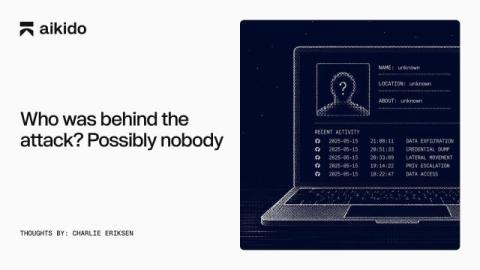
Who was behind the attack? Possibly nobody

The fever dream continues, and I'm not even in Vegas for Hacker Summer Camp. Last week I wrote about Anthropic disclosing that one of their models published live malware to PyPI while believing it was inside a simulation. I was running a fever when I read the report. The metaphor was too good: a model that couldn't tell simulation from reality, covered by a writer who wasn't sure which way was up. I thought that was a one-week story. Very naive of me to have so much faith, I know.

Your Scanners See a Different Internet Than Your Users Do

A few years ago, cloaking was mostly a black hat SEO problem. Someone would serve one version of a page to Googlebot and another to human visitors, and the worst outcome was a spammy search result. It has since become one of the more effective evasion techniques in the phishing and malvertising toolkit, and most security teams are still measuring their external exposure from a vantage point that attackers stopped caring about some time ago.

How Geo-Targeted Attacks Evade Detection

The era of spray-and-pray cyberattacks is effectively over. Modern threat actors do not launch global, noisy campaigns. They launch highly localized, surgical strikes. They analyze regional vulnerabilities. They deploy localized phishing lures. Most importantly, they perfectly mimic local network traffic. When an attack originates from an IP address that your security perimeter explicitly trusts, traditional alarms stay silent. This is the core danger of geo-targeted evasion.