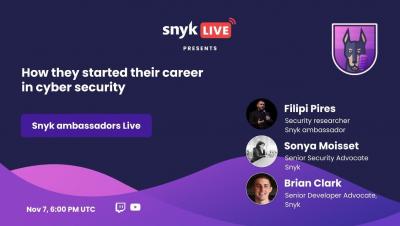
How They Started in Cybersecurity - Snyk Ambassadors Show
Join Snyk ambassador Filipi Pires, Sonya Moisset and Brian Clark as they discuss how they started in cybersecurity, talk about their inspirations and mentors, useful tools, etc...


On November 1st 2022, the OpenSSL team released an advisory detailing two high severity vulnerabilities — CVE-2022-3602 and CVE-2022-3786. This was pre-announced as a critical bug, but later downgraded to high for the actual release. This could still be problematic though, OpenSSL is one of the predominant encryption libraries and is underpinning a significant portion of the internet’s TLS protected communications.
As available software on the market increases, so do vulnerabilities. When a company's system is weak due to vulnerabilities in the software it uses, attackers take advantage of the situation to: This, in turn, causes the company to lose customers, reputation and money. To reduce threats, network personnel and system administrators are always on the front line, constantly patching the organization's software and operating systems. But to what end?
Everything on the internet has a Uniform Resource Locator (URL) that uniquely identifies it — allowing Internet users to gain access to files and other media. For instance, this article has a unique URL that helps search engine optimization (SEO) crawlers index it for users to find. The first definition of the URL syntax is in the 1994 Request for Comments (RFC) 1738. Since then, the structure of URLs has gone through many revisions to improve their security.
The OpenSSL project has announced two security vulnerabilities tracked as CVE-2022-3602 and CVE-2022-3786. The good news is that these vulnerabilities are unlikely to facilitate remote code execution as originally anticipated, and only OpenSSL version 3.0.0 and later are impacted. The bad news, however, is that even though the remote control is unlikely, it’s still possible.
Security policies are still awaiting digital transformation. A key phrase in today’s cloud-driven world, “digital transformation” generally refers to the ongoing work of digitizing formerly paper-based processes. “Paper,” however, is not literal — many processes don’t use paper, but still flow as if they were. Uploading a document to Google Drive, in other words, doesn’t amount to digital transformation.
On October 25th, The OpenSSL team announced that OpenSSL 3.0.7 will contain a fix for a critical severity vulnerability that affects OpenSSL 3.x. The full details about the vulnerability were held in an embargo until November 1st. Due to the rarity of an OpenSSL critical-severity issue and the overwhelming popularity of OpenSSL, social media was flooded with messages about this issue, expecting a “Log4Shell”-level event.