Security | Threat Detection | Cyberattacks | DevSecOps | Compliance

When Defense becomes Dialogue: The Problem with LLM Security

For about thirty years, security has rested on the assumption that the measures guarding your systems do not have opinions. A firewall does not care how politely you ask it to open a port. An SQL filter does not weigh the context of a query before deciding whether to pass it through. An authentication check does not get distracted or talked round. You either present the right credential or you do not, and the answer is the same every time you ask.

CVE-2026-23918: Apache HTTP/2 Double-Free Vulnerability with Possible RCE

A high-severity double-free vulnerability in Apache HTTP Server 2.4.66 allows low-privileged attackers to remotely crash vulnerable servers through a crafted HTTP/2 request sequence, with a demonstrated path to remote code execution on common Linux deployments. Tracked as CVE-2026-23918, the vulnerability exists in Apache’s mod_http2 module and affects deployments using multi-threaded MPMs such as worker and event.

The Hidden Security Risks of Mobile Workforce Applications in Field Operations

Mobile workforce applications are a $7+ billion market, forming the backbone of modern field service, but they are also becoming the primary targets of sophisticated cyberattacks. For a field technician, a mobile device is a tool, like a wrench or a multimeter, yet it holds the keys to your entire customer database and internal financial records.

Top tips: How you can shrink the time between a vulnerability and an attack

Top tips is a weekly column where we highlight what’s trending in the tech world and share ways to stay ahead. This week, we’re looking at how the gap between a vulnerability and an attack is shrinking rapidly. A vulnerability is discovered. It could be a small bug, a missed update, or a gap in how a system is configured. It gets reported, documented, and sometimes even publicly disclosed. For a long time, there used to be an extended window between discovery and attack.

Snyk Embeds Anthropic's Claude to Advance AI-Powered Security for Software Development

BOSTON, May 7, 2026 — Snyk, the AI security company, today announced it is leveraging Anthropic's Claude models to advance software security in an era of AI-powered development. Starting today, Snyk has integrated Claude into the Snyk AI Security Platform — powering automated vulnerability discovery, prioritization, and developer-ready fixes across code, dependencies, containers, and AI-generated artifacts. The threat driving that integration is real and accelerating.

CVE-2026-0300 - Critical Buffer Overflow in PAN-OS User-ID Authentication Portal

On May 6, 2026, Palo Alto Networks disclosed a critical buffer overflow vulnerability (CVE-2026-0300) in the User-ID Authentication Portal (Captive Portal) component of PAN-OS. This vulnerability allows an unauthenticated, remote attacker to execute arbitrary code with root privileges on affected PA-Series and VM-Series firewalls by sending specially crafted packets. No user interaction or credentials are required.

How Cloudflare responded to the "Copy Fail" Linux vulnerability

On April 29, 2026, a Linux kernel local privilege escalation vulnerability was publicly disclosed under the name "Copy Fail" (CVE-2026-31431). Cloudflare’s Security and Engineering teams began assessing the vulnerability as soon as it was disclosed. We reviewed the exploit technique, evaluated exposure across our infrastructure, and validated that our existing behavioral detections could identify the exploit pattern within minutes.

CVE-2026-0300: Unauthenticated Root RCE via Buffer Overflow in Palo Alto PAN-OS User-ID Authentication Portal

CVE-2026-0300 is a critical buffer overflow vulnerability in the User-ID Authentication Portal (Captive Portal) of Palo Alto Networks PAN-OS. It allows unauthenticated remote attackers to send specially crafted packets and execute arbitrary code with root privileges on affected PA-Series and VM-Series firewalls. The flaw, actively exploited in the wild since early May 2026, stems from improper handling of input in the authentication portal service.

Breaking the Cycle of Technical Debt with Agentic Exposure Management

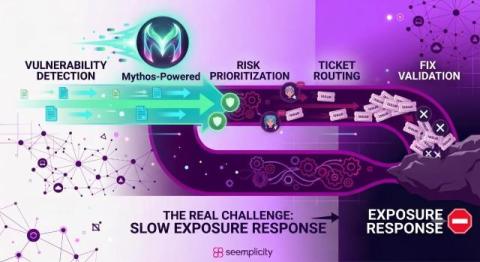
In this video, Rob Babb, Exposure Management Strategist at Seemplicity, shares key insights from a presentation at ISACA Atlanta’s Geek Week regarding breaking the cycle of technical debt through agentic exposure management. The discussion focuses on why standard scoring methods like CVSS are often insufficient on their own for effective vulnerability prioritization.12 Key Topics Covered: For more information on agentic exposure management, visit: seemplicity.ai.

Are You Behind on Patching? | CISA KEV vs. Third-Party KEVs

Are you relying solely on the CISA KEV list for your vulnerability management? You might already be behind. In this video, Rob Babb, Exposure Management Strategist at Seemplicity, discusses why waiting for a vulnerability to appear on the CISA KEV list can leave your organization exposed for weeks. In this video, you’ll learn: It's time to break the cycle of technical debt. Learn more at: seemplicity.ai.