Security | Threat Detection | Cyberattacks | DevSecOps | Compliance

Zero Trust: Execution is now the standard

In January 2026, the National Security Agency released its first Zero Trust Implementation Guidelines (ZIGs). Their aim was to do something prior guidance intentionally avoided: move Zero Trust from architectural alignment to operational execution. That timing matters. Zero Trust has been a framework for years and rightly so. Like a quality standard, it is designed to evolve. The same tools, techniques, and skills shaping modern cyber defense are available to both friend and foe.

How intelligent workflows help MSSPs deliver customer outcomes at scale

For managed security service providers (MSSPs), customer loyalty is the most critical indicator of business health. Unlike other metrics that you directly control, such as mean time to respond or mean time to detect, it can’t be gamed: customers will either stay with you or they’ll churn. This means that the top priority for any MSSP should be to deliver the specific customer outcomes they were hired to provide, like helping to stop threat actors before they cause damage.

Tackling alert fatigue with AI & automation: How MSSPs scale Tier 1 triage

For managed security service providers (MSSPs), alert fatigue doesn’t just burn out your analysts: it’s a real risk to your business. From the financial costs of missed SLAs and security incidents to the customer trust lost when critical alerts are overlooked, alert fatigue negatively impacts customer outcomes, client retention, and your profitability.

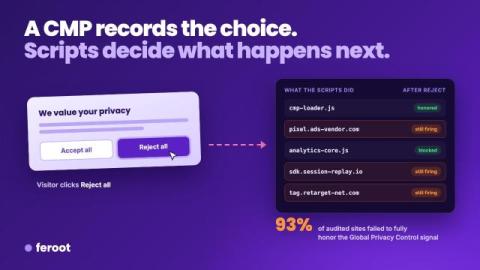
Feroot Launches AI-Powered Digital Consent Audit to Prove CMP Enforcement

Organizations have invested heavily in consent management. Consent Management Platforms (CMPs) are standard infrastructure for privacy programs, and for good reason. Regulations like GDPR, CCPA/CPRA, LGPD, PDPA, and HIPAA require organizations to obtain, record, and honor user consent before collecting or processing personal data. CMPs provide the framework to do that. Most organizations have done the right thing, they just don’t know if they’ve done the right thing right.

Why Security Debt Should Be a Board-Level Priority

Security debt (the accumulation of unresolved vulnerabilities that are over a year old) is no longer just a technical problem. It has become a significant business liability that directly impacts risk, revenue, and reputation. For too long, it has remained a concern siloed within IT departments. That approach is no longer sustainable. It is time to elevate security debt to a board-level key performance indicator (KPI) and tie its reduction to strategic business objectives.

Emerging Threat: Axios npm Supply Chain Attack Drops Remote Access Trojan (RAT)

On March 31, 2026, two malicious versions of axios were published to npm, , using credentials stolen from a lead axios maintainer. The attacker injected a hidden dependency into both releases that drops a remote access trojan (RAT) on any machine that ran npm install during the exposure window. No CVE identifier has been assigned at the time of writing. The malicious dependency executes automatically at install time via a postinstall hook, without any action by the developer.

Accelerating Secure Software Delivery in Southeast Asia: Why the "Surge of Binaries" Demands a Unified Strategy

For years, the conversation around digital transformation in Southeast Asia focused on “getting to the cloud.” Today, that conversation has shifted. Our region is no longer just adopting the cloud; we are leapfrogging traditional development cycles by integrating AI and cloud-native architectures at a staggering pace. However, this acceleration has created a byproduct that many organizations are struggling to contain.

Introducing Programmable Flow Protection: custom DDoS mitigation logic for Magic Transit customers

We're proud to introduce Programmable Flow Protection: a system designed to let Magic Transit customers implement their own custom DDoS mitigation logic and deploy it across Cloudflare’s global network. This enables precise, stateful mitigation for custom and proprietary protocols built on UDP. It is engineered to provide the highest possible level of customization and flexibility to mitigate DDoS attacks of any scale.

AI Integration Security: Why the Biggest Risk Is Not the Model

When people talk about AI security risks, the conversation usually starts with the model. Can it be jailbroken? Can someone get around the guardrails? Can an attacker make it say or do something it should not? Those are fair questions, but they are not the most important ones. The bigger risk is not the model on its own: it’s everything the model is connected to.