


|
By Feroot
If people in California use your website or app, assume CIPA applies. CIPA was written for telephone wiretapping, and courts have applied its "technology-neutral" terms to online communications for years. The business's location does not matter; the visitor's does.

|
By Feroot
If the CCPA covers your business, you must treat an opt-out preference signal as a valid request to opt out of the sale or sharing of personal information. "Sharing" includes disclosures for cross-context behavioral advertising, which is what most advertising pixels do.

|
By Feroot
An AI shopping assistant can recommend a product without being allowed to buy it. An agentic AI system may go further: access an account, select a payment method, interact with a checkout, and initiate a transaction. Each added permission changes the payment-security questions you need to answer. Before adding an agent to a payment journey, draw its boundary. What can it read? What can it change? What can it authorize? What happens when it encounters content controlled by someone else?

|
By Feroot
Before you buy another security tool or remove an existing control, answer one question: how does your website actually present the payment form? For e-commerce merchants completing PCI DSS Self-Assessment Questionnaire A (SAQ A), that architectural detail matters. An embedded payment form, a redirect, and a fully outsourced payment process are different arrangements, with different implications for how the SAQ A script-attack eligibility criterion applies.

|
By Feroot
At the 2026 PCI SSC North America Community Meeting in Vancouver, continuous compliance was a recurring theme: how do organizations move beyond point-in-time validation and keep security controls working as their environments change? For payment-page security, that question is especially practical. Your last assessment captured your environment at a point in time. Since then, a release may have added a checkout dependency. A vendor may have updated its JavaScript. Marketing may have changed a tag.

|
By Feroot
New DXComply release enables privacy, GRC and security teams to verify whether native apps honor user consent choices without SDK integration or code changes. Toronto, Canada, September 23, 2026: Feroot Security Inc. today announced expanded native mobile application consent auditing capabilities in DXComply, enabling enterprises to verify whether iOS and Android apps honor users’ consent choices without requiring SDK integration or changes to application code.
|
By Feroot
Here’s a question I’ve started asking privacy and security leaders in almost every conversation: if I asked you right now to list every script collecting data on your website, could you do it? If I then asked how many of those scripts are overwriting consent preferences, would you know? Most people pause. Some laugh. A few say yes with real confidence. But when we run the audit, the answer is almost always more complicated than they expected.

|
By Feroot
I recently had the opportunity to speak at the ISACA GRC Conference in San Diego about a challenge I see becoming increasingly important for governance, risk, and compliance teams: How do you prove your controls are actually working in digital environments that never stop changing?

|
By Feroot
Ivan Tsarynny, CEO of Feroot Security, joined CNBC’s The Exchange on July 31, 2026 to discuss a string of recent AI model “breakouts”—incidents where AI systems slipped past their own safety guardrails during testing—and what those incidents mean for how governments should regulate artificial intelligence.

|
By Feroot
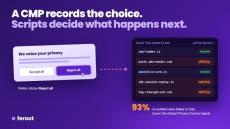
Cookie consent banners have become the public face of GDPR compliance. Nearly every organization operating in Europe has one, and many privacy teams have invested heavily in Consent Management Platforms (CMPs) to capture user preferences and satisfy regulatory requirements. The problem is that a consent banner only asks a question. It doesn’t prove the website honors the answer.

|
By Feroot
Feroot Security Inspector automatically discovers and reports on all JavaScript web assets and their data access. Inspector finds JavaScript security vulnerabilities on the client-side and reports on them, and provides specific client-side threat remediation advice to security teams in real-time. With Inspector, customers are able to conduct constant client-side attack surface management and defense.

|
By Feroot
Feroot Security co-founders, Ivan Tsarynny and Vitaliy Lim, discuss the client-side landscape and why security is needed to protect the front-end.

|
By Feroot
Head of Application Security at The Motley Fool, Paolo del Mundo, shares his experience with Feroot's Inspector and how it has increased visibility into their client-side attack surface.

|
By Feroot
Client-side security is important today because of the increase in attacks against individuals using the web to access services that require the sharing of sensitive and personally identifiable information (PII). Feroot enables proactive client-side security programs to protect the customer journey. Our products are designed to significantly diminish a threat actor’s ability to breach customer data or damage websites via client-side attacks. We help cybersecurity and application security professionals guard the customer experience.

|
By Feroot
Empower your business with client-side security. Arm your application developers, security professionals, and privacy professionals with reliable client-side security technologies to develop secure JavaScript applications, stop client-side cyberattacks, and ensure compliance with global privacy regulations. Learn more about Feroot Security and what we can do to help you secure your client-side attack surface!

|
By Feroot
See Feroot Security Inspector in action. Learn how you can deploy client-side JavaScript security monitoring to detect Magecart, e-skimming, formjacking, JavaScript vulnerabilities, and other threats to your customer-facing web applications.

|
By Feroot
Learn how to protect your client-side web applications and the customer data you collect via your websites. Gain a deep understanding of how to stop skimming breaches by closing gaps in your web application firewalls, content security policies, penetration testing, security testing, and vulnerability scanning coverage. Explore the basics of client-side security and learn how businesses can protect themselves and their customers with automated tools, monitoring, and controls to stop threats, all while safeguarding customer data.

|
By Feroot
In a world in which commerce, business, and information are driven almost exclusively by the internet, protecting both consumers and data is critical.

|
By Feroot
Learn how client-side web security programs use Feroot Security to align with cybersecurity frameworks.

|
By Feroot
Learn everything you need to know about client-side security to protect JavaScript web applications and customer data. Discover how to secure your business so that it may succeed in today's digital economy.

|
By Feroot
Learn how to protect your JavaScript web applications and customer data from cyberthreats. Discover how to secure your webpages and web applications so that your business can thrive. The guide highlights the fundamental risks associated with using JavaScript in an unprotected client-side environment and what web application developers and security professionals can do to better protect their websites and website users.
- October 2026 (5)
- September 2026 (2)
- August 2026 (1)
- July 2026 (1)
- June 2026 (2)
- May 2026 (1)
- April 2026 (1)
- March 2026 (12)
- February 2026 (12)
- January 2026 (11)
- December 2025 (9)
- November 2025 (11)
- October 2025 (14)
- September 2025 (9)
- August 2025 (9)
- July 2025 (14)
- June 2025 (14)
- May 2025 (11)
- April 2025 (12)
- March 2025 (2)
- February 2025 (12)
- January 2025 (6)
- December 2024 (9)
- November 2024 (2)
- October 2024 (1)
- August 2024 (2)
- May 2024 (2)
- March 2024 (1)
- October 2023 (2)
- May 2023 (1)
- April 2023 (5)
- March 2023 (1)
- February 2023 (2)
- January 2023 (1)
- August 2022 (6)
- July 2022 (1)
- June 2022 (6)
- May 2022 (4)
- April 2022 (4)
- March 2022 (9)
- February 2022 (4)
- January 2022 (5)
- December 2021 (1)
- November 2021 (1)
- October 2021 (2)
- September 2021 (2)
- July 2021 (1)
- June 2021 (1)
Secure your JavaScript web applications and webpages with automated security scanning, monitoring, and controls to stop cyber threats and protect customer data.
Arm your application developers, security professionals, and privacy professionals with reliable client-side security technologies to develop secure JavaScript applications, stop client-side cyberattacks, and ensure compliance with global privacy regulations.
Empower your business with client-side security:
- Know your client-side attack surface: Create an inventory of client-side elements and gain a deep understanding of how scripts and applications behave and the data they can access.
- Uncover suspicious behavior: Discover and control client-side web assets. Monitor web application behavior to determine if baseline scripts or applications show runtime or access abnormalities.
- Act on privacy & compliance reports: Gain deep transparency of your client-side asset inventory, tracking, and remediation status’. Track PCI DSS, NIST, CIS Top 20, OWASP Top 10, and MITRE ATT&CK program maturity.
Client-Side Security Made Easy.