Windows 11 Boosts Security: NTLM Out, Kerberos In

Microsoft’s initiative to phase out NTLM authentication in favor of the more secure Kerberos protocol was originally announced back in October 2023. At that time, the Windows maker declared its intention to deprecate NTLM and encourage organizations to transition to Kerberos for authentication purposes across its ecosystem. Microsoft announced this week that later this year they are expecting to retire NTLM authentication in Windows 11.

UpGuard Summit May 2024 (North America)

In this quarter's UpGuard Summit, we’re continuing our focus on scaling your Third-Party Risk Management (TPRM) program. Hear how you can eliminate manual work, harness automation and keep up to date with emerging threats. You’ll also learn how security leaders have evolved their TPRM function and the lessons they’ve learnt along the way. Interested in finding out more about UpGuard?

How Can AI Be Used to Combat Phishing Attacks

Phishing is not going away—it’s morphing and evolving. As an example, in late 2022 the overnight commodification of artificial intelligence (AI) changed the phishing threat landscape forever, lowering the barrier to entry for novice fraudsters who had previously had the motives, but lacked the means to launch sophisticated scams. ChatGPT and fraud-specific Generative AI tools (like the aptly named FraudGPT and WormGPT) granted malefactors the ability to supercharge and scale their operations.

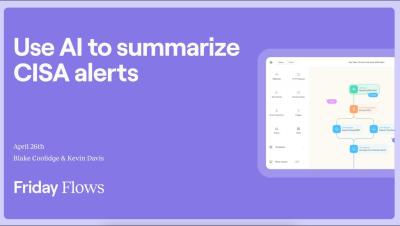
Friday Flows Episode 26: Use AI to Summarize CISA Alerts

In this Friday Flows, Kevin Davis walks through a new story incorporating CISA’s catalog of known exploited vulnerabilities, filters them to identify the most critical ones, and then prioritizes and offers a concise summary for each vulnerability… using our new AI features! There are two main ways Tines has incorporated AI into workflow building: 1) "Automatic Mode" in our Event Transform action and 2) a new AI action.

Four Operational Security Pillars for Building Blockchain Apps

For hackers in 2024, digital assets likely look like a gold mine. Looking back at 2023, many people in the industry celebrated that there were only $1.5 billion of funds stolen due to hacks and security breaches over the course of the year (a smaller number when contrasted with 2022’s jaw-dropping $3.8 billion).

UEBA Superpowers: Simplify Incident Investigations to Increase SOC Efficiency

In an era marked by an increasing volume and sophistication of cyber threats, the efficiency of your SOC operations has become more important than ever. SOCs are flooded by a daily barrage of attacks and alerts, with a significant portion being false positives, leading to alert fatigue and the potential for genuine threats to slip through the cracks.

EPA Alert Warns Nation's Drinking Water at Risk: SecurityScorecard's recommendations for securing critical infrastructure

This week, the U.S. Environmental Protection Agency (EPA) warned that cyberattacks against water utilities across the country are becoming more frequent and more severe. The agency urged water systems to take immediate actions to protect the nation’s drinking water. According to the EPA, there are more than 150,000 public water systems across the U.S. serving over 300 million people—virtually all of which are administered and secured at local levels of government.

Network Security and Application Security: The Power Duo of Cybersecurity

In a world with frequent technological changes, maintaining the trustworthiness and protection of your data and systems should be of paramount importance. With technology constantly evolving for the better, dangers and susceptibility could also make your online security more extraordinary. This is where the issues of network security and application security appear, which may be referred to as two complementary subtopics.

Memcyco Presents: The State of Digital Impersonation Fraud Resilience

Ever had those sleepless nights, tossing and turning, worrying about your next health checkup? Well, in the cyber world, it’s your brand that’s losing sleep! We recently talked to 200 top-notch security and fraud professionals—think of them as the cardiologists of the cybersecurity world. They spilled the beans on how digital impersonation attacks mess with their brand’s health.