
Why PDF-to-Video Conversion Is Becoming Standard Practice in Compliance and Risk Teams
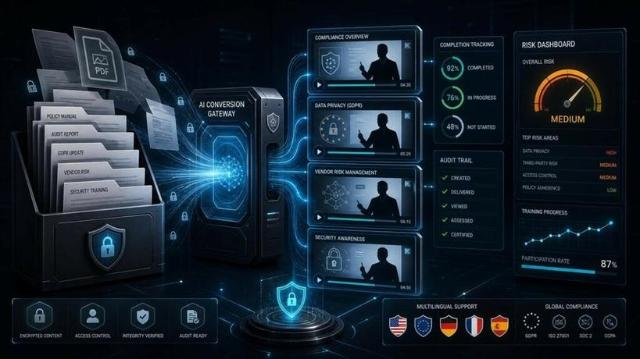
Most compliance documents don't get read. Risk managers and compliance officers know this — the annual policy updates, the security awareness reminders, the regulatory change summaries that go out as PDFs and are opened by 12% of the organization. The people who most need to understand the content are exactly the ones who find dense text formats least accessible.
This isn't a motivation problem. It's a format problem. And PDF to video conversion is one of the more practical solutions that's gained traction in risk and compliance teams over the past two years.
The Readership Problem with PDF-Based Compliance Content
Regulatory content is inherently dense. A 20-page GDPR compliance update or a revised vendor risk assessment policy has to be precise, which often makes it difficult to read. Legal and compliance teams write for defensibility, not engagement. That's appropriate, but it creates a secondary problem: the people who need to act on the policy don't actually absorb it.
The data on this is not subtle. Organizations that have measured policy acknowledgment rates — as opposed to completion clicks — consistently find that comprehension of PDF-distributed policy content is significantly lower than comprehension of the same content delivered in video format. The gap is usually 30 to 40 percentage points.
This has direct consequences for organizational risk:
- Security incidents caused by employee error increase when training comprehension is low
- Audit trails show acknowledgment without evidence of understanding
- Regulatory investigations following incidents frequently uncover that the relevant policy existed but wasn't effectively communicated
The document isn't the problem. The delivery format is.
How PDF-to-Video Conversion Works in Practice
The process is more straightforward than most compliance teams expect. You take an existing PDF — a policy document, a training module, a risk framework summary — and convert it into a narrated video. The resulting video features an AI presenter reading and explaining the content, with on-screen text and visual scene formatting to support comprehension.
The output isn't a screen recording of someone scrolling through a PDF. It's a structured presentation that takes the existing content and packages it as a multi-scene video, with each section of the document corresponding to a scene with appropriate visual treatment.
For compliance use cases, a few specific capabilities matter:
Accuracy preservation. The content of the PDF is the content of the video — not a summary or reinterpretation. This is important for regulatory and legal precision. Good PDF-to-video tools render the source text faithfully rather than AI-paraphrasing it.
Audit documentation. Video completion tracking provides better evidence of training delivery than PDF open events. Most compliance learning management systems support video completion analytics, which creates a stronger audit trail.
Multilingual output. If your organization operates across jurisdictions — or if you have a workforce where English is not the primary language for all employees — generating the same compliance content in multiple languages from the same source document is a significant operational advantage. This used to require separate translation and production processes; current AI tools handle it in a single session.
Where This Format Is Being Deployed
Security awareness training. Annual security training is often the weakest link in a compliance program — largely because it's delivered in formats employees can click through without reading. Video completion requires actual time investment, and the format is more resistant to disengaged clicking-through.
Regulatory change communication. When a regulation changes, the people who need to understand the change are often distributed across departments without specialized compliance background. A five-minute video explaining what changed and what it means for their role is more effective than a policy addendum.
Third-party and vendor training. Onboarding vendors and contractors to your security requirements is a persistent compliance challenge. A standard PDF of security requirements has limited effectiveness. A video walkthrough of the same requirements — with a completion tracking link — creates a documented record and meaningfully increases comprehension.
Board and executive briefings. Risk summaries for non-technical audiences. A two-page risk register excerpt may be appropriately precise for the compliance record, but a four-minute video explaining the same risk landscape to the board is dramatically more likely to be engaged with and understood.
Limitations to Be Aware Of
PDF-to-video conversion works best with content that is primarily text-based and structured sequentially. Highly technical documents with embedded tables, complex diagrams, or dense data visualizations may require additional preparation before conversion produces clean output.
The technology is also not suitable for documents that require legal signature — the video is a communication tool, not a replacement for the controlled document itself. The PDF remains the source of record; the video is the delivery mechanism.
Implementation Considerations
Before deploying PDF-to-video for compliance content, check your LMS's support for video completion tracking — specifically whether it generates SCORM-compatible completion events. Most modern platforms do, but it's worth confirming before building a compliance workflow around a format your LMS doesn't track.
Also consider which documents in your library have the lowest acknowledgment-to-comprehension ratios. Start with those. The return on converting a policy document nobody reads is higher than converting a policy employees were already engaging with.