How to secure your cloud credentials against AndroxGh0st

On January 16, the U.S. Cybersecurity and Infrastructure Security Agency (CISA) and the Federal Bureau of Investigation (FBI) sent out a Cybersecurity Advisory (CSA) about active threat actors deploying the AndroxGh0st malware. This is significant as cyber criminals are actively using this malware to target Laravel (CVE-2018-15133) (an open source PHP framework).env files and obtain credentials for various high profile applications like Office365, SendGrid, and Twilio.

Trustwave SpiderLabs Uncovers Ov3r_Stealer Malware Spread via Phishing and Facebook Advertising

During an Advanced Continual Threat Hunt (ACTH) investigation that took place in early December 2023, Trustwave SpiderLabs discovered Ov3r_Stealer, an infostealer distributed using Facebook advertising and phishing emails. SpiderLabs’ “Facebook Advertising Spreads Novel Malware Variant,” is an in-depth dive into Ov3r_Stealer, exposing what the Threat Hunt team learned about the threat actors, their techniques, tactics, and procedures and how the malware functions.

Balancing Data Privacy, Regulations and Revenue in Telecom

The need to find the balance between providing a unique and tailored customer experience, ensuring data privacy, and adhering to market regulations has become more critical than ever for Communications Service Providers (CSPs). In a world where customers are more demanding, regulations are more stringent, and attacks are more sophisticated, it’s easy to see how telecom organisations deem balancing act challenging.

Leaky Vessels deep dive: Escaping from Docker one syscall at a time

The Snyk Security Labs team recently embarked on a research project into the Docker engine. During this project, I had the opportunity to perform what is arguably my favorite kind of research using my favorite selection of tools. The research panned out quite successfully, and we identified four high severity vulnerabilities that allow a malicious attacker to break out of a container environment with a controlled Dockerfile under docker build and, in one case, docker run.

Security Bulletin: AnyDesk Production Systems Breach

On February 2nd, 2024, AnyDesk disclosed that their production systems had been compromised and that private code signing keys and source code were stolen, while an unknown number of user accounts had their passwords reset. This is a significant concern, as it would allow a malicious attacker to generate malicious versions of AnyDesk software with compromised code that appears to be legitimate. It is assessed that approximately 18,000 credentials are available for sale on the Dark Web as a result.

Data Subject GDPR Requests: Rights and Requirements

The General Data Protection Regulation (GDPR) is a European Union law that governs how companies may collect and use the personal data of EU residents. It establishes standards that help ensure that this data is not stored, handled or shared in a way that would expose individuals to risk. The law also specifies how organizations must respond in case of a data breach.

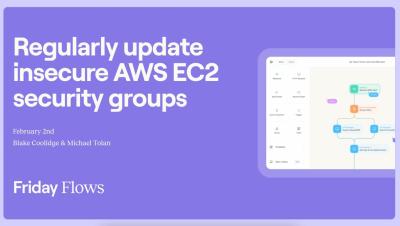
Friday Flows Episode 20: Regularly Update Insecure AWS EC2 Security Groups

Launching an AWS EC2 instance can be done in seconds, but are they being set up securely for success? In today's Friday Flows, Michael Tolan helps us celebrate the 700th Tines Story Library addition with a look at a customer submitted workflow to audit and remediate default security groups for virtual machines in AWS.

EP 45 - OT Security's Digital Makeover

In this episode of Trust Issues, the conversation revolves around the challenges and transformations in operational technology (OT) security. Guest Mike Holcomb, the Fellow of Cybersecurity and the ICS/OT Cybersecurity Lead at Fluor shares insights with host David Puner on securing legacy systems, the impact of generative AI – and the evolving threat landscape.

Another Year of RATs and Trojan Stealer: Detection Commonalities and Summary

In 2023, Remote Access Trojans (RATs) and Trojan Stealers were some of the most prevalent types of malware in the cybersecurity landscape. RATs and Trojan Stealer malware represent significant cybersecurity threats, as they’re often employed to conduct espionage, surveillance, and data theft, which emphasizes the critical need for robust defenses.