Default Permissions in SQL Server Public Role - permission not granted

In an SQL Server, roles act like security groups that control what users can do within the database environment. The roles designate the access groups determining who can access specific databases and what they can do with the data within those databases. The public role is a special database role that everyone is assigned by default when they become a member of a database. By default, the public role has very limited permissions, often no permissions at all.
Never Miss a Critical Alert: Graylog 6.0 Elevates Security Alerting with Pushover Integration

Responding rapidly to cyber threats is a make-or-break capability in today’s high-stakes security environment. A missed alert can quickly escalate a minor incident into a major crisis, jeopardizing your organization’s critical assets and hard-earned reputation. A recent IBM study revealed that companies took an average of 237 days to identify a data breach in 2021 — an inexcusable delay that could invite catastrophic consequences. (Source: IBM Cost of a Data Breach Report 2022)

Getting Started with Microsoft 365 Security and Compliance

In 2022, Microsoft rebranded its compliance and risk management tools under the name Microsoft Purview. Microsoft Purview provides a wealth of valuable functionality, including capabilities formerly provided by tools like Office 365 Security and Compliance, Microsoft 365 Security Center and Microsoft Compliance Manager.

The Vital Role of Car Accident Lawyers

The situation in the wake of a car crash is overwhelming and disorienting. The shock of the accident and possible injuries, coupled with the labyrinthine nature of insurance claims, blankets the entirety of the situation in bleakness. However, this is where lawyers specializing in car accidents make their grand entrance. Their help is beyond valuable, working to ensure that victims are rightly served with justice and due compensation.

Platformization in cybersecurity: Dueling visions for the future of security

The platform approach in cybersecurity is gaining traction. However, it’s becoming clear that two very different models of platformization are in play. In this piece, we’ll talk about platformization in cybersecurity, the two major approaches to security platforms, and what it all means for the future of cybersecurity.

Quick Guide to Popular AI Licenses

Only about 35 percent of the models on Hugging Face bear any license at all. Of those that do, roughly 60 percent fall under traditional open source licenses. But while the majority of licensed AI models may be open source, some very large projects–including Midjourney, BLOOM, and LLaMa—fall under that remaining 40 percent category. So let’s take a look at some of the top AI model licenses on Hugging Face, including the most popular open source and not-so-open source licenses.

LNK or Swim: Analysis & Simulation of Recent LNK Phishing

LNK (shortcut) files are a common starting point for many phishing campaigns. Threat actors abuse the unique properties of LNK files to deceive users and evade detection and prevention countermeasures, making them potent tools for compromising systems and networks. In this blog, we'll provide an in-depth analysis of recent LNK phishing campaigns, examining the tactics, techniques, and procedures (TTPs) employed by threat actors.

Get to Know MXDR: A Managed Detection and Response Service for Microsoft Security

The Microsoft 365 E5 license gives users entitlements to numerous Microsoft Security products—so many, in fact, that as companies deploy the Microsoft Security suite, they may need a managed detection and response (MDR) service to get the most out of it. Enter Trustwave Managed Extended Detection and Response (MXDR) for Microsoft, an MDR service built specifically for Microsoft Security customers.

Reduce False Alerts - Automatically!

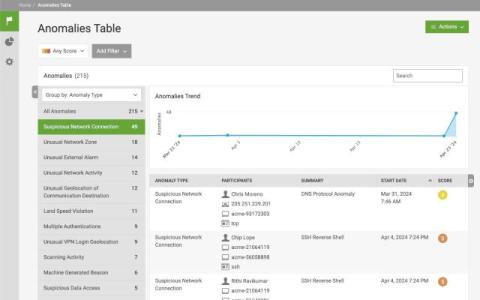
Analysts rely on User and Entity Behavior Analytics (UEBA) tools to track anomalies, investigate incidents, and respond to cybersecurity threats. However, the varying nature of user and entity behaviors across different organizations means that predetermined thresholds often fail to account for unique baselines. Even within the same environment, temporal variations can cause significant differences in monitoring signals.