Security | Threat Detection | Cyberattacks | DevSecOps | Compliance

The Role of AI Security Agents in Modern Exposure Management

AI security agents are reshaping how organizations manage exposure. This blog explores where they deliver the most impact — from smarter prioritization to faster ownership mapping and assisted remediation — and how this shift moves security teams from automation to autonomy.

Build SOAR Workflows Instantly with Charlotte AI

With Charlotte AI and Falcon NextGen SIEM, build SOAR workflows instantly from natural language. Create reliable, intelligent automation that helps SOC teams respond at machine speed. CrowdStrike Falcon Next-Gen SIEM: Consolidate security operations with the world’s most complete AI-native SOC platform.

How Insurity and Reach Built a Living Zero Trust Model - with Jay Wilson & Garrett Hamilton

Would you rather run a network where everyone trusts everything, or one where nothing moves without being continuously verified? Most would agree that the most secure is ideal. The real question is: how do you get there, and by what means? And where is "there"? That’s the spectrum of Zero Trust maturity most organizations find themselves navigating—from implicit trust and flat networks to real-time validation and least-privilege access that adjusts as environments change.

How MSSPs can automate their way to full-spectrum security

The end of October is here, which means it is time to ask: What have you, as a managed service provider (MSP), learned from Cybersecurity Awareness Month? The most critical lesson remains that human behaviour is the single greatest risk and the single greatest opportunity for defence. While no amount of training can eliminate every mistake (which is why we need automation), a security-aware technician acts as the final, critical filter that can spot novel social engineering attacks and enable fast incident response, but only if the back end is hyper-automated, so technicians know about these potential attacks immediately.

From Neural Networks to Threat Networks: How AI Development is Reinventing Security Intelligence

In the digital age, the landscape of cybersecurity is evolving faster than ever. Threat actors are becoming increasingly sophisticated, while traditional security measures struggle to keep pace. Enter Artificial Intelligence (AI)-an innovation that is transforming security intelligence by converting neural networks, traditionally used for pattern recognition, into threat networks capable of predicting, detecting, and mitigating cyberattacks in real time.

What is KeeperAI?

KeeperAITM is an agentic, AI-powered engine embedded within KeeperPAM that delivers real-time threat detection and response, as well as privileged session analysis. Built for Privileged Access Management (PAM), KeeperAI monitors user activity, providing behavioral insights and automated incident response in both live SSH sessions and post-session playback.

Experience Over Hype: How Reach Built AI for Real-World Security

Innovation comes from experience — and from taking a pragmatic, problem-driven approach. As Garrett Hamilton told Ed Amoroso, Reach’s foundation is built on the work of co-founder Colt Blackmore — whose experience building machine-learning models at Cylance and Proofpoint now drives how we apply AI to exposure management today. That experience shapes how Reach approaches AI: practical, proven, and focused on results — not trends.

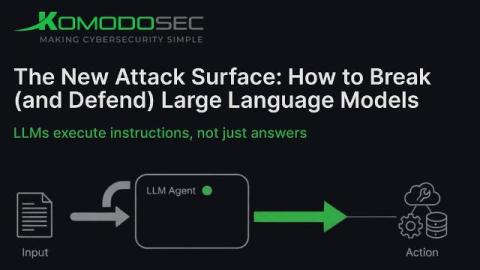
The New Attack Surface: How to Break (and Defend) Large Language Models

Large Language Models now automate customer support, write code, classify emails, generate content, and - disturbingly - execute tasks through plugins and agents. Once an AI can act on your behalf, it becomes part of your operational infrastructure, not a toy. OWASP’s Top-10 for LLM Applications formalized the threat landscape, and quietly confirmed what security researchers have been yelling for two years.