Security | Threat Detection | Cyberattacks | DevSecOps | Compliance

Secure Your App with Mend.io's AI-Native AppSec Platform (featuring ByteGrad)

This video, originally created by Wesley from ByteGrad, walks through how to secure your applications using Mend.io’s AI-Native AppSec Platform — including SAST, SCA, and SBOM scanning. Wesley explores how Mend integrates with GitHub, automates code fixes, and helps developers stay ahead of vulnerabilities. Creator: ByteGrad YouTube Channel Timestamps.


Adopting cold-war tactics for AI deep fakes?

The AI arms race in deepfake detection has a critical problem: the technology can't keep up. In this episode, Navroop Mitter, CEO of ArmorText, discusses why the industry is shifting away from relying on AI detection alone. A recent study from SKKU in South Korea found that zero out of sixteen top deepfake detection technologies could reliably identify deepfakes in real-world conditions. They worked fine in controlled lab settings, but failed when it mattered most.

How Are Cyber Security Companies Managing AI Attacks?

AI attacks pose real risks for companies because of their ability to scale and automate attacks like brute force attacks, smarter malware, deep fakes and advanced phishing. Attacks that were once slow, manual and easy to spot are now becoming faster, more sophisticated and harder to detect. UK government research shows that 32% of UK businesses have experienced a cyber attack in the last year, and experts warn that AI could make this number rise significantly.

Why Every Tech Company is Talking About OWASP for AI (and You Should Too)

AI is changing everything—but with innovation comes new risks. In this episode of AI on the Edge, we dive deep into OWASP's Top 10 for Large Language Models with security leader Steve Wilson (Exabeam). Discover why every tech company is suddenly talking about LLM security and how you can stay ahead. Inside this episode: Why traditional security doesn’t work for AI Learn from Steve’s new book The Developer’s Playbook for LLM Security and get actionable tips to protect your AI systems.

The Critical Inflection Point: Navigating Apex Risks from AI to Stolen Credentials

The global cyber threat landscape has accelerated beyond traditional defense, reaching a critical inflection point. Today, organizations are no longer battling isolated attackers; instead, they are confronting industrialized, financially motivated cyber syndicates that leverage cutting-edge technologies to maximize their impact. Moreover, the rise of AI in Cybersecurity has created both opportunities and threats.

From Model Drift to API Exploitation: The Next Challenge in AI Security

From Model Drift to API Exploitation: The Next Challenge in AI Security In this clip from "Securing AI Part 4: The Rising Threat of Hidden Attacks in Multimodal AI," Diptanshu Purwar and Madhav Aggarwal summarize why external guardrails are the only sustainable defense against the new wave of AI exploitation. Jamison Utter then sets the stage for the next topic in the series: securing the fundamental protocols and APIs that AI agents rely on.

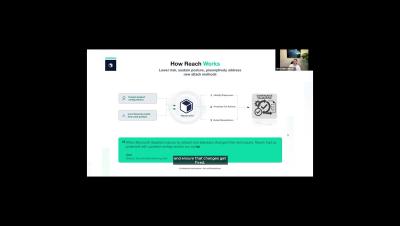
How Reach Security Automates Remediation and Prevents Configuration Drift

From identification to remediation to drift management. When Reach flags an exposure, it doesn’t stop there. It shows exactly how much risk you’ll reduce by fixing it — and what impact it’ll have on users. In this short demo, CRO Jared Phipps walks through how Reach:︎ Quantifies residual risk reduction (e.g., 62%, 91%, etc.)︎ Weighs that against user impact︎ Guides teams through the remediation process︎ Integrates with Jira or other ticketing systems to track fixes︎ Monitors configurations to prevent drift and maintain baselines.

5 Critical LLM Privacy Risks Every Organization Should Know

Large language models take in unstructured data. They transform it into context, embeddings, and answers. That journey touches raw files, vector stores, model logs, and third-party services. Traditional privacy programs focus on databases and forms. LLMs push risk to the edges. The riskiest moments are when you ingest messy content, when your system retrieves chunks to support an answer, and when an agent with tool access is tricked into over-sharing.