Security | Threat Detection | Cyberattacks | DevSecOps | Compliance

How Can Creative AI Tools Help You Design Personalized Security Awareness Posters?

The truth is, the majority of the security awareness poster are forgettable. You may have encountered them: stock image of a pad lock, some bold printed text with a warning about phishing emails, perhaps a stock image of a person staring at his/her laptop in a concerned manner. They also become part of the office walls like a beige paint, and no one really listens to them.
Featured Post

Security's Next Turning Point Is the Workforce

Cybersecurity is entering a turning point. It has less to do with new tools than a new reality: the workforce has changed. For years, security programs assumed risk lived in systems, controls, and configurations. People were the variable managed through policies, training, and best-effort awareness. That model was already under strain. Now it is being outpaced.

Tensorway: Redefining AI Software for Mission-Critical Applications

AI software is no longer limited to experiments, internal tools, or innovation labs. Today, it operates at the core of mission-critical systems - influencing financial decisions, controlling industrial processes, supporting healthcare workflows, and enabling real-time risk assessment. In these environments, failure is not an option, and reliability matters more than novelty.

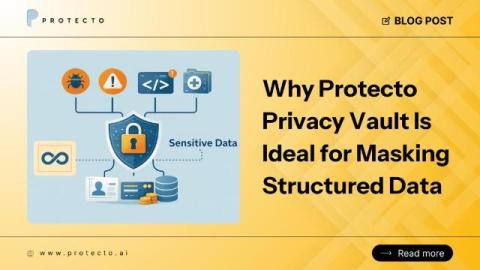
Why Protecto Privacy Vault Is Ideal for Masking Structured Data

Picture this. You’re a data engineer at a healthcare company with millions of patient records in Snowflake. HIPAA requires you to protect PII before sharing data with researchers or running analytics. So you tokenize the data. And your system catches fire. Your joins break. Your ETL pipelines fail. BI dashboards return wrong results. ML model training jobs crash. All because something fundamental changed about your data architecture.

AI Strategy: Building a Future-Proof Framework

Artificial intelligence (AI) adoption is fast becoming a strategic necessity for modern businesses. With adoption continuing at pace, a carefully considered strategy is essential for gaining or maintaining a competitive advantage, managing downside risk and addressing the continued regulatory, legal, ethical and operational complexities presented by AI.

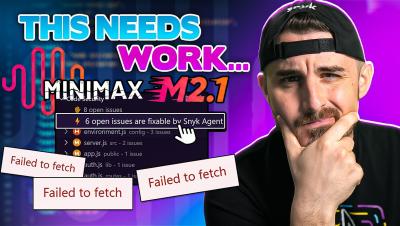
Testing MiniMax M2.1 for AI Coding: The Results Might Surprise You

Can "lesser-known" AI models actually keep up with the giants like Google, OpenAI, and Anthropic? In today’s video, we put MiniMax M2.1 to the ultimate test: building a production-ready, secure Node.js note-taking application from a single prompt. We’ll explore how to access MiniMax natively in the Windsurf IDE, walk through the debugging process for common errors (like environment variables and OS-specific dependencies), and perform a deep-dive security audit using Snyk. Stick around until the end to learn how to integrate MiniMax M2.1 into VS Code using OpenRouter.

Top 3 Skills for AI Security in 2026 #shorts

Are your cybersecurity skills ready for the AI era? In this clip, we reveal which traditional security frameworks still work and the one new mental shift you need to survive. It’s not just about code anymore—it’s about "Socio-Technical" thinking. Raji (Microsoft AI Security) breaks down exactly how to future-proof your career.

Why Vulnerability Management Falls Short - And How Exposure Management Fixes It

Vulnerability management identifies weaknesses. Exposure management helps prioritize them based on real-world risk and context. Ed and Garrett unpack why traditional vulnerability programs struggle to drive real risk reduction. The challenge isn’t discovery. It’s prioritization and follow-through. Too often, vulnerabilities are treated as isolated IT tasks—handed off, tracked by SLAs, and stripped of the context that explains why they matter in the first place.

The Asymmetric Threat: Why AI API Traffic is Hard to Predict

The Asymmetric Threat: Why AI API Traffic is Hard to Predict As AI becomes more integrated into business operations, the way data moves through APIs is changing. In this clip from the A10 Networks webinar, "APIs are the Language of AI: Protecting Them is Critical," experts Jamison Utter and Carlo Alpuerto break down the concept of data asymmetry in AI.

How CEOs are turning AI investment into a competitive advantage

Artificial intelligence has moved quickly from experimentation to expectation. In many organisations, the question is no longer whether to invest, but how to turn investment into advantage that is durable, measurable, and defensible. The early wave of AI activity produced a familiar pattern: plenty of pilots, proofs of concept, and internal demos, but fewer examples of sustained value at scale. In 2025, that gap is narrowing. More leadership teams are treating AI as a core capability rather than a side project, and they are building the structures needed to capture value repeatedly, not just once.