Security | Threat Detection | Cyberattacks | DevSecOps | Compliance

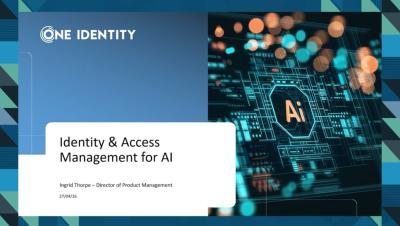
Govern AI agents the right way with Identity Manager by One Identity

AI agents are becoming an inseparable part of identity governance, sometimes being created by other AI agents and acting proactively across platforms at machine speed — but who’s watching them? Identity Manager 10.0 by One Identity answers that question. Hear Ingrid Thorpe, director of product management for Identity Manager, explore how the solution governs agentic workflows, tackles agent-specific risks and integrates across cloud and enterprise platforms, holding non-human identities (NHIs) accountable.
The Authorization Trap: Why Your IAM Controls Don't Cover AI Agent Risk

If there's one idea that shaped RSA 2026, it was identity. Vendor booths, keynotes, conversations. All roads led back to the same instinct: control identity, control access, control risk. That instinct is directionally correct. Identity governance is foundational. But identity answers only part of the question agentic AI is asking. Here's the part it doesn't answer: authorization tells you what an agent was permitted to do. It says nothing about whether what it actually did was appropriate.

AI Agents, Enterprise Scale, No Compromises: Now via AWS

A couple of years ago, AI agent security was a niche conversation. The practitioners who took it seriously were a small group of researchers, a handful of forward-looking CISOs, and a few founders who had watched the attack surface forming in real time. The broader market hadn't caught up yet. It has now. Enterprises are deploying AI agents at scale across platforms. The productivity gains are real. The competitive pressure to adopt is real.

What it took to get 90% of Tines using AI workflows in production

Every conversation I have with CIOs and IT leaders right now starts the same way. They're not short on activity. They've got pilots running, tools deployed, teams experimenting. What they don't have is much to show for it. The data backs it up: 92% of companies are ramping AI investment right now. Only 1% consider themselves mature.

Why AI-era attacks demand deterministic defense

The security industry spent a good chunk of early 2026 debating whether Anthropic’s Mythos and OpenAI’s Daybreak are truly dangerous or just good marketing. It's a reasonable debate. But while we're having it, attackers are asking a different question: how do we use tools like this to move faster than defenders can respond?

Essay Grader AI: The Complete Guide to Saving 80% of Your Grading Time

Teachers spend countless hours every week reviewing student essays, providing feedback, and assigning grades. For many educators, grading has become one of the most time-consuming and mentally exhausting parts of the job. What if you could dramatically reduce that burden while actually improving the quality of feedback your students receive?

When humans are a minority, IAM requires a rethink

In a typical enterprise, non-human identities (NHIs) are thought to outnumber human users by at least 50:1. NHIs are various and include: It is estimated that the NHI: human ratio may have leapt to 144:1 as more AI agents were deployed over the last year. CISOs are already alive to the risks posed by orphaned accounts on their systems. They know that automated rotation is required to revoke privileges as soon as NHIs complete tasks.

OpenAI's Fotis Chantzis on why identity protocols weren't designed for agents

Zero-Shot Learning is a podcast for AI builders, hosted by Nancy Wang, Chief Technology Officer at 1Password, and Dev Tagare, Senior Director and Head of Engineering for Gemini Enterprise & Business at Google. Together, they’ve built and scaled AI systems at the infrastructure and product layers and bring a builder's perspective to every conversation.

Warning: Phishing Attacks Are Abusing the Kuse AI App

Attackers are abusing the storage and sharing features of Kuse, a free AI app, to assist in phishing campaigns, according to researchers at Trend Micro. Kuse is a legitimate agentic AI platform used by employees to streamline workflows. Users can share files with coworkers, which generates a link hosted by Kuse’s domain. In this case, attackers are abusing the share feature to generate legitimate-looking phishing links.