Security | Threat Detection | Cyberattacks | DevSecOps | Compliance

Viberails: Guardrails for AI Operations.

Sr. Technical Content Strategist The recent attention on OpenClaw brought something we've known for a while at LimaCharlie into sharp focus: Unrestricted AI operations are extremely powerful and incredibly risky. The security challenges presented by AI adoption can rival the productivity gains it delivers. Unrestricted AI agents can read credentials, execute commands, send emails, and make API calls without meaningful oversight.


6 Top AI Pentesting Platforms in 2026

AI penetration testing has moved beyond experimentation and into operational reality. What started as automation layered on top of traditional scanners has evolved into platforms capable of simulating attacker behavior, validating exploit paths, and continuously reassessing exposure as environments change.

Agentic AI Security and Regulatory Readiness: A Security-First Framework

AI is getting smarter; instead of just waiting for us to tell it what to do, it's starting to jump in, make its own calls, and get whole jobs done by itself. These independent systems can mess with data, use tools, and talk to people in all sorts of places, often doing things way faster than we can keep an eye on. This means we need a new way to stay safe, one that's all about managing what these AIs do and making sure we can always see what's happening and know who's responsible.

MomentProof Deploys Patented Digital Asset Protection

MomentProof, Inc., a provider of AI-resilient digital asset certification and verification technology, today announced the successful deployment of MomentProof Enterprise for AXA, enabling cryptographically authentic, tamper-proof digital assets for insurance claims processing. MomentProof's patented technology certifies images, video, voice recordings, and associated metadata at the moment of capture, ensuring claims evidence is protected against AI-based manipulation, deepfakes, and other malicious digital alterations.

Automating Cybersecurity Governance: How Bitsight Is Expanding AI-Powered Workflows Across SPM and VRM

Security governance was never meant to be this manual. Yet for most security and third-party risk teams, governance work still means reviewing documents line by line, mapping controls by hand, interpreting evidence subjectively, and repeating the same processes across internal teams, subsidiaries, and vendors. These activities are critical, but they’re also slow, inconsistent, and difficult to scale. At Bitsight, we believe cybersecurity governance should move at the speed of risk.

AI Principles in Practice: Auditability in non-negotiable

When AI acts on your behalf, auditability is non-negotiable. In the latest Principles in Practice video, Anand Srinivas, 1Password VP of Product & AI, explains why every AI agent action involving credentials must leave a clear audit trail: Who approved the access and why When and where were credentials used What did the agent access and when Did access end when the task was completed Without auditability, AI usage can break trust between employees, security teams, customers, and regulators.
Featured Post

Innovation at Speed: Why Machine Identity Security Is Now a Boardroom Priority

CEOs across the manufacturing sector remain optimistic about the potential of digital transformation to boost productivity, efficiency, and competitiveness. Yes - manufacturers face a double bind - innovate fast (and potentially feel pain) or risk falling behind; but every step forward expands the attack surface. This sits alongside a stark reality: the manufacturing sector now suffers 26% of all cyberattacks, making it one of the most targeted industries globally. However, the most significant emerging threat is not always the one that leaders expect.

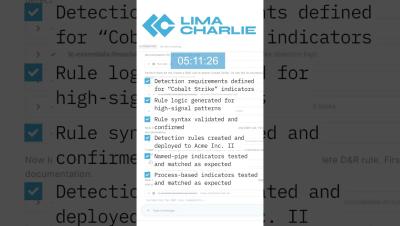
Claude Code writes and tests Cobalt Strike detection rules #cybersecurity #ai #securityoperations

Watch Claude Code generate production-ready Cobalt Strike detection rules in LimaCharlie. The agent defines detection requirements, creates rule logic for high-signal patterns, validates syntax, and deploys rules to the tenant. Named-pipe indicators and process-based signatures are tested against positive and negative controls to confirm accuracy. Security teams can operationalize threat-specific detections in minutes instead of hours.

The AI Blind Spot Debt: The Hidden Cost Killing Your Innovation Strategy

In today’s AI rush, I’ve seen even the most disciplined organizations find it almost impossible to apply the hard-won lessons of DevOps and DevSecOps onto AI adoption. These organizations often feel forced to choose between moving fast and staying in control. As a result, they develop a “wait and see” approach to AI usage and implementation, and it’s creating a new, more dangerous form of technical debt. I call it the AI Blind Spot Debt.