Security | Threat Detection | Cyberattacks | DevSecOps | Compliance

When AI Can Act: Governing OpenClaw

Agentic AI burst into public consciousness this week with talk of Moltbook – a social network designed for AI agents built on OpenClaw (formerly Clawdbot and Moltbot). The resulting conversations about identity, forming a new religion, social engineering humans, and more between bots have sparked alarms everywhere. For IT leaders, one thing is clear: AI crossed a meaningful threshold.


AI agents are forcing a reckoning with identity and control

Most organizations never planned for AI to start making real decisions. They started with simple helpers. An agent answered basic questions or generated small automations so teams could avoid opening another IT ticket. It felt harmless. But as these agents become more capable and more autonomous, they begin operating across systems at machine speed. They connect tools, provision access, and trigger chained actions long after the original request.

Compensating Controls: The Unsung Heroes of Cyber Resilience

Article updated and refreshed February 3rd, 2026. When ideal controls aren’t possible, intentional alternatives help reduce exposure. Most security teams know what the “right” controls look like on paper.But real-world environments rarely match the blueprint. Between legacy systems,limited staffing, and overlapping tools, the gap between what’s ideal and what’s feasible is often wide. That’s where compensating controls come in. They aren’t shortcuts.

Security Control Management: The New Mandate for Risk-Driven Security

Article updated and refreshed February 3rd, 2026. Because the tools you’ve deployed aren’t the same as the ones you’re using. Security teams today aren’t short on tools. Most environments are packed with security controls—spanning email, identity, network, endpoint, and cloud. But despite this abundance, risk remains stubbornly high. Attacks continue to land. Exposure persists. The problem isn’t the absence of controls. It’s the lack of control over the controls.

5 Essential AI Tools for Project Managers to Boost Productivity in 2026

It's 2026, and if you're still manually color-coding spreadsheets or manually typing meeting minutes, you're stuck in the past. We are no longer "task trackers", we're "strategic navigators". But with the release of GPT-5.2 and the deluge of AI agents, it's noisy. I've seen so many PMs download 20 different AI apps and they're all the same: "generating some generic text for you". If you really want to save time, you don't need more writing tools; you need a varied toolkit that takes care of the different parts of your brain: your scheduler, your communicator, your designer, your librarian.

The CISA ChatGPT Incident Makes the Case for AI-Native DLP

The acting director of America's Cybersecurity and Infrastructure Security Agency—the person tasked with defending federal networks against nation-state adversaries—triggered multiple automated security warnings by uploading sensitive government documents to ChatGPT. If this happened at CISA, it can happen at your organization too.

API-Based Zero Trust Assessment: Measuring Your Security Posture in Minutes

Zero Trust (and probably many general posture) conversations stall at one question: Where are we actually today? Because Reach connects directly through APIs, teams can quickly assess their environment without deploying new agents or ripping anything out. That makes it practical to benchmark a Zero Trust program against the CISA Zero Trust Maturity Model — and see what’s real vs. assumed.

The Economics of an Agentic SOC: How AI Reduces Security Operations Costs

See how Torq harnesses AI in your SOC to detect, prioritize, and respond to threats faster. Request a Demo This article was originally published on Security Info Watch. Running a SOC has never been cheap — but in 2026, it’s become unsustainable. The combination of surging alert volumes, rising labor costs, sprawling tool stacks, and skyrocketing breach expenses has pushed the traditional model to the breaking point.

Claude Code configures AWS S3 export for security detections #cybersecurity #ai

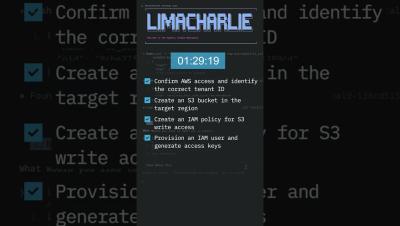
Claude Code automates the entire detection export pipeline from LimaCharlie to AWS S3. The agent confirms AWS access, creates buckets with proper regional placement, provisions IAM policies with appropriate permissions, stores credentials securely, and enables continuous delivery. Security data flows from LimaCharlie to S3 for retention and analysis without manual AWS configuration.