Security | Threat Detection | Cyberattacks | DevSecOps | Compliance

One Identity Appoints Michael Henricks as Chief Financial and Operating Officer

One Identity, a trusted leader in identity security, today announced the appointment of Michael Henricks as Chief Financial and Operating Officer. This decision reflects the continued growth of the business and a focus on aligning financial leadership with operational objectives as One Identity scales.

Identity is the foundation of effective visibility and control. #identitysecurity #netwrix

Identity is the foundation of effective visibility and control. In Voices of Cyber Asia, we explore how identity-driven insights improve access management and support compliance. Join Netwrix at the Gartner Security & Risk Management Summit in Sydney. Visit our booth to see how identity-first visibility connects data and identity security to strengthen data security, reduce risk, and simplify compliance.

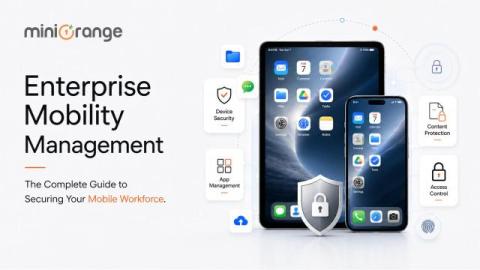
UEM vs. EMM: What's The Difference?

68% of companies suffered endpoint attacks that compromised sensitive data, 28% of those involved stolen or hacked devices. — Study by Ponemon Institute Here, the problem is not just mobile devices anymore. It’s laptops, tablets, IoT sensors, rugged field devices, third-party vendor systems, all accessing corporate data from everywhere. And this is where the confusion begins: Should an organization rely on Enterprise Mobility Management (EMM)?

What Is Kiosk Mode and How Does It Work?

Customer engagement plays a major role in how businesses retain users and build lasting relationships. Whether it’s a retail store, a logistics operation, or a healthcare facility, the way people interact with devices directly impacts efficiency and experience. This is where kiosks come in. Modern businesses increasingly rely on POS and kiosk-driven interactions to simplify workflows and improve customer satisfaction.

How to Set Up the OTP Verification Plugin with JetFormBuilder Contact Form?

The OTP Verification Plugin ensures that users’ email addresses or mobile numbers are verified by sending a unique one-time password (OTP) before form submission. By confirming the authenticity of the provided contact details, this plugin helps prevent fake leads and ensures higher-quality submissions. In this video, we’ll guide you through a step-by-step setup of the miniOrange OTP Verification plugin with the JetFormBuilder Contact Form. Learn how to enable verified lead generation in JetFormBuilder Contact Form and ensure that every form submission comes from a genuine user.

The new AI access problem: Why machine identities now drive trust in banking

In my experience working inside banks, identity security can be like plumbing: when it’s working, no one wants to talk about it. When there’s an incident, an audit, or a regulator—suddenly everyone wants to understand how it works. Artificial intelligence (AI) brings the same “no one cares until everyone does” energy, but with face-melting velocity. Today, AI is embedded across large parts of the financial services industry, and it has been around for more than 25 years.

Post-incident review: Source map exposure on non-production subdomain

Update (February 24, 2026): @vmfunc has published part two of their series about Persona. You can read it here. We will update this post with part three when it is released. On February 16, 2026, security researchers @vmfunc, @MDLcsgo, and @DziurwaF published a blog post identifying exposed frontend source maps on a non-production subdomain under withpersona-gov.com.

Non-human identities (NHIs) explained and how to secure them

Non-human identities are the fastest-growing and least-governed identity population in most environments. Service accounts, API keys, and AI agents run without MFA, without owners, and without expiration. Traditional identity and access management (IAM) wasn't built to manage them. Without governance for discovery, ownership, and lifecycle management, stale machine credentials become attacker footholds that persist for months.

Difference between Network DLP vs Endpoint DLP vs Cloud DLP

When it comes to protecting business-sensitive data, understanding the difference and the scope of Network DLP, Endpoint DLP, and Cloud DLP is essential. Each of these Data Loss Prevention solutions (DLP) plays a unique role in securing data across various environments, whether it is on the Network, on individual devices, or in the Cloud. Knowing how each solution works can help you determine the best approach to safeguard your organization's sensitive information.

What is Data Loss Prevention (DLP)?

Data Loss Prevention (DLP), also called data leakage protection, is a cybersecurity approach designed to detect, prevent, and manage unauthorized access, sharing, or transfer of sensitive information. In simple terms, DLP helps organizations keep control of critical data such as personally identifiable information (PII), financial records, credentials, and intellectual property (IP).