How CIOs and CISOs are unlocking AI's full value: 5 real-world takeaways

Recent research from Forrester Consulting commissioned by Tines, Unlocking AI’s full value: How IT orchestrates secure, scalable innovation, underscores the essential role IT leaders must play in AI orchestration, as well as the challenges that stall adoption – and the opportunities that await those who overcome them. But how do these findings translate to real life, and what are leaders and practitioners doing to navigate this landscape?

It's time to rethink shadow AI.

It's time to rethink shadow AI. We've been told it's a fringe activity. A risk from rogue employees. Our new research proves that wrong. This is, ironically, no longer a "shadow" problem. It's a universal workflow hiding in plain sight. The question is no longer "how do we stop it?" It's "how do we manage it?" Our new report lands next week with the date you need to start answering that important question.

Why External Exposure Management Must Be at the Core of Your Security Operations

Part of our two-part series on the evolution from EASM to EEM. This post explains how External Exposure Management becomes an operational muscle that empowers continuous defense, real-time remediation, and proactive protection. External exposure is now the frontline of cyber defense. These are the assets attackers can reach without authentication, without privilege escalation, and without internal access. That means speed and agility are not luxuries they are non-negotiable.

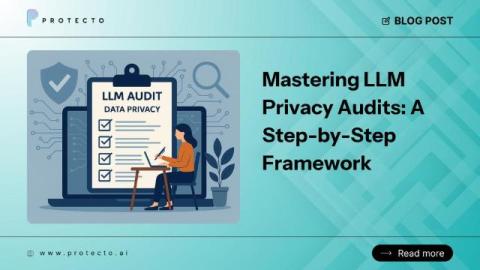
Mastering LLM Privacy Audits: A Step-by-Step Framework

Language models now touch contracts, tickets, CRM notes, recordings, and code. That means personal data, trade secrets, and regulated content move through prompts, embeddings, caches, and third-party endpoints. If your audit still reads like a generic security review, you will miss the places where leaks actually happen. A modern LLM Privacy Audit Framework starts where the risk starts.

SaaS intrusion trends and logging visibility with Julie Agnes Sparks

Join us for this week's Defender Fridays as we explore the critical challenges of SaaS security logging and detection engineering with Julie Agnes Sparks, Security Engineer at Datadog. At Defender Fridays, we delve into the dynamic world of information security, exploring its defensive side with seasoned professionals from across the industry. Our aim is simple yet ambitious: to foster a collaborative space where ideas flow freely, experiences are shared, and knowledge expands.

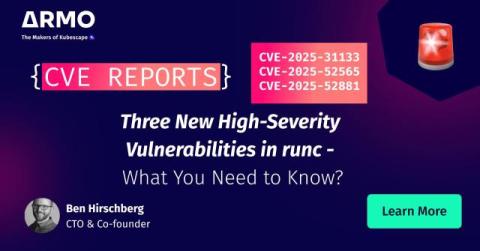
Three New High-Severity Vulnerabilities in runc: What You Need to Know

Within 24 hours, three new high-severity vulnerabilities were disclosed in runc, the low-level runtime that underpins most container platforms, including Docker, containerd, Kubernetes, and nearly every major cloud provider’s managed Kubernetes service. These vulnerabilities (CVE-2025-31133, CVE-2025-52565, CVE-2025-52881) allow a malicious container image to break out of the container boundary and affect the host machine directly.

APT-C-60 Exploits Zero-Day Vulnerabilities: Inside the SpyGlace Loader, COM Hijacking, and C2 Infrastructure

The cyber espionage landscape continues to evolve in sophistication and stealth—and among the more notable actors is APT-C-60. In recent months, this adversary has significantly escalated its tactics by leveraging zero-day vulnerabilities and orchestrating multi-stage campaigns to deploy the SpyGlace back-door.

PCI DSS 6.4.3 Is the Canary in the Coal Mine for Client-side Security

Here's the hard truth: 98% of websites load third-party scripts. Few teams know exactly what scripts are loaded. Even fewer know what those scripts do (what elements in the browser they are interacting with), and a miniscule amount of teams have any control over what those scripts do. When I say "teams" I'm referring to different stakeholders - security engineers, risk & fraud analysts, compliance managers, and even the marketing department. That's one of the challenges of client-side security. Almost every internal department touches the website. It might be the most collectively edited environment that exists in a company.

How Physical Asset Security Strategies from Cybersecurity Apply to Gold Bullion Storage

The parallels between protecting digital assets and physical gold bullion reveal a fundamental truth about modern security architecture: threats evolve, but the principles of defense remain constant. Organizations safeguarding high-value physical assets can extract substantial operational advantage by adopting frameworks originally designed for cyber defense. This convergence of physical and digital security thinking represents a strategic shift in how enterprises approach asset protection.