How to Automate Payment Page Script Audits for PCI DSS: 6 Hours to 6 Minutes

Most teams spend more than 40 hours a week just keeping their payment page script inventories updated. And that’s meticulous work as they have to load the page, watch what scripts fire, map domains, and compare it all to the last version, just to ensure the changes are documented before the details go stale. Also check out How to Maintain PCI Compliance Across Hundreds of Payment Pages But for organizations with 50 to more than 200 payment pages, it goes even further.


React and Next.js unauthenticated remote code execution (CVE-2025-55182, CVE-2025-66478)

On 29 November 2025, researcher Lachlan Davidson reported a critical React vulnerability that allows unauthenticated remote code execution via specially crafted React Server Function payloads. This vulnerability was disclosed as CVE-2025-55182 (React) and CVE-2025-66478 (Next.js) and is rated CVSS 10.0. A public proof concept has also been released so patching is of utmost importance.

Principles in Practice 2: Authorization Should Be Deterministic, Not Probabilistic

Here’s the reality: AI unlocks incredible innovation, but it also introduces real security risk. LLMs are probabilistic, which makes them great for generating code or summarizing data, but unreliable when it comes to enforcing access. Security requires verifiable, rule-based truth. At 1Password, our approach to AI keeps authorization in a secure, auditable flow so you always know who is accessing what, and why.

7 Tips for Just-in-Time Privileged Access Management You Need to Implement Today

Managing access can become tedious and clunky. Someone always ends up with too much power, someone else is locked out when something’s on fire, and no one remembers who approved what in the first place. It’s the slow creep of “we’ll fix it later.” However, that “later” is catching up.

The complete guide to securing Microsoft 365: Why one platform beats seven tools

Microsoft 365 has become the backbone of modern business productivity, with more than 450 million paid seats and over 300 million monthly Teams users. But this widespread adoption comes with a sobering reality: Microsoft 365 is now a prime target for cybercriminals worldwide.

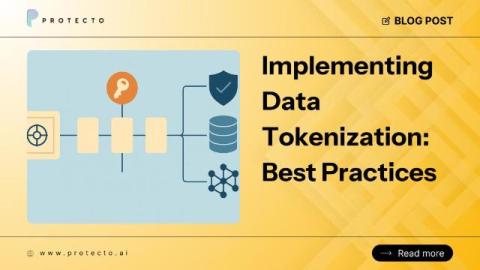
Best Practices for Implementing Data Tokenization

Data is no longer confined to a few clean relational systems. It now flows through microservices, data lakes, event streams, vector databases, and LLM pipelines. Sensitive information spreads quickly, and once it reaches ungoverned surfaces—logs, analytics exports, embeddings—it becomes extremely painful to unwind. Tokenization is one of the few controls that can both minimize data exposure and preserve business functionality.

The Mythical 1+1=3 Model in Cybersecurity

The mythical 1+1=3 model in security? It happens when the tools you already own stop working in isolation — and start working as a system. Jay Wilson and Garrett Hamilton dig into why Reach’s platform approach matters: not just enhancing individual controls, but creating compounding value across identity, endpoint, email, and network. When visibility, configuration, and enforcement align, the outcome isn’t incremental — it’s exponential.

Security Alert: CVE-2025-66478 & CVE-2025-55182 (React2Shell) - Next.js React Server Components Remote Code Execution

A critical vulnerability, CVE-2025-66478, has been identified in Next.js applications using React Server Components (RSC) with the App Router. This vulnerability receives a CVSS score of 10.0 and a Bitsight Dynamic Vulnerability Exploit (DVE) score of 7.85. This vulnerability may allow remote code execution (RCE) when affected servers process attacker-controlled RSC requests. CVE-2025-66478 is tied to an upstream React issue (CVE-2025-55182–DVE score 9.15) affecting the RSC protocol implementation.