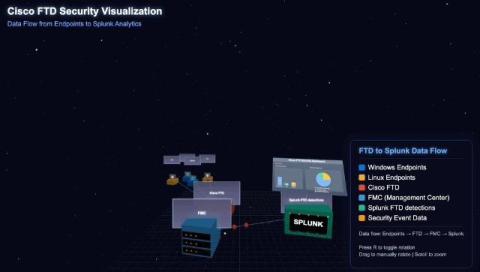
Securing the Network Edge: Cisco Secure Firewall Threat Defense Detections for Splunk

By integrating Cisco’s Firepower Threat Defense (FTD) with Splunk’s analytics platform, your security team immediately gains comprehensive, organization-wide visibility into network threats far beyond what any single firewall can detect alone. Yet, despite the critical need to bridge network and security data, many organizations still deploy perimeter defenses like Cisco's FTD but struggle to convert its rich telemetry into actionable insights useful to a SOC.


How VRM Determines Runtime Security Flaws

Modern application environments are increasingly complex, combining containers, microservices, CI/CD pipelines, and ephemeral compute. While Static Application Security Testing (SAST) and Software Composition Analysis (SCA) can uncover vulnerabilities during build time, they often leave a critical gap: runtime security flaw detection and determining whether a detected flaw is actually exploitable and running in production.

Storm-0558 and the Dangers of Cross-Tenant Token Forgery

Modern cloud ecosystems often place a single identity provider in charge of handling logins and tokens for a wide range of customers. This approach certainly streamlines single sign-on (SSO) for end users, but it also places enormous trust in a single set of signing keys. If those private keys are compromised, attackers can create tokens that appear valid to any service that relies on them.

Trustwave SpiderLabs Report Highlights Ransomware and Dark Web Dangers for the Hospitality Sector

The summer travel season is almost here, and travelers worldwide are in the process of booking their holidays, thus placing some of their most vital personal and financial information into the hands of the hospitality industry. A fact not lost to threat actors who thrive on gaining access and stealing this data.

Asset Discovery and Risk Mapping in Cybersecurity Operations using Deception

Asset discovery and risk mapping represent fundamental components of effective cybersecurity operations. Organizations face significant challenges in maintaining accurate inventories of their IT assets across on-premises, cloud, container, and IoT environments. Deception technology provides technical capabilities that enhance asset discovery while delivering actionable risk intelligence based on adversary behavior.

Security Testing for Single-Page Applications (SPAs)

When developing a web application, dev teams can choose from two fundamental design patterns: Single-Page Applications (SPAs) or traditional Multi-Page Applications (MPAs). Deciding which one to use can depend on multiple factors, but more and more companies are developing SPAs since they can provide a smoother user experience (UX), which, in turn, might just result in better user adoption.

EASM top features: 7 capabilities your solution needs

External attack surfaces have never been more sprawling, or more vulnerable. As organizations increasingly rely on dynamic, cloud-based infrastructures, and third-party services, digital footprints are only going to carry on growing. So, it’s no surprise many are turning towards External Attack Surface Management (EASM) tools for more visibility into both known and unknown assets. But what should you be looking for in a solution?

Powering the Next Era of Digital Value

Powering over 2,000 businesses and securing more than $10 trillion in digital asset transactions , we know what it takes not just to participate in this new economy — but to lead it. In the past 12 months, we’ve seen a clear shift. Crypto is entering the mainstream — and fast. With digital assets getting integrated into modern finance, the infrastructure supporting them must rise to the occasion — purpose-built for scale, security, and resilience.

The Next Generation of Full Stack Protection: Smarter Controls, Safer DeFi, and Full-Stack Protection

The crypto market has grown to over $3.2 trillion, driven by institutional adoption, stablecoin innovation, and a boost in DeFi activity. But every new dollar—and every new user—expands the attack surface potential. From credential stuffing and phishing, to malicious smart contracts and front-end exploits, today’s threat landscape is broader, faster, and more sophisticated than ever.