Security | Threat Detection | Cyberattacks | DevSecOps | Compliance

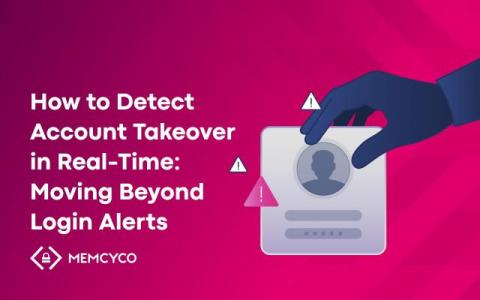
How to Detect Account Takeover in Real-Time: Moving Beyond Login Alerts

Most enterprise fraud stacks are built to detect account takeover after it’s already succeeded. Login anomaly rules fire at authentication. Transaction models fire at monetization. By both points, the attacker is already inside. Knowing how to detect account takeover in real-time means shifting detection upstream – to behavioral signals, device trust, credential exposure feeds, and session integrity monitoring that activate before any fraudulent transaction is attempted.

How leadership should assess DevOps backup solutions before purchase

Managing a growing list of vendors can add complexity across an organization. Adding a new partner may require navigating additional administrative processes and internal alignment. As a result, third-party DevOps backup often ends up lower on the priority list until one serious data deletion, prolonged recovery, or failed restore turns it from a “nice to have” into an executive-level decision.

2026 Public Sector Cyber Attacks and Data Breaches

In 2026, the public sector continues to face numerous cyber attacks, with data breaches often exposing sensitive information, disrupting essential services and undermining public trust. From municipal governments to federal agencies, public sector organizations of all sizes face challenges from threat actors exploiting outdated systems, human error and expanding digital footprints. These incidents are more than isolated security failures.

Turn Busywork Into Real Work With Egnyte's AI

It’s Friday afternoon, and you need a quick team update. Five minutes, tops, right? You ping Slack. A few people reply, a few don’t. So, you schedule a “quick sync” to get everyone on the same page. Two hours later, you’ve spent your afternoon chasing updates instead of doing actual work. And you’ll do it all over again next week. Now picture this. You’re collecting product demo videos for an agency.

Remote Penetration Testing in 2026: A CTO & CISO Guide

Your presence here, reading this, insinuates that something is nagging at you. Maybe it’s the Ivanti headline you saw last week or the fact that half your engineering team works from cafés, co-working spaces, and home offices you’ve never set foot in. Maybe it’s the audit coming up and that one checklist item about remote access controls you’ve been putting off. No, you’re not being paranoid. We have numbers that justify your burgeoning anxiety.

AI Agent Incident Response in Cloud-Native Environments: A Playbook for Modern SOCs

It’s 2 a.m. and the SOC has a Tier 3 page. A customer-service agent on the production cluster has just wired refund payments to seven addresses outside the approved disbursement list. The runbook is unambiguous: isolate the pod, image the disk, image the memory, root-cause within 48 hours.

AI Agent Security Performance: Framework for Evaluating Latency, Throughput, and Observability Overhead

Every AI workload security PoC reaches the same conversation. Platform engineering pushes back: the AI team won’t accept extra latency on inference. The security engineer hunts for benchmarks and finds a contradiction. Langfuse publishes 15% overhead. AgentOps publishes 12%. The security vendor quotes 1–2.5%. None is lying. They measure different layers.

How to Harden AI Agents in Cloud Environments: The 9 Capabilities Your Stack Must Provide

Most “hardening” advice for AI agents is a checklist of things to configure before the agent runs. CIS Kubernetes Benchmark gates. Pod Security Standards baselines. NetworkPolicy templates. None of it’s wrong — it’s just one of four phases, the one your stack already covers. The other three are Observe, Enforce, and Reconcile. They’re where AI agents actually get breached, and they’re where most stacks have nothing.

AI Is Moving Fast in Manufacturing

Artificial intelligence is rapidly becoming embedded across manufacturing environments, from engineering and design to supply chain optimisation and operations. What was once experimental is now being applied in day-to-day workflows, often driven by the need for speed, efficiency, and competitive advantage. Recent research shows that 73% of manufacturing organisations report rapid AI adoption, with 90% ranking AI as a top security priority for 2026. The direction of travel is clear.