Security | Threat Detection | Cyberattacks | DevSecOps | Compliance

We wrote the docs

Most security vendors hide their documentation behind a login. Some don’t write it at all. You get a sales page, a demo, and a request to install an agent on your servers, and you’re expected to trust that the thing does what the marketing says. That’s backwards. So we wrote the docs, and we put all of them at certkit.io/docs. No login, no account gate, no “contact us for details.” You can read every page before you create an account.

Inside CVE-2026-53435: Authenticated Deserialization to Full Controller Takeover in Jenkins via config.xml

How a low-privileged account turns an XML configuration upload into arbitrary file read, user impersonation, and remote code execution — and how to detect and stop it. Published 16 June 2026 · Fact-checked against the official project advisory and government vulnerability databases.

1Password + Kiro: Trusted Access for AI-Powered Development

AI agents now write code, fix bugs, and ship to production. But in order to do useful work, agents require credentials. At 1Password, one of our core AI security principles is that raw credentials should never be directly exposed to LLMs, but all too often, that’s exactly what happens: most teams sacrifice security for speed and hand agents secrets in plaintext.

Bringing more agent harnesses and frameworks to Cloudflare, starting with Flue

2026 is the year agent harnesses go to production. The software that controls the model’s access to the outside world — harnesses like Codex, Claude Code, OpenCode, Pi, and Project Think — has matured to the point where teams are deploying agents as real, load-bearing infrastructure, not just prototypes. But building agents that survive production is hard.

Introducing the Cloudflare One stack: agent-powered deployment

Adopting or migrating to a Zero Trust network architecture can be a daunting task. Before a single policy changes, teams have to recall how their network is actually built: which applications exist, their authentication and authorization constructs, how traffic flows between them, and any assumptions the current architecture makes. This hands-on process requires practitioners to decode the intent behind every security and routing policy in place.

What is Data Residency? A Clear Guide for IT Teams

Every piece of data your organization stores lives in a specific server, facility, and country. Data residency refers to where that data physically sits, and governments increasingly care about the answer. The EU, India, Brazil, and dozens of other jurisdictions now enforce strict rules about storage locations. Get it wrong, and you’re looking at regulatory fines, lost contracts, or both.

AI Is Reshaping Cyber Risk Faster Than Most Boards Realize

Artificial Intelligence is no longer a future cybersecurity concern. It is actively reshaping how attacks are conducted, how organizations respond, and how business leaders must think about enterprise risk. While much of the conversation around AI has focused on productivity and innovation, threat actors are already leveraging AI to make cyber-attacks faster, more scalable, more convincing, and increasingly difficult to detect.

From 1% to 26%: How AIDA Orchestration Fixes the Remedial Training Gap

As we speak, bad actors are using AI agents to do their dirty work. Our own research tells us 85.8% of phishing attacks were AI-driven in the past 12 months. Agentic power is helping social engineering and malware get smarter, faster and harder to detect. But enough of what you probably already know. Let’s talk about how we can address these risks. Our CISO Advisor Dr. Martin Kraemer wrote recently about AI agents being used for good.

Best AI Agent Security Tools for SMB and Enterprise in 2026

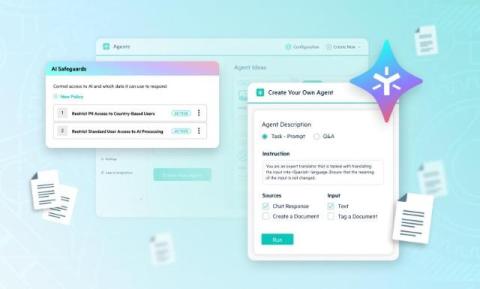
Enterprise AI agent adoption has created a massive blind spot: 83% of organizations have no visibility into what their AI agents are doing, while 86% lack visibility into their AI data flows. With 1 in 3 enterprise employees now using an AI assistant daily — mostly without security governance — this visibility gap has become a critical enterprise risk. The security industry's response splits into two distinct layers.

Zenity and Carahsoft Partner to Bring AI Agent Security to Government Agencies

The next government security challenge isn’t AI models, it’s AI agents. Zenity and Carahsoft are helping agencies prepare. Across government agencies, AI agents are already interacting with sensitive data, mission-critical workflows, and public services. Yet most organizations still lack visibility into where these agents are deployed, what they can access, and how they behave once operational. The result is a growing governance gap between AI adoption and AI security.