Security | Threat Detection | Cyberattacks | DevSecOps | Compliance

Risk management maturity model: How to assess and improve your program

Accelerating security solutions for small businesses‍ Tagore offers strategic services to small businesses. A partnership that can scale‍ Tagore prioritized finding a managed compliance partner with an established product, dedicated support team, and rapid release rate. Standing out from competitors‍ Tagore's partnership with Vanta enhances its strategic focus and deepens client value, creating differentiation in a competitive market.

You can build verifiers for messy problems

Accelerating security solutions for small businesses‍ Tagore offers strategic services to small businesses. A partnership that can scale‍ Tagore prioritized finding a managed compliance partner with an established product, dedicated support team, and rapid release rate. Standing out from competitors‍ Tagore's partnership with Vanta enhances its strategic focus and deepens client value, creating differentiation in a competitive market.

Why Traditional Security Monitoring Is No Longer Enough in 2026

Cybersecurity has become significantly more complex over the past few years. Attackers no longer rely solely on mass phishing campaigns or simple malware. Modern threat actors use automation, artificial intelligence, credential theft, living-off-the-land techniques, and multi-stage attacks designed to evade traditional security controls. As a result, organizations that still depend on conventional monitoring tools often struggle to detect and contain threats before damage occurs.

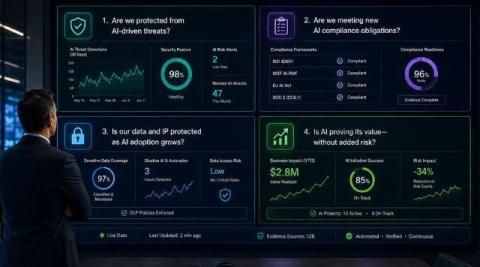
4 Questions every CISO needs to answer about AI

If your board asked today how you are governing AI, how would you respond? Not just the policy you wrote, but what is actually happening across the business. Could you answer with evidence? Many CISOs cannot answer with certainty. AI has entered the business faster than anyone could write policy for it, and securing it across all areas now seems to be the CISO’s responsibility.

AI Governance vs AI Compliance: What's the Difference?

The main difference between AI governance and AI compliance is that AI governance is the internal framework an organization develops to manage AI responsibly, while AI compliance is how organizations demonstrate to external regulators that they’re adhering to applicable laws and regulations. These two terms get used interchangeably, but they solve different problems. With compliance alone, an organization can satisfy regulators without meaningfully controlling how its AI behaves.

Automate your GRC program with the Vanta Agent

Your compliance program never sits still. Controls drift, tests fail, policies go out of date. The Vanta Agent keeps up. It has full context on your program through Vanta's Trust Graph, so it never hits a dead end. It always recommends the next step. The Trust Graph is Vanta's data and intelligence layer, powered by 400+ integrations that map your risks, controls, policies, and vendors. Add continuous monitoring, risk scoring, automated testing, and framework mapping, and the Agent works with the full picture.

Deploying Microsoft 365 Policy Management in Complex Environments

Achieving regulatory compliance across a modern enterprise requires a reliable strategy for Microsoft 365 policy management. In complex organizational structures, simply storing documents in cloud libraries is not enough; organizations must actively distribute, track, and verify that critical policies are read and acknowledged. Implementing purpose-built Microsoft 365 policy management ensures your compliance processes transition from passive document storage to an automated, audit-ready policy management system natively integrated into your existing workspace.

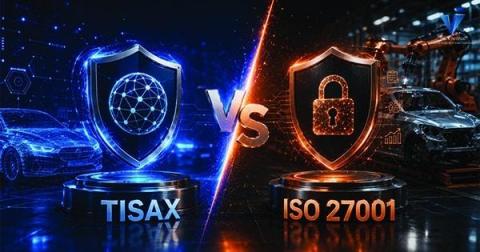
TISAX vs ISO 27001: What German Automotive Suppliers Need to Know

TISAX and ISO 27001 are related but not interchangeable. ISO 27001 is a general-purpose information security certification accepted across any industry; TISAX is the automotive industry’s mandatory, shared assessment framework, built on ISO 27001’s structure but adding prototype protection and data protection requirements that OEMs specifically demand. Most automotive suppliers need TISAX, and an existing ISO 27001 program is the fastest route to get there.