Security | Threat Detection | Cyberattacks | DevSecOps | Compliance

The Imperative of Data Loss Prevention in the AI-Driven Enterprise

As organizations increasingly integrate artificial intelligence (AI) into their operations, the nature of data security is undergoing significant transformation. With AI’s ability to process vast amounts of data quickly, the risk of data breaches and leaks has grown exponentially. In this context, Data Loss Prevention (DLP) has (re)emerged as a critical component for IT professionals seeking to safeguard sensitive information.
Gen AI Guardrails: 5 Risks to Your Business and How to Avoid Them

As businesses increasingly adopt Generative AI (Gen AI) to enhance operations, customer engagement, and innovation, the need for robust AI guardrails has never been more critical. While Gen AI offers transformative potential, it also introduces significant risks that can jeopardize your business if not properly managed. Below, we explore five critical risks associated with Gen AI and provide strategies to avoid them.

Why AI Guardrails Need Session-Level Monitoring: Stopping Threats That Slip Through the Cracks

AI guardrails are vital for ensuring the safe and responsible use of AI/large language models (LLMs). However, focusing solely on single prompt-level checks can leave organizations vulnerable to sophisticated threats. Many company policy violations and security risks can be cleverly split across multiple, seemingly innocent queries. To effectively protect against these threats, a more comprehensive approach is needed — session-level monitoring.

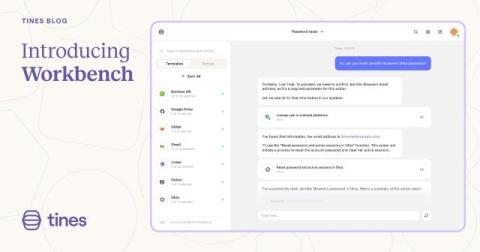
Introducing Tines Workbench

You trust us with your most important workflows, and we take that trust seriously. In developing AI in Tines, we’ve been laser-focused on helping users leverage AI without exposing their organizations to security and privacy risks. But we also spoke with so many teams struggling to fully realize AI's potential impact. They wanted AI to do more, while still preserving those all-important security and privacy guardrails.

7 Examples of How AI in Data Security is Transforming Cybersecurity

AI in data security transforms how organizations protect sensitive information. Companies turn to artificial intelligence for robust defense mechanisms as cyber threats evolve. This cutting-edge technology analyzes vast datasets, identifies patterns, and responds to threats in real-time, surpassing human capabilities. From small businesses to large enterprises, AI-powered solutions guard against increasingly sophisticated attacks.

How to mitigate security issues in GenAI code and LLM integrations

GitHub Copilot and other AI coding tools have transformed how we write code and promise a leap in developer productivity. But they also introduce new security risks. If your codebase has existing security issues, AI-generated code can replicate and amplify these vulnerabilities.

How to Marry Customer Communication Tools with AI to Enhance Customer Support

For companies, customer service plays a critical role in retaining customers and driving growth. Studies show that 93% of customers are likely to make repeat purchases from companies that provide excellent customer service. To succeed in today's competitive business environment and meet ever-increasing customer expectations, more and more companies are considering integrating artificial intelligence with customer communication tools, which include software that interacts with customers across multiple channels, such as email, free live chat, and social media. In the article, we will explore how marrying customer communication tools with AI can revolutionize the way companies interact with their customers, and list the benefits a company can reap by doing so.

Zero Trust + AI: fewer alerts, guaranteed security

Excessive cybersecurity alerts are not a trivial matter; they pose a real challenge that directly impacts business security strategies. Too many notifications generate stress on IT teams, which are increasingly being reduced in size while facing a heavier burden of tasks. This situation can lead to urgent alerts being overlooked, putting system security at risk.