Security | Threat Detection | Cyberattacks | DevSecOps | Compliance

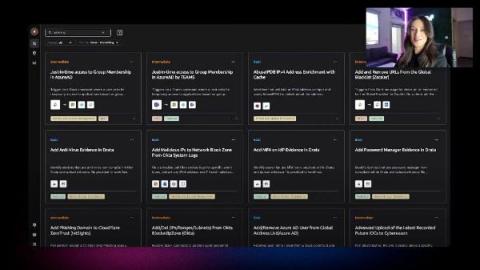
Tines Technical Advisory Board (TAB) Takeaways with Pete: part one

I’m Peter Wrenn, my friends call me Pete! I have the pleasure of being the moderator of the Tines Technical Advisory Board (TAB) which is held quarterly. In it, some of Tines’s power users engage in conversations around product innovations, industry trends, and ways we can push the Tines vision forward — automation for the whole team. Well, that’s the benefit to our customers and Tines.

You're Not Hallucinating: AI-Assisted Cyberattacks Are Coming to Healthcare, Too

We recently published a blog post detailing how threat actors could leverage AI tools such as ChatGPT to assist in attacks targeting operational technology (OT) and unmanaged devices. In this blog post, we highlight why healthcare organizations should be particularly worried about this.

AI at Egnyte: The First Ten Years

In the 1960s, Theodore Levitt published his now famous treatise in the Harvard Business Review in which he warned CEOs of being “product oriented instead of customer oriented.” Among the many examples cited was the buggy whip industry. As Levitt wrote, “had the industry defined itself as being in the transportation business rather than in the buggy whip business, it might have survived. It would have done what survival always entails — that is, change.”

[HEADS UP] See WormGPT, the new "ethics-free" Cyber Crime attack tool

CyberWire wrote: "Researchers at SlashNext describe a generative AI cybercrime tool called “WormGPT,” which is being advertised on underground forums as “a blackhat alternative to GPT models, designed specifically for malicious activities.” The tool can generate output that legitimate AI models try to prevent, such as malware code or phishing templates.

Darknet Diaries host Jack Rhysider talks about hacker teens and his AI predictions

It’s human nature: when we do something we’re excited about, we want to share it. So it’s not surprising that cybercriminals and others in the hacker space love an audience. Darknet Diaries, a podcast that delves into the how’s and why’s and implications of incidents of hacking, data breaches, cybercrime and more, has become one way for hackers to tell their stories – whether or not they get caught.

Unlocking the Potential of Artificial Intelligence in IoT

Imagine a world where IoT devices not only collect and transmit data, but also analyse, interpret, and make decisions autonomously. This is the power of integrating artificial intelligence in IoT (AI with the Internet of Things). The combination of these two disruptive technologies has the potential to revolutionize industries, businesses, and economies.

How the Digital-First Economy and Digital Trends Impact CISOs

To understand how the digital-first economy and global trends have impacted the role of the CISO, Salt partnered with the research firm Global Surveys to study 300 worldwide Chief Information Security Officers. This video highlights trends revealed by the survey including: These were just a few of the highlights from our recent state of the CISO survey. We encourage you to download the full report for even more great insights.

LLMs Need Security Too

In this episode Jb and Izar are joined by David Haber, CEO of Lakera, who focuses on securing LLMs and their use. We explore topics like prompt injection and their impact on security, safety and trust, and we look at the Gandalf experiment ran by Lakera. We touch on the recently drafted OWASP Top 10 on LLM project, and have a great discussion on what LLMs are really doing and their potential as tools and targets.

AWS Amplify Hosted Phishing Campaigns Abusing Telegram, Static Forms

Netskope Threat Labs is tracking phishing campaigns that are abusing several free cloud services to host their websites and collect user information. These campaigns host their phishing sites in AWS Amplify which is available to free-tier users. Some phishing campaigns also abuse Telegram and Static Forms to collect users’ credentials. These phishing attacks aim to steal banking, webmail, and Microsoft 365 credentials, as well as victims’ card payment details.