Security | Threat Detection | Cyberattacks | DevSecOps | Compliance

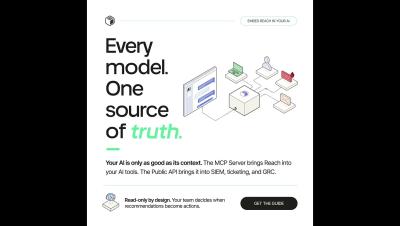
Mallory Unifies Threat Intelligence, Exposure Context, and Response Into One Architecture for Security Teams

As AI-assisted attackers compress exploitation timelines to hours, Mallory turns live adversary intelligence into prioritized, policy-governed action across the tools security teams already run.

Airlock Digital Unveils Agentic AI Control & Governance to Extend Preventative Endpoint Security

Airlock Digital announces Agentic AI Control & Governance, extending its preventative endpoint security solution with visibility into trusted AI agent behavior and governance over what trusted agents are allowed to do on endpoints.

From Data Classification to Runtime Data Security for AI

Authentication used to be a login form. Then it became IAM: identity providers, roles, federation, lifecycle. Then it became Zero Trust: no built-in trust, every request checked in context. Each step did not replace the last so much as fold it into a bigger runtime decision. The login still happens, but it is now one input to a constant, context-based check.

Secure Agent Harness Execution: Preventing Escape

At CrowdStrike, we conduct extensive red-team testing of agentic systems using diverse models, tools, and adversarial evaluation harnesses designed to probe for containment failures. To date, none of our offensive agents have escaped their intended sandbox boundaries.

The AI agent working for you probably has more access than you do

Say a sales rep uses an AI assistant to help manage their pipeline. The rep has role-based access to Salesforce, scoped to their territory and their accounts. The assistant, wired in through an API integration, often doesn't have that same scoping. It authenticates as a service account with broad read and write access across the org, because that was faster to set up than a permission model that matches what the actual user is allowed to see.

Automate your GRC program with the Vanta Agent

Your compliance program never sits still. Controls drift, tests fail, policies go out of date. The Vanta Agent keeps up. It has full context on your program through Vanta's Trust Graph, so it never hits a dead end. It always recommends the next step. The Trust Graph is Vanta's data and intelligence layer, powered by 400+ integrations that map your risks, controls, policies, and vendors. Add continuous monitoring, risk scoring, automated testing, and framework mapping, and the Agent works with the full picture.

Zenity Now Integrates with Microsoft Agent 365

AI agents have moved from pilots into broad enterprise use. They read email, query systems of record, take actions, invoke tools, and coordinate with other agents on behalf of employees. Every line of business wants more of them, and security teams are being asked to enable that expansion without losing visibility or control.

AI Governance vs AI Compliance: What's the Difference?

The main difference between AI governance and AI compliance is that AI governance is the internal framework an organization develops to manage AI responsibly, while AI compliance is how organizations demonstrate to external regulators that they’re adhering to applicable laws and regulations. These two terms get used interchangeably, but they solve different problems. With compliance alone, an organization can satisfy regulators without meaningfully controlling how its AI behaves.

AI's Hidden Identity Risk for MSPs

Organizations are rapidly integrating AI into everyday business operations. Teams are using Microsoft Copilot and Gemini to summarize meetings, developers are accelerating software delivery with coding copilots and customer service teams are deploying AI-powered chatbots to improve response times. While these initiatives are viewed through the lens of productivity and innovation, they are also reshaping organizations’ identity environments in ways that frequently go unnoticed.