Security | Threat Detection | Cyberattacks | DevSecOps | Compliance

Proactive Strategies to Prevent Ransomware Attacks

In today’s digital age, ransomware attacks have emerged as one of the most formidable threats to organizations worldwide. These malicious software attacks encrypt files on a device, rendering them inaccessible to users, and demand a ransom for decryption keys. The impact of ransomware can be devastating, leading to significant financial losses, operational downtime, and reputational damage.
TPRM & Remote Learning: Defending the Education Sector

The rise of remote learning has motivated cybercriminals to advance their assault on the education sector. In 2022, cybercriminals deployed more than 2200 attacks against higher education institutions every week, a 44% increase compared to 2021 (Check Point, 2022). Risk professionals attribute this increase to various factors, including the structure of remote learning environments.

University Vendor Management: Advanced Risk Assessment Techniques

Like most high-performing organizations, higher education institutions often utilize third-party vendors to outsource key services, such as data management and research initiatives. This reliance on third-party vendors can lead to various risks, including data privacy vulnerabilities, compliance issues, and operational disruptions. Therefore, universities must implement advanced vendor management processes to mitigate these risks.

Secure your code and protect your data flows with Riscosity and Semgrep

Semgrep is a leading static application security testing (SAST) tool powered by an open-source community for surfacing bugs, discovering vulnerabilities, and enforcing code standards. Semgrep has scanned over 75 million packages, contributed to 2000 community rules, and supports over 30 coding languages. Riscosity is the leading data flow observability and security platform. This is why we’re excited to announce Ricosity’s new integration with Semgrep.

Communicating Cyber Risk to Executives and Boards with Shamane Tan

In this episode of Cyber Security Decoded from Rubrik Zero Labs, host Steve Stone is joined by Chief Growth Officer at Sekuro and Best-Selling Author Shamane Tan to discuss differences in the cybersecurity landscape between the US and APAC, communication strategies for CISOs, building trust for better cybersecurity outcomes, improving organizational resilience, and diversity in the cybersecurity field.

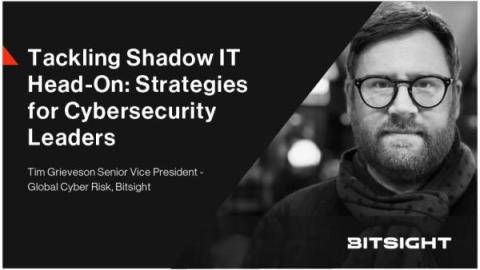
Tackling Shadow IT Head-On: Strategies for Cybersecurity Leaders

As cybersecurity leaders, we're all too familiar with the challenges posed by Shadow IT—a persistent thorn in the side of IT and security teams worldwide. And when high-profile supply chain attacks make headlines, the urgency to understand our reliance on third parties becomes all too real.

Visualizing Vulnerability Management: What Does a Single Pane of Glass Really Look Like?

Single Pane of Glass (SPOG) is a common buzzword that sends shivers down the spines of technical folks everywhere. Yet, executive teams ask for it, especially in vulnerability management. At the same time, the complex and fragmented nature of modern IT environments wreaks havoc on organizations aiming to understand their current location related to remediating and patching risks. So, what exactly is a single pane of glass, and what does it look like for enterprises today?

SecurityScorecard 2024 Global Third-Party Cybersecurity Breach Report: Software supply chain is top target for ransomware groups

The SecurityScorecard Global Third-Party Breach Report uses the world’s largest proprietary risk and threat dataset to provide unique insights into the intricate web of supply chain vulnerabilities exploited by ransomware groups. As the digital landscape continues to evolve, so too do the tactics of cyber adversaries. Ransomware groups, in particular, have honed in on a prime target: the software supply chain.

Top 10 Digital Risk Protection Software Solutions

It’s no longer a question of ‘if’, but ‘when’ and ‘how’ cyber threats will target an organization. This reality demands a proactive approach to digital security. Recent data shows that over 85% of organizations have experienced a cyber attack supporting this need for vigilance. These incidents range from data breaches to brand impersonation, each carrying significant risks to business integrity and continuity.