Security | Threat Detection | Cyberattacks | DevSecOps | Compliance

CISO Risk Intel Brief: Exploited Control Planes, Not Patch Volume, Define Residual Risk

This executive intelligence briefing covers from the past week (2–9 September 2026) and the past month (approximately 10 August – 9 September 2026). CISOs, start here: do not open a 974-row spreadsheet. That queue is the failure mode. This week’s material risk sits in four places you can name before noon.


FIPS 140-2 vs FIPS 140-3, Explained

FIPS 140-3 is the current standard for validating cryptographic modules, which are the specific hardware or software components that implement encryption and manage keys inside a defined boundary. FIPS 140-3 was approved on March 22, 2019, became effective on September 22, 2019, and supersedes FIPS 140-2, which dates back to 2001. Most FIPS 140-3 security requirements come from ISO/IEC 19790:2012, with test requirements drawn from ISO/IEC 24759:2025.

Ransomware in OT environments: why it's different and how to recover

OT ransomware is not IT ransomware with an industrial label. An encrypted HMI, engineering workstation, SCADA server or virtualization host can remove operator visibility and force a controlled shutdown even when PLCs continue running. Recovery ends only when operations, engineering, safety and security agree that restored systems and the physical process are trustworthy.

MFA for Telecommunications: Securing Networks, Admins, and Customer Accounts

A single telecom login is one of the most dangerous keys in existence. Behind it sit subscriber identities, billing systems, and the network backbone every other industry depends on. In April 2025, SK Telecom admitted attackers had stolen authentication records tied to its USIM cards, affecting 27 million subscribers, with malware present for years before discovery. Weeks earlier, the FBI warned of a campaign using AI-generated voice and text to trick targets into handing over account access.

How Is AI Transforming Identity and Access Management?

Traditional Identity and Access Management (IAM) relies on authentication methods, predefined roles, and access policies to control who can access business applications and data. These controls remain essential, but they do not always provide enough context to identify unusual behavior or changing access risks. AI in Identity and Access Management (IAM) adds another layer of intelligence by analyzing login context, user behavior, device information, access patterns, and identity activity.

Is Your Endpoint Strategy Broken?

Endpoint security is changing, but are organisations still protecting devices for a way of working that no longer exists? From Windows endpoints drifting out of compliance to VDI, preventative security and a radically different approach to what runs locally, the full Razorwire episode asks whether it’s time to rethink the endpoint. Watch the full episode to discover what modern endpoint security could look like.

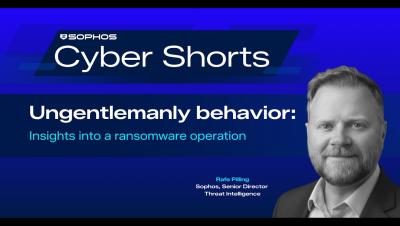
Ungentlemanly behavior: Insights into a ransomware operation

They call themselves The Gentlemen Behind the name is one of the most active ransomware operations of the past 12 months, linked to 683 victims and a playbook built around compromised credentials, legitimate tools, rapid privilege escalation, and aggressive defense evasion. In this video, Susie Evershed and Rafe Pilling break down the latest research from Sophos Counter Threat Unit (CTU), revealing how some affiliates can move from initial compromise to ransomware deployment in less than 24 hours.

What is GRC transformation? A practical definition for enterprise CISOs

GRC transformation is the organizational change from running governance, risk, and compliance as periodic, check-the-box paperwork to running it as continuous, AI-native cyber risk assurance measured in business outcomes. It is not a tooling upgrade. It is a change in what you are asked to prove. The old question was whether the work got done by audit time. The new question is whether risk is understood and the controls meant to manage it are working right now.

An agent breaks in production. Who's accountable?

We asked eight security and product leaders who's accountable when an agent ships to production and breaks something. Nobody said the model. Harish Gaggar named the reason. An agent runs on permissions someone approved and configuration someone set. Ron Reiter drew the line in the same place, accountability sits with whoever decided what the agent could actually do. As agents act across more systems, the accountability trail gets harder to follow. Most teams cannot determine which human granted an agent access.

AI agents can inherit local admin rights

An AI agent runs as a process under whatever account launched it, and it inherits that account's access token. If the account has local admin rights, so does the agent, along with every helper process and script it spawns, an example would be Claude Desktop running under an admin account, spawning PowerShell helpers. What makes agents different from a typical privileged app is that their next action often comes from content parsed at runtime, including untrusted input.