Security | Threat Detection | Cyberattacks | DevSecOps | Compliance

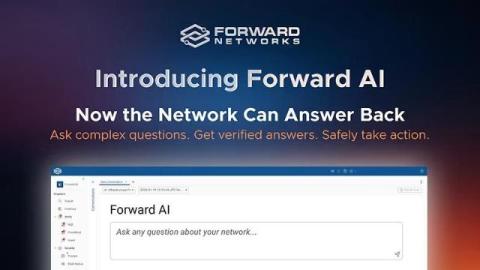
Introducing Forward AI

As enterprises move toward agentic operations, speed without data accuracy becomes a liability. At Forward Networks, we recognized this challenge and set out to deliver a solution: speed backed by mathematical accuracy. In networking, acting on incomplete or approximate data is not an inconvenience, it is a cause of outages, security exposure, and operational risk.

AI is Actively LEAKING Your Data (And You Don't Know It) #apisecurity #airisks #dataprotection #ai

AI agents don't think. They pattern-match. Critical to understand: Generative AI (ChatGPT, Claude, etc.) does NOT reason like humans. It: The API Security problem: When you give an AI agent access to an API, it will: AI agents can't reason. They recreate patterns based on weights. You need to be very careful: data in, data out. Practical example: text User: "Show me the account balance for user" AI agent → calls GET /api/account/123 API → returns { balance: 5000, name: "John", SSN: "123-45-6789" } AI agent → outputs EVERYTHING to user (including SSN!)

Introducing Forward AI

The Network is Complex. Operating It Shouldn't Be. Forward AI transforms network operations by reducing manual analysis, expert dependency, and guesswork. By combining conversational interaction with a mathematically accurate digital twin, teams can validate intent, understand actual network behavior, and act with confidence across even the most complex environments.

OpenClaw (Moltbot) Personal Assistant Goes Viral - And So Do Your Secrets

Early 2026, Moltbot a new AI personal assistant went viral. GitGuardian detected 200+ leaked secrets related to it, including from healthcare and fintech companies. Our contribution to Moltbot: a skill that turns secret scanning into a conversational prompt, letting users ask "is this safe?".

Threat hunting to detection engineering: Analyzing real malware with Claude Code, LimaCharlie, and Linux

Claude Code, originally just auto-complete on steroids for IDEs, shows a lot of promise for becoming a major tool in the DFIR/detection engineering/security analyst’s toolbox. Whether it’s Claude Code’s support of MCP, agent skills, or general ability to quickly figure out how to accomplish a given task, it is rapidly becoming more than a code generation tool. This is the first of a three-part series.

Semantic Guardrails for AI/ML - Protegrity AI Developer Edition

In this installment of our AI Developer Edition Set-up series, Dan Johnson, a software engineer at Protegrity, introduces semantic guardrails. Learn how to protect your LLM and chatbot workflows from malicious prompts and insecure AI responses. As AI becomes central to enterprise operations, controlling the context of conversations is a major challenge. Semantic guardrails provide a safety layer that ensures your AI stays on topic and never leaks sensitive PII.

Agentic SecOps Workspace (ASW) office hours with LimaCharlie

Join us for a special Defender Fridays Office Hours session where the LimaCharlie team demonstrates the new Agentic SecOps Workspace (ASW) and explores what's possible when AI agents operate security infrastructure directly. At Defender Fridays, we delve into the dynamic world of information security, exploring its defensive side with seasoned professionals from across the industry. Our aim is simple yet ambitious: to foster a collaborative space where ideas flow freely, experiences are shared, and knowledge expands.

Sumo Logic's 2026 Security Operations Insights report: AI, siloed tools, and team alignment

Security threats have always been expanding and evolving, but recent data shows that modern applications are more complex for security and operations than ever before. And AI is only a piece of that puzzle. To stay on top of the changing market and hear directly from security leaders on what’s really top of mind, Sumo Logic surveyed over 500 security leaders with the help of UserEvidence. We asked about data pipelines, tool sprawl, confidence in SIEM, and, of course, AI.