Security | Threat Detection | Cyberattacks | DevSecOps | Compliance

Why Remote IT Monitoring Is Essential for Modern Businesses

Every minute of unexpected downtime costs more than most leaders want to admit. And in a world where operations genuinely never stop, a single undetected network failure can snowball fast, resulting in lost revenue, a bruised reputation, and customers venting on social media. Remote IT monitoring gives businesses something they actually need: continuous, full-spectrum visibility across their entire IT environment, with no one physically on-site required.

What Hiring Managers Are Actually Looking for in 2026 - Straight From the Job Postings

Job descriptions have always been a useful mirror. They reflect not what organisations wish the talent market looked like, but what they actually need right now, in the roles they are actively trying to fill. Reading them carefully, across industries and seniority levels, tells a more honest story about professional demand than any survey of executive sentiment or forward-looking forecast.

AI Market Competition Depends on Control of Infrastructure, Industry Analysis Suggests

The brief leadership crisis at OpenAI in late 2023 triggered widespread debate about the future of artificial intelligence companies. While many observers focused on governance issues, some analysts viewed the situation as evidence of deeper forces shaping the industry. As reported by The Silicon Review, entrepreneur and IFORELS founder Vlad Panin argued that the long-term balance of power in AI would depend less on public leadership disputes and more on who controls critical resources such as computing infrastructure, distribution channels, data access, and financial incentives.

AI Evaluation and Security: Why Real-World Testing Matters More Than Ever

As organizations deploy artificial intelligence across customer service, HR, finance, and business operations, security concerns are expanding beyond traditional cybersecurity risks. Companies are no longer focused solely on protecting systems from external threats. They must also ensure AI tools behave reliably, safely, and consistently when interacting with real users.

Five Signals, One Answer: Why Single-Signal AI Security Always Fails

The security industry hasn’t been wrong about agentic AI risk. It’s been incomplete. There’s no shortage of single-signal solutions for the problem: tools that analyze prompts for malicious content, platforms that monitor data access patterns, capabilities that assess model behavior for signs of manipulation. Each captures something real. None is sufficient on its own.

AI in Australian schools: Managing emerging risks while building a safer learning environment

AI is everywhere in Australian schools. Students are using AI-powered tools to support learning, teachers are leveraging AI to improve productivity and lesson planning, and school administrators are exploring new ways to simplify operations. But while AI holds a lot of promise, it also introduces new cybersecurity challenges. Australian schools increasingly find themselves balancing innovation with the need to protect students and staff.

The New Security Risks of the Agentic Development Lifecycle

For years, application security ran on a simple assumption: software moves through a lifecycle, and security inspects the artifacts as they travel from development to production. Developers plan, write code, commit it, test it, scan it, and ship it. Every control built, including pull request reviews, CI/CD gates, and post-commit scanning, assumed a human was sitting between each step, making decisions a tool could later check.

Third Party Risk in the Age of AI. A Spotlight on Black Kite

Your vendors are adopting AI faster than you can assess them. What does that mean for your third party risk? Welcome to Razorwire, the podcast where we share our take on the world of cybersecurity with direct, practical advice for professionals and business owners alike. I'm Jim and in this Spotlight on Technology episode, I'm joined by Jeffrey Wheatman, Senior Vice President and Cyber Risk Strategist at Black Kite. Jeffrey previously spent over a decade as an analyst VP at Gartner, where he launched their third party cyber risk management coverage.

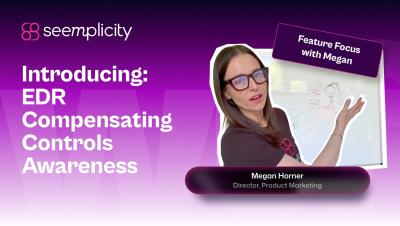
Exposure Management in the AI Era | Introducing EDR Compensating Controls Awareness

In this Feature Focus, Megan Horner, Product Marketing Director at Seemplicity, explores the evolving landscape of vulnerability management in the AI era. As the rise of AI models like Claude Mythos enables attackers to shrink exploit windows, security teams are facing an overwhelming flood of high-priority vulnerabilities.