Security | Threat Detection | Cyberattacks | DevSecOps | Compliance

What is SecOps?

SecOps is a short form for Security Operations, a methodology that aims to automate crucial security tasks, with the goal of developing more secure applications. The purpose of SecOps is to minimize security risks during the development process and daily activities. Under a joint SecOps strategy, the security and operations teams work together to maintain a safe environment by identifying and resolving vulnerabilities and resolving any security issues.

CVE-2022-23648 - Arbitrary Host File Access from containers launched by containerd CRI and its impact on Kubernetes

Recently discovered vulnerability - CVE-2022-23648 - in containerd, a popular container runtime, allows especially containers to gain read-only access to files from the host machine. While general container isolation is expected to prevent such access, in Kubernetes, it is especially dangerous because well-known and highly sensitive files are stored in known locations on the host.

An Analysis of Ransomware Encryption Speeds by Splunk SURGe

Did you know the median time for ransomware to encrypt nearly 100,000 files is 42 minutes and 52 seconds? This speed is likely beyond the capabilities of most organizations to respond effectively before encryption is complete. These findings are the result of research published by SURGe, Splunk’s strategic cybersecurity research team.

The Comprehensive Approach to Cybersecurity Assessment and Testing | Cyphere

Cyphere is a cybersecurity assessment and testing company that quickly identifies the weakest points in an organisation's cyber security. We do this by using the best practices to simulate real-world attacks against your systems. The goal is to identify potential risks before they can lead to a potential disaster.

How to Configure SSO for AWS Resources with Okta and SAML

This blog is part of a series on how to provide identity-based access to AWS resources. In the first tutorial, we saw how to set up an identity-aware AWS bastion host using the OSS solution, Teleport. In this blog, we will expand the scenario to use a single-sign-on (SSO) authentication mechanism to issue certificates to specific groups of users to access AWS resources.

Secure Office 365 with PowerShell via the CIS approach - Pt 2

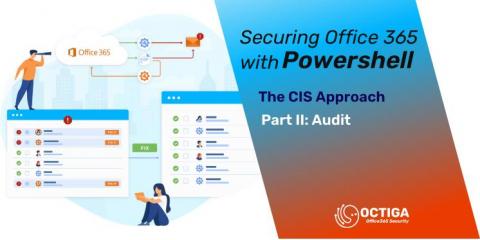
This is the second blog in a multi part series helping admins, service providers, consultants and security admins to check and achieve a level of security control in Office 365. Part 1 of this series covered the basic PowerShell commands for Authentication through CIS, here we will talk about ‘Audit’.

Digital Forensics Basics: A Practical Guide for Kubernetes DFIR

Containerization has gone mainstream, and Kubernetes won out as the orchestration leader. Building and operating applications this way provides massive elasticity, scalability, and efficiency in an ever accelerating technology world. Although DevOps teams have made great strides in harnessing the new tools, the benefits don’t come without challenges and tradeoffs.

Building a secure GraphQL API with Node.js

GraphQL provides security straight out of the box with validation and type-checking. However, it doesn’t fully address security concerns around APIs. In this article, we’ll learn how to secure GraphQL APIs by building a simple Node.js application using Fastify and GraphQL. According to its official documentation, GraphQL is a graph query language for APIs and a runtime for fulfilling those queries with our data.

The Public Sector Has the Highest Proportion of Security Flaws of Any Industry

We recently launched the 12th annual edition of our State of Software Security (SOSS) report. To draw conclusions for the report, we examined the entire history of active applications. For the public sector data, we took the same approach. We examined the entire history of applications for government agencies and educational institutions. We found that the public sector has the highest proportion of security flaws of any industry.