Master regulatory compliance: Dominate change before it dominates you

In this article Change is no longer the exception; it’s the baseline. As we move into 2025, regulatory compliance is morphing faster than many organizations anticipated. New laws, shifting political priorities, disruptive technologies such as AI and IoT, and rising expectations from stakeholders are all combining to reshape what compliance looks like.

From Shadow IT to Shadow AI: The Evolution of Unseen Risk

Security leaders are well acquainted with Shadow IT; the unsanctioned apps, services, and even devices employees adopt to bypass bureaucracy and accelerate productivity. Think rogue cloud storage, messaging platforms, or unapproved SaaS tools. These all often slip past governance until they trigger a breach, compliance issue, or operational failure. Now, a more complex threat is emerging - Shadow AI.

90 Days to SOC Autonomy: How Torq Customers Get There

Security operations shouldn’t be defined by burnout, backlog, and brittle tools. Torq HyperSOC replaces the slow, manual SOC model with an autonomous system powered by agentic AI, Hyperautomation, and seamless stack integration. In just 90 days with Torq, security teams move from reactive to proactive — automating Tier-1 triage, accelerating response, and freeing analysts to focus on what matters most.

Linux Version 6.17 - Pre-Release Preview from a Security Perspective

Linux kernel v6.17 is on the horizon (expected release by the end of September 2025 – Canonical said to release 25.10 with the new kernel in early October), and it brings some interesting security-focused improvements. This release continues Linux’s trend of hardening the kernel against both hardware-level vulnerabilities and general attack vectors, while refining security subsystems for better performance and maintainability.

Automate Network Intelligence with the Forward Networks API

The Forward Networks platform creates a complete digital twin of your network—but the power of that data multiplies when it’s accessible via API. Whether you’re pushing insights into dashboards, validating changes before rollout, or automating ticket generation, the API puts your network state into your workflows.

Understanding AI and Data Privacy: Key Principles

AI is now part of customer service, product design, operations, and decision making. That reach brings real benefits, and it also surfaces personal and sensitive data in new places. It raises the question: How do we ship useful AI while protecting people and meeting laws? This guide helps you understand AI and data privacy as one practice through core principles, common pitfalls, practical controls, and a step by step plan to build privacy into your AI stack from the start.

From Shadow IT to Shadow AI: The Evolution of Unseen Risk

Security leaders are well acquainted with Shadow IT; the unsanctioned apps, services, and even devices employees adopt to bypass bureaucracy and accelerate productivity. Think rogue cloud storage, messaging platforms, or unapproved SaaS tools. These all often slip past governance until they trigger a breach, compliance issue, or operational failure. Now, a more complex threat is emerging - Shadow AI.

Jailbreaking 101: How to Set Up Your iOS Device for Security Testing?

Mobile app security can’t afford surface-level assessments. To truly verify how apps handle compromise, security teams must venture deeper, and in the iOS world, that means jailbreaking. Jailbreaking an iOS device grants pentesters the access required to uncover weaknesses otherwise invisible under Apple's sandboxing model. By removing Apple’s built-in restrictions, testers gain deeper access to system files, APIs, and hidden behaviors that standard tools can’t expose.

IoT Security Compliance: Meeting NIST, CRA, and WP.29 Requirements with Automation

As billions of connected devices come online across industries and various sectors such as smart cities, consumer electronics, and healthcare, organisations face increasing pressure to comply with global IoT security regulations. Cyber threats are no longer isolated incidents; they are systemic risks that can disrupt healthcare, transportation, energy, and manufacturing.

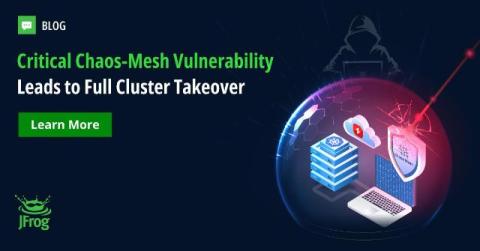
Chaotic Deputy: Critical vulnerabilities in Chaos Mesh lead to Kubernetes cluster takeover

JFrog Security Research recently discovered and disclosed multiple CVEs in the highly popular Chaos engineering platform – Chaos-Mesh. The discovered CVEs, which we’ve named Chaotic Deputy are CVE-2025-59358, CVE-2025-59360, CVE-2025-59361 and CVE-2025-59359. The last three Chaotic Deputy CVEs are critical severity (CVSS 9.8) vulnerabilities which can be easily exploited by in-cluster attackers to run arbitrary code on any pod in the cluster, even in the default configuration of Chaos-Mesh.