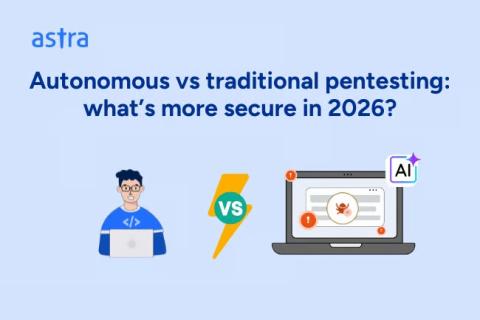
Autonomous vs Traditional Pentesting: What's More Secure in 2026?

In 2026, the attack surface isn’t just digital anymore; it’s AI-native. Attackers deploy automated exploits much faster, while most security teams still run pentests annually. And this leads to a relentless increase in security gaps. Traditional pentesting brings depth but takes time, autonomous pentesting moves fast but misses logic flaws that cause real breaches. Relying on one approach is like defending your business security with either walls or guards, never both.


When Zero Trust Stops Being a Buzzword and Becomes Security

The cyber landscape is a minefield, and one wrong step can trigger disaster! As organizations digitize more of their operations, their attack surface expands, giving cybercriminals more opportunities for sophisticated attacks. The days of relying solely on a strong perimeter firewall are over; once a threat breaches that outer wall, traditional security models often leave the internal network exposed. This reality has driven innovative IT leaders to adopt more rigorous security strategies.

Why Security Teams Misapply EDR, NDR, XDR, and MDR

There are different cybersecurity solutions that security teams can choose from. Some of the popular ones include EDR, NDR, XDR, and MDR. Each security solution offers significant benefits but also has certain limitations. Security teams can add the solution according to their requirements. But these solutions don’t guarantee safety against breaches. This doesn’t mean the tools are ineffective, but it is how security teams decide to use them.

Top Dark Web Forums to Watch in 2026

If you listen to the news, the “Dark Web” sounds like a digital version of a back-alley movie set. But if you’re a threat researcher, it looks a lot more like a marketplace one that is surprisingly organized, highly volatile, and increasingly sophisticated. As we move through 2026, the underground isn’t just one big scary place; it’s a fragmented collection of forums, each with its own “culture” and specialty.

Why Every Website Needs a Reliable URL Checker

Links are the connective tissue of the web. They guide users to content, help search engines understand structure and distribute authority across pages. When links fail, everything from user trust to search visibility can suffer. This is where a URL checker becomes essential. A URL checker is more than a quick "does this page load?" tool. At its most basic level, it confirms whether a URL resolves successfully. At a deeper level, it reveals status codes, redirect chains, DNS issues and server errors that aren't obvious from simply clicking a link.

Voice Phishing Kits Give Threat Actors Real-Time Control Over Attacks

Researchers at Okta warn that a series of phishing kits have emerged that are designed to help threat actors launch sophisticated voice phishing (vishing) attacks that can bypass multifactor authentication. “The most critical of these features are client-side scripts that allow threat actors to control the authentication flow in the browser of a targeted user in real-time while they deliver verbal instructions or respond to verbal feedback from the targeted user,” Okta says.

Episode 8 - Enterprise Nervous System: Using Network Signal to Direct Business Strategy

In this episode of Corelight Defenders, I’m joined by Bernard Brantley, Chief Information Security Officer at Corelight, as we delve into the concept of the enterprise nervous system. Bernard shares insights from his extensive experience in network analysis, explaining how organizations can leverage their network traffic data to enhance security and drive business outcomes. We discuss the importance of understanding the interdependencies between assets, processes, and goals, and how security teams can position themselves as integral to business success rather than just risk mitigators.