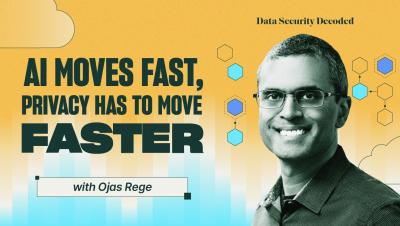
AI Moves Fast, Privacy Has to Move Faster with Ojas Rege

In this episode, Caleb Tolin welcomes Ojas Rege of OneTrust for a practical, wide-ranging conversation on how data privacy and governance must evolve alongside enterprise AI adoption. Ojas explains why AI fundamentally changes the privacy conversation: the same systems that enable organizations to move faster can also cause harm faster when guardrails aren’t in place. From agentic AI systems that dynamically repurpose data to general-purpose models that blur traditional notions of “intended use,” the challenge isn’t just compliance—it’s trust.

AI Agent Sandboxing & Progressive Enforcement: The Complete Guide

Your CISO just got word that engineering is deploying AI agents into production Kubernetes clusters next quarter. Not chatbots—autonomous agents that generate and execute code, call external APIs through MCP tool runtimes, access internal databases, and make decisions without human review. The question lands on your security team: “How are we securing these?”

What You Need to Know about the University of Hawaii Cancer Center Data Breach

The University of Hawaii Cancer Center is the only National Cancer Institute-designated cancer center in Hawaii. Located in Honolulu, the center employs over 300 faculty and staff conducting critical epidemiological research studying cancer risks across diverse populations. In August 2025, the Cancer Center fell victim to a ransomware attack that exposed Social Security numbers of up to 1.15 million people.

10 data governance best practices for compliance

Data governance best practices give organizations the documented policies, assigned ownership, and enforceable controls that auditors require. Without governance, compliance gaps emerge across access controls, retention enforcement, and audit evidence, creating exposure under GDPR, HIPAA, and SOX. Closing those gaps requires classification, accountability, continuous monitoring, and tooling that connects policies to evidence.

AI-Aware Threat Detection for Cloud Workloads: 4 Attack Chains Most Security Stacks Miss

Your security stack was built for workloads that follow predictable code paths. AI agents don’t. They interpret prompts, generate code on the fly, invoke tools dynamically, and escalate privileges in ways no developer anticipated — all as part of normal operation. The signals that indicate a compromise in a traditional container are indistinguishable from an AI agent doing its job. And most detection tools can’t tell the difference. This isn’t a theoretical gap.

7 best Privileged Access Management (PAM) solutions in 2026

PAM solutions in 2026 must cover non-human identities, enforce zero standing privilege, and deploy in days rather than quarters. Legacy vault-centric tools leave standing accounts in place between rotations, giving attackers persistent targets across service accounts and machine workloads. Evaluating modern PAM requires testing JIT access depth, AD/Entra ID integration, and real-world deployment timelines against your hybrid environment.

The Power of an AI Ecosystem: When Fragmented Content Connects, AI Delivers

AI tools are everywhere. Value isn’t. Most organizations already use AI—chatbots answer questions, assistants summarize documents, and agents kick off workflows. And yet, day-to-day work often feels the same, with people still digging through folders and teams still double-checking decisions. AI exists, but the returns vary widely. The problem isn't with AI. It's the way the work is set up. Work is fragmented across tools, systems, and formats that were never designed to work together.

Falcon Exposure Management Browser Extension Control: Demo Drill Down

Browser extensions are a growing and often unmanaged attack surface, with many requesting access to credentials, cookies, and sensitive browsing data. Most organizations rely on fragmented tools that lack centralized visibility and consistent enforcement. In this demo, see how Falcon Exposure Management introduces Browser Extension Control to define rule groups, configure allowlist or blacklist policies, and assign enforcement to host groups—all from the Falcon platform.

AI Security Posture Management (AI-SPM): The Complete Guide to Securing AI Workloads

Every cloud security vendor now has an AI-SPM dashboard. Strip away the branding, though, and most of these dashboards are doing the same thing: checking IAM configurations, scanning for misconfigured network access, inventorying AI models across cloud accounts, and flagging compliance gaps. It’s cloud security posture management with an AI label applied. That’s a problem, because AI workloads don’t behave like other cloud workloads.