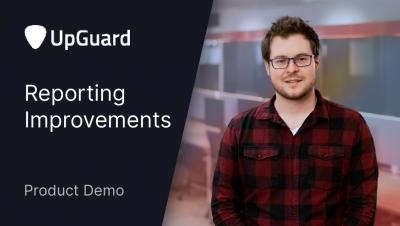
UpGuard Reporting Improvements Demo // Chris Schubert, Senior Product Manager

Hear from UpGuard's Senior Product Manager, Chris Schubert, as he introduces you to UpGuard's new Reporting Improvements Our new reports library which centralizes a variety of frequently used reports for you to explore and generate. Some updates we’ve made to both BreachSight and Vendor Risk reports; making it easier for you to generate either executive level summary reports or detailed reporting.

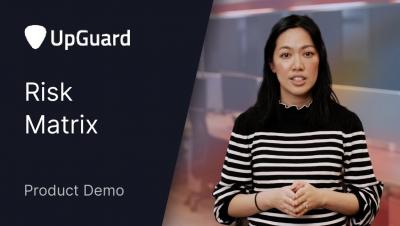
UpGuard Vendor Risk Matrix Demo // Annie Luu, Product Marketing Manager

Hear from UpGuard's Product Marketing Manager, Annie Luu, as she introduces you to UpGuard's new Vendor Risk Matrix. The new vendor risk matrix, that measures vendor security ratings by business impact, has been added to the Vendor Risk Executive Summary. This feature will help drive action where it matters most, highlighting your vendors of most concern in the top right of the matrix.It’s now easier to quickly focus on the most impactful areas of your third party risk management program, by visualizing your vendor portfolio risk by Security Rating and Tier.

How Secure is My Password?

A secure password contains randomized letters, numbers and characters with a minimum length of 8 characters. Memorizing strong passwords can be difficult which is why passwords are often reused. While reusing passwords makes it easier for you to remember, it also makes it easy for cybercriminals to gain access to your personal data. To prevent your data from falling into the wrong hands, it is important to learn the best practices that will ensure your passwords are secure.

Why Vendor Risk Management is Critical for Indian Businesses

Few Indian businesses are included in the ever-increasing list of major data breaches. But data suggests that this streak of luck could soon be reaching its end. Increasing third-party security risks and a deficiency of security controls addressing them create the perfect conditions for a large-scale global supply chain attack facilitated by breached Indian business.

Enhancing Security with AI/ML

Digital transformation has driven the rapid adoption of cloud-delivered services like SaaS/IaaS/PaaS in enterprises. This, in turn, has resulted in the migration of digital assets (aka data) from the confines of enterprise data centers to the cloud data centers that are not under the control of the enterprises. Additionally, the onset of the COVID-19 pandemic has resulted in remote work becoming the norm.

PyPi Malware Stealing Discord and Roblox Payment Info

Raul Onitza-Klugman, Senior Security Researcher at Snyk, joins Kyle to take a deep dive in to the latest set of malicious packages discovered by the Snyk Security Research team. Join us as we discuss how these findings came to be, what they mean for open source security, and some hypotheses about the future of supply chain security.

AppLocker Rules as Defense Evasion: Complete Analysis

Microsoft continues to develop, update and improve features to monitor and prevent the execution of malicious code on the Windows opearting system. One of these features is AppLocker. This feature advances the functionality of software restriction policies and enables administrators to create rules to allow or deny applications from running based on their unique identities (e.g., files) and to specify which users or groups can run those applications.

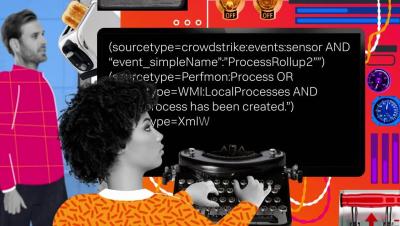
Introduction to Splunk Common Information Model

Security and IT analysts need to be able to find threats and issues without having to write complex search queries. The Splunk Common Information Model (CIM) delivers a common lexicon of field names and event types across different vendor data sources making them consistent so that analysts can write clearer queries and get better results with more true positives and fewer false positives.