Security | Threat Detection | Cyberattacks | DevSecOps | Compliance

Why High DLP False Positive Rates Are a Security Problem, Not Just an Ops Problem

Most security teams treat a high volume of false positives as an analyst problem. Too many alerts, too little time, not enough headcount. So they add analysts, tune a few policies, and move on. That response is understandable, but it misdiagnoses the problem. When data loss prevention (DLP) false positive rates stay high over time, the issue is not a staffing gap. It is a detection accuracy problem, one that sits inside the tool, not the team.

Top 8 Access Control Challenges (And How to Fix Them)

Why do access control challenges exist, despite most companies following it? The gaps could be due to inconsistent permissions, accumulation of accesses, or poor management of user lifecycles. Access control is about governance. It answers two questions: “Who are you?” and “What are you allowed to do?” To add on, in today’s multi-cloud hybrid reality, governance is hard to handle. This isn’t another theoretical deep dive.

Vulnerability Prioritization Requires More Than a Score

As AI systems become more capable and increasingly embedded into business operations, security teams are confronting a familiar challenge in a new form: speed without context. Vulnerability discovery is accelerating toward machine scale, while adversaries continue to adapt in real time. In response, the industry has gravitated toward data‑driven scoring models to help determine what deserves attention first.

Longhorn on Production Clusters: Storage Configuration, Tuning, and Gotchas

Longhorn is a lightweight, distributed block storage system built specifically for Kubernetes. It runs entirely inside your cluster, turning local disks on worker nodes into replicated persistent volumes with no external storage array required. That simplicity is what makes it appealing, especially in the Rancher and SUSE ecosystem where it ships as the default storage option. You get persistent storage that is easy to install, easy to understand, and tightly integrated with the Kubernetes lifecycle.

Simplify Your IT With 11:11 Managed Database Services

IT departments frequently face the challenge of doing more with less. You are expected to support complex systems and drive internal projects, leaving little time to focus on delivering true business value. Keeping mission-critical applications and data secure requires constant attention. If your team feels overwhelmed by the daily demands of database management, it is time for a change. We provide a cost-effective way to outsource these routine tasks with our 11:11 Managed DB Services recovery solution.

Whole-of-state cyber defense: How AI-driven security helps US states protect what matters most

Short answer: Because attackers exploit fragmentation faster than governments can respond This shift toward collective cyber defense is a cornerstone of the new federal vision. The March 2026 National Cyber Strategy for America explicitly calls for a "new level of relationship between the public and private sectors" and demands "unprecedented coordination across government" to protect the American people.

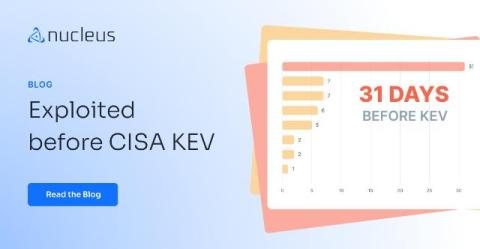
Exploited Before CISA KEV: What 8 Confirmed Cases Reveal

Most vulnerability programs are built to act when risk looks obvious, such as when a vulnerability lands in CISA KEV, a public exploit emerges, or EPSS rises. This approach is rational because it provides a clear, defensible trigger for action. But it often comes with delay: by the time signals are strong enough to drive consensus, the window to get ahead of risk may already be closing.

Prompt and Tool Call Visibility: What Your AI Agents Are Actually Doing

It is 11:47 p.m. and the on-call security engineer is staring at two dashboards. On the left, LangSmith — the ML team’s debugging stack — showing the agent’s prompts, model responses, tool calls, and tokens consumed. On the right, the runtime detection console showing eBPF-captured syscalls, network connections, and process trees from the same Pod. Both are populated.

AI-SPM for Financial Services: Managing AI Risk Under SOC2, PCI-DSS, and MAS TRM

The external auditor’s evidence request lands Tuesday morning. A security architect at a Tier 1 bank pulls up her AI-SPM dashboard for the SOC2 Type 2 review. Eighty-three AI agents running across the bank’s clusters. For each one, the dashboard shows the current configuration and the current behavioral baseline. The data is accurate, comprehensive, and point-in-time.