Security | Threat Detection | Cyberattacks | DevSecOps | Compliance

TEFCA compliance for digital health companies: a guide to identity proofing

In 1996, the US signed the Health Insurance Portability and Accountability Act (HIPAA) into law. One of the government’s chief goals was to safeguard sensitive patient data and protected health information (PHI) from unauthorized disclosure. While these protections were critical, HIPAA compliance requirements (alongside an already-fragmented electronic health record systems) have led to ongoing data silos across healthcare.

What You Need to Know about the BWH Hotels Data Breach

BWH Hotel Group is one of the world's largest hotel networks, operating more than 4,000 hotels in over 100 countries. The company evolved from Best Western and today manages a multi-brand portfolio spanning budget to luxury hospitality. BWH Hotels' portfolio includes prominent brands such as Best Western Hotels & Resorts, WorldHotels, and Sure Hotels, serving millions of guests annually across approximately 4,300 hotels that generate more than $8.5 billion in annual revenue.

Enabling Mirantis Self-Service Virtualization with CloudCasa

As enterprises modernize infrastructure, the shift toward self-service virtualization on Kubernetes is accelerating. Platforms such as Mirantis k0rdent AI and k0rdent Enterprise feature KubeVirt-based virtualization, enabling organizations to deliver on-demand infrastructure while maintaining governance controls.

Six MCP Security Incidents Every Security Leader Should Know

In July 2025, an AI agent reviewed a support ticket, queried a production database, and leaked integration tokens directly to the attacker watching the thread. Months earlier, another AI followed "hidden instructions" in a public repository, exfiltrating private code into a visible pull request. In both cases, the AI wasn't broken; it simply obeyed the attacker instead of the developer.

Data quality defines a ceiling for SOC performance

Defenders have long known that richer evidence improves security outcomes by enabling faster triage, deeper analysis, and more complete investigation. Although Corelight was founded on this premise, it’s been hard for us to quantify the impact of better network data - until now. Recently, we built an agentic test harness to measure the success of frontier LLMs in responding to real-world attack scenarios, using a range of source data.

The Rise of Cyber Threats and AI in the Philippines: A New Era Beyond Legacy Security

The Philippines, like many other nations, is witnessing a dramatic increase in cyber threats, fueled by the rapid adoption of digital technologies and the proliferation of sophisticated cybercriminals. This article examines the evolution of cyber threats in the Philippines, with a focus on phishing, email security and the risks posed by agentic AI.

Navigating the Cybersecurity Landscape in India Empowering Human and AI Agents

The Asia-Pacific and Japan (APJ) region, with its dynamic economic growth and technological advancements, presents unique challenges and opportunities in the realm of human risk management and agentic risk management, particularly within the financial services sector. As financial institutions strive to protect themselves from increasing cyber threats, they must align their security practices with the regulations set forth by central banks across the countries.

BDRShield v9.1.0: Faster, safer backups for virtual, endpoint, and DR workflows

BDRShield v9.1.0, released o May 6, 2026, brings practical improvements that speed backups, strengthen recover-ability, and give admins clearer visibility—especially for distributed sites, and MSP operations. This update focuses on...

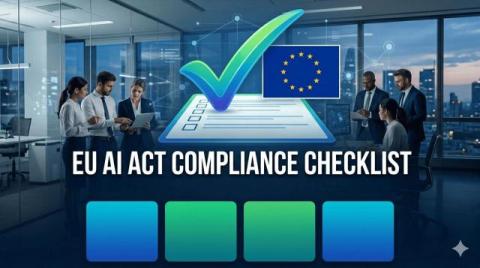
EU AI Act Compliance Checklist - A Practical Guide for Businesses

An EU AI Act compliance checklist is a structured framework that helps organisations systematically identify, classify, and govern all AI systems within scope of Regulation (EU) 2024/1689. It covers AI system inventory, risk classification (unacceptable, high-risk, limited, and minimal), conformity assessment requirements, technical documentation (Annex IV), human oversight obligations, GPAI model obligations, and post-market monitoring.