Security | Threat Detection | Cyberattacks | DevSecOps | Compliance

Combatting Cloud Threats: The Accelerated Attack Speed of 2023 (LIVE)

Cloud threats are evolving and attackers are moving faster than ever! Join Sysdig’s Michael Clark (Director, Threat Research) and Anna Belak (Director, Office of Cybersecurity Strategy) LIVE on Linkedin, Twitter, and Youtube, as they discuss key findings from Sysdig’s �������� ������������ ���������� ������������ ������������. From cloud automation as a weapon to software supply chain vulnerabilities — the annual report authored by Sysdig’s Threat Research Team exposes shocking statistics on the evolving tactics of attackers lurking within the clouds.

Cloud Application Security: What Every Organization Needs to Know About Protecting Data in SaaS Apps

The rise of hybrid work has accelerated digital transformation for organizations of all sizes. As a result, more and more applications and data are moving to the cloud. While this has created a number of benefits — including cost savings, ease of access, and increased operational efficiencies — the cloud has also made it more challenging to protect sensitive data.

Simplify and Secure Applications Across Clouds with the Latest, High-Performance Thunder ADC Images

In today’s hybrid environments, delivering a consistent application experience across clouds, securely, and reliably has become an imperative. The A10 Thunder® Application Delivery Controller (ADC), which comes in multiple form factors, provides the security, performance and availability required for applications in a hybrid cloud infrastructure.

What's ABAC? How Attribute Based Access Control Works

Multi-cloud environments are getting plenty of buzz in recent years. It’s no wonder, really, that increased flexibility, risk mitigation, performance optimization and compliance adherence associated with the practice have drawn in new muli-cloud evangelists across the industry. For all the great benefits multi-cloud offers, it does present one significant challenge: how do you ensure a single point of control while establishing consistent security policies for all users?

17 Best Cloud WAAP & WAF Software in 2023

A web application firewall is a security software that observes and filters HTTP/HTTPS traffic between a web application and the internet. While this has been available for decades, with the evolution of the threat landscape, WAFs have also added additional capabilities to protect not only web apps but also APIs against a range of attacks, including DDoS and bot attacks. So, the category has evolved and is currently called Web Application and API Protection (WAAP).

One Drive, Double Agent: Clouded OneDrive Turns Sides

Over the past few years, ransomware has emerged as one of the most significant cybersecurity threats. Recent research conducted by Sophos indicates that the situation is becoming increasingly dire. Notably, the payments demanded by ransomware groups have surged, making the attacks even more costly for victims. Additionally, an alarming 66% of organizations have reported being targeted by ransomware attacks in the last two years alone.

Cloudflare Bot Management now on IBM Cloud Internet Services to address growing threat landscape for enterprises

IBM Cloud Internet Services (CIS) expands offering with Cloudflare Bot Management now available to protect enterprises from increased security threats across the business landscape.

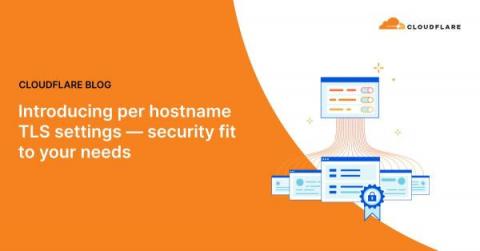
Introducing per hostname TLS settings - security fit to your needs

One of the goals of Cloudflare is to give our customers the necessary knobs to enable security in a way that fits their needs. In the realm of SSL/TLS, we offer two key controls: setting the minimum TLS version, and restricting the list of supported cipher suites. Previously, these settings applied to the entire domain, resulting in an “all or nothing” effect.

The Top 5 Vendor-Neutral Cloud Security Certifications of 2023

All segments of the cloud market are predicted to see growth in 2023, according to research by Gartner. In an April Press Release, the firm forecasts that global spending on public cloud services will exceed 21% this year, totaling $597.3 billion overall in 2023. This is up over $100 billion from last year’s (mere) $491 billion.