Security | Threat Detection | Cyberattacks | DevSecOps | Compliance

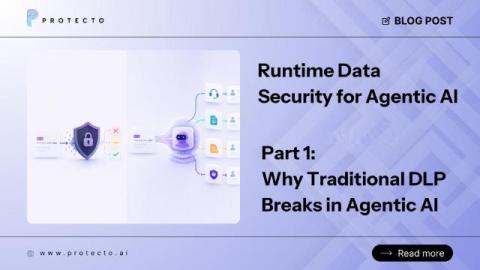
Why Traditional DLP Breaks in Agentic AI

A customer support agent needs a payment reference, a token or transaction ID, to issue a refund. A summarization agent reading the same ticket needs none of it. A billing agent needs only the last four digits to match a transaction. A fraud agent needs the full credit card number, but only when a case is open and only for the account it is reviewing. Traditional DLP sees one thing across all four: sensitive data, a 16-digit string that matches a card pattern. It makes one choice: block, redact, or allow.
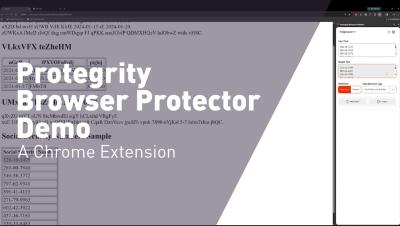
Protegrity Browser Protector: Zero-Trust Data Security for Web Apps (MV3)

Are you struggling to extend data protection to modern web applications without the friction of custom SDKs? Zero-Trust architecture and AI governance are no longer optional—they are operational imperatives. The Protegrity Browser Protector is a Manifest V3 Chrome extension designed to solve the "last mile" of data security. It allows authorized users to protect, unprotect, and mask sensitive information (like SSNs, PII, and financial data) directly within any web browser—without modifying the underlying application code.

LangGraph Integration for Protegrity AI Developer Edition

See how Protegrity AI Developer Edition helps protect sensitive data in AI agent workflows built with LangGraph. This demo shows how Protegrity can fit into modern AI development pipelines as both a preprocessor and postprocessor guardrail, helping teams discover, protect, tokenize, mask, and redact sensitive data before it reaches an LLM — and before responses leave the application. In this video, you’ll learn how developers can.

Qubits vs Classical Bits - Understanding Quantum Computing For Your Data

Einstein called quantum entanglement "spooky action at a distance," but it’s actually a fundamental lesson in how particles share identical information. While classical bits are limited to 0 or 1, quantum bits (qubits) exist in a combination of both until the moment they are measured. Understanding these complex data states is essential as we move toward a future of quantum-resistant security and advanced AI. At Protegrity, we are dedicated to protecting your most sensitive data across every stage of the evolving digital landscape.

The Hidden Security Risks of Unstructured Data in File Shares

Most organisations have a data problem they rarely see clearly. It is not always inside databases, CRMs, finance systems, or other structured platforms. More often, it is hidden in shared drives, old project folders, exported spreadsheets, PDFs, email attachments, archived documents, and duplicate files saved across departments. This is unstructured data. It is easy to create, easy to copy, and difficult to control. Over time, it can become one of the biggest blind spots in an organisation's cybersecurity and compliance strategy.

The Hidden NetSuite Delete-All-Data Risk: How to Recover Faster and Protect Historical Records

Enterprise Resource Planning (ERP) platforms have become the operational backbone of modern organizations. Finance teams rely on them for reporting and compliance, operations teams depend on them for workflows, and executives use them to make business-critical decisions. Because of this reliance, most organizations assume their ERP data is always recoverable. However, one often-overlooked risk in cloud ERP environments is the possibility of large-scale data deletion, accidental overwrites, failed imports, or configuration changes that impact historical records.

Data on The Frontline: How Geopolitical Tensions Change Cybersecurity

Chris Jacob, Field CISO, Securonix There is a particular kind of unease that comes with geopolitical tension. It rarely arrives for security teams as one clean, obvious event. More often, it shows up as a change in tempo across the environment. Scanning increases and phishing attempts feel sharper. Then you start having leadership asking harder questions about exposure, suppliers, regions, and sensitive data.

AI Agent Security Explained: Agents, MCP, Prompt Injection, and the AI Harness

AI Agent Security is quickly becoming one of the most important areas in cybersecurity. Terms like "agent," "harness," "MCP," "tool calls," "tool responses," "instruction hijacking," "indirect prompt injection," "prompt exfiltration," and "tool misuse" are appearing in conference talks, vendor announcements, podcasts, and industry discussions, often without clear explanations.

What is Data Encryption & How It Protects your Files

Data encryption is a complex, but crucial aspect to protect your data, either in the cloud, in your private cloud storage, or when you send messages, emails, or send or transfer any information via the internet. To help simplify this topic, this article will cover: We will also cover the best encrypted cloud storage to protect your data in the cloud, and which encryption methods are best for your privacy.

AI Data Exfiltration: Types, Risks, Prevention Strategies

Generative AI has revolutionized productivity — but it has also introduced a massive, often invisible new vulnerability: AI data exfiltration. Whether it’s a well-meaning engineer pasting source code into an LLM for debugging, or a marketer feeding sensitive customer data into a prompt for analysis, your organization’s most valuable intellectual property is likely walking out the virtual front door.

Nightfall's integration with Claude's Compliance API is now live

What this milestone means for enterprise AI security - and why we built it. AI adoption inside the enterprise didn't slow down and wait for security to catch up. It accelerated. And nowhere is that more visible than in the rapid deployment of large language models like Claude across enterprise workflows. Customer support teams use it to summarize tickets. Legal teams use it to review contracts. Engineers use it to write and review code. Finance teams use it to draft reports.

The Security Risk That May Already Be Sitting Inside Your Home

The idea of digital privacy often feels straightforward. People create passwords, enable security settings, and assume that taking a few precautions is enough to keep unwanted visitors out of their lives. Yet many privacy concerns do not begin with hackers targeting large organizations or criminals developing sophisticated attacks. They begin with devices that people voluntarily bring into their homes.

The Hidden Path From a Household Gadget to Your Personal Data

Most people think about cybersecurity in terms of computers and smartphones. When they hear about data breaches, identity theft, or compromised accounts, they picture hackers targeting laptops, email inboxes, or financial institutions. Few people imagine that a device mounted quietly on a wall could become part of the story.

Securing Your AI Agents: Today's New Data Threat

AI agents are already inside your company - reading files, calling APIs, executing code. Most of them were never approved by security. In this session, Nightfall AI walks through exactly how agents become an attack surface: prompt injection, malicious MCP servers, credential exfiltration, and more.

PII protection: 8-step framework from discovery to security

Most organizations can't answer three basic auditor questions simultaneously: where PII lives, who can access it, and how it's protected. One-off scans and manual classification go stale as data volumes grow. A repeatable, eight-step PII protection program from initial discovery through ongoing governance is what separates a defensible compliance posture from a snapshot that collapses under scrutiny.

Microsoft 365 DLP: what it covers and where it falls short

Microsoft 365 DLP delivers real protection for regulated data in Exchange, SharePoint, Teams, and managed Windows endpoints, but only within that boundary. On-premises file servers, Linux endpoints, unmanaged devices, and non-Microsoft SaaS fall outside enforcement regardless of how policies are configured. Most security teams can't yet clearly distinguish the gaps that configuration fixes can address from those that require supplemental controls.

archTIS and Mattermost Partner to Deliver Secure Collaboration for Defence Operations

archTIS and Mattermost are pleased to announce a collaboration to deliver policy-enforced, data-centric security to secure operational collaboration for Defence Ministries, NATO Allies, and coalition partners worldwide. The collaboration combines Mattermost’s secure, mission-critical command-and-control surface with archTIS Trusted Data Integration (TDI) platform, to enable secure collaboration using dynamic policy orchestration via Attribute-Based Access Control (ABAC).