Security | Threat Detection | Cyberattacks | DevSecOps | Compliance

Grid by LimaCharlie is now in beta: Agentic SecOps for the stack you have

Grid is LimaCharlie's agentic AI layer for security teams that want AI operations running across their existing stack right now. Security providers and SOCs need access to AI capabilities without waiting for a migration window, a contract renewal, or a vendor to ship the features they need. Every major security vendor is offering some version of AI. CrowdStrike has Charlotte AI. SentinelOne has Purple AI. Microsoft has Copilot for Security.

When humans are a minority, IAM requires a rethink

In a typical enterprise, non-human identities (NHIs) are thought to outnumber human users by at least 50:1. NHIs are various and include: It is estimated that the NHI: human ratio may have leapt to 144:1 as more AI agents were deployed over the last year. CISOs are already alive to the risks posed by orphaned accounts on their systems. They know that automated rotation is required to revoke privileges as soon as NHIs complete tasks.

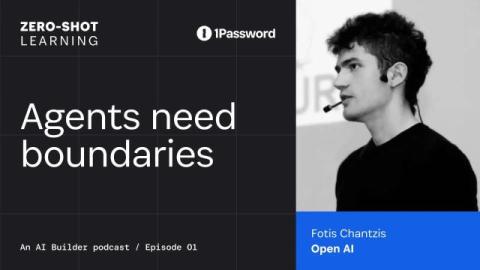
OpenAI's Fotis Chantzis on why identity protocols weren't designed for agents

Zero-Shot Learning is a podcast for AI builders, hosted by Nancy Wang, Chief Technology Officer at 1Password, and Dev Tagare, Senior Director and Head of Engineering for Gemini Enterprise & Business at Google. Together, they’ve built and scaled AI systems at the infrastructure and product layers and bring a builder's perspective to every conversation.

Warning: Phishing Attacks Are Abusing the Kuse AI App

Attackers are abusing the storage and sharing features of Kuse, a free AI app, to assist in phishing campaigns, according to researchers at Trend Micro. Kuse is a legitimate agentic AI platform used by employees to streamline workflows. Users can share files with coworkers, which generates a link hosted by Kuse’s domain. In this case, attackers are abusing the share feature to generate legitimate-looking phishing links.

Using Generative AI for Incident Response Automation: A Complete Guide to AI Agent Development

Security Operations Centers run on caffeine and context-switching. Any given shift means hundreds of alerts, tools that don't talk to each other, and analysts who know that somewhere in that noise is a real threat - they just need time to find it. That's the core tension AI agent development is built to resolve. This guide covers the full lifecycle: from scoping your first use case to maintaining a production-grade agentic SOC.

What Finance Teams Actually Want From AI

Of all industries, it feels like it's the finance industry that's in the best position to benefit from AI integration, especially finance teams. After all, it's those teams that typically have to manually deal with data - and that's just the kind of thing that AI can help with. With that said, though AI can be beneficial for finance teams, it's far from a slam dunk. AI integration among finance teams has been slower and less extensive than it could have been, and that's in large part because employees haven't been given the AI tools that they actually want, or which make their jobs easier.

Security infrastructure for building AI in SecOps

Some of the security industry is still cautiously evaluating its relationship with AI. They are weighing questions, sitting with uncertainty, and waiting for something to ease their concerns about trusting AI in production. This post isn't for that group. This is for AI tool developers already in motion. The ones who vibe-coded a log parser over a weekend, spun up local inference on dedicated hardware, or ran cross-model research pipelines across multiple data sources.

AI builders can now easily access 1Password secrets management and developer tools

AI coding tools have changed who builds software. The barrier to entry has dropped to the point where a designer, an analyst, or a first-time founder can turn an idea into a working app in an afternoon. That shift is real, and it's accelerating.

How to Reduce Alert Fatigue in AI Agent Detection: Why It's a Unit-of-Detection Problem, Not a Triage Problem

When AI agent workloads start generating more alerts than your SOC can keep up with, the instinct most teams reach for is to deploy more triage on top of what they already have. If the SIEM is producing thousands of atomized alerts, plug in something downstream that can cluster, prioritize, and auto-resolve them faster than a human can. The market has consolidated around exactly this answer.

What Is an Al Agent in Cybersecurity?

At the Milken Conference in May 2026, Robert F. Smith, founder and CEO of Vista Equity Partners, described a shift that every security leader should hear. Software, he said, has moved through three states: product, then service and now worker. "That agent, that software, actually does work." Companies that do not make the transition to software as a worker, he was blunt, risk being disintermediated entirely.